
Northern Ireland Priority species (NIPS)
| ECHINODERMATA : Dendrochirotida : Cucumariidae | STARFISH, SEA URCHINS, ETC. |
Thyonidium drummondii (Thompson, 1840)
Drummond's sea cucumber
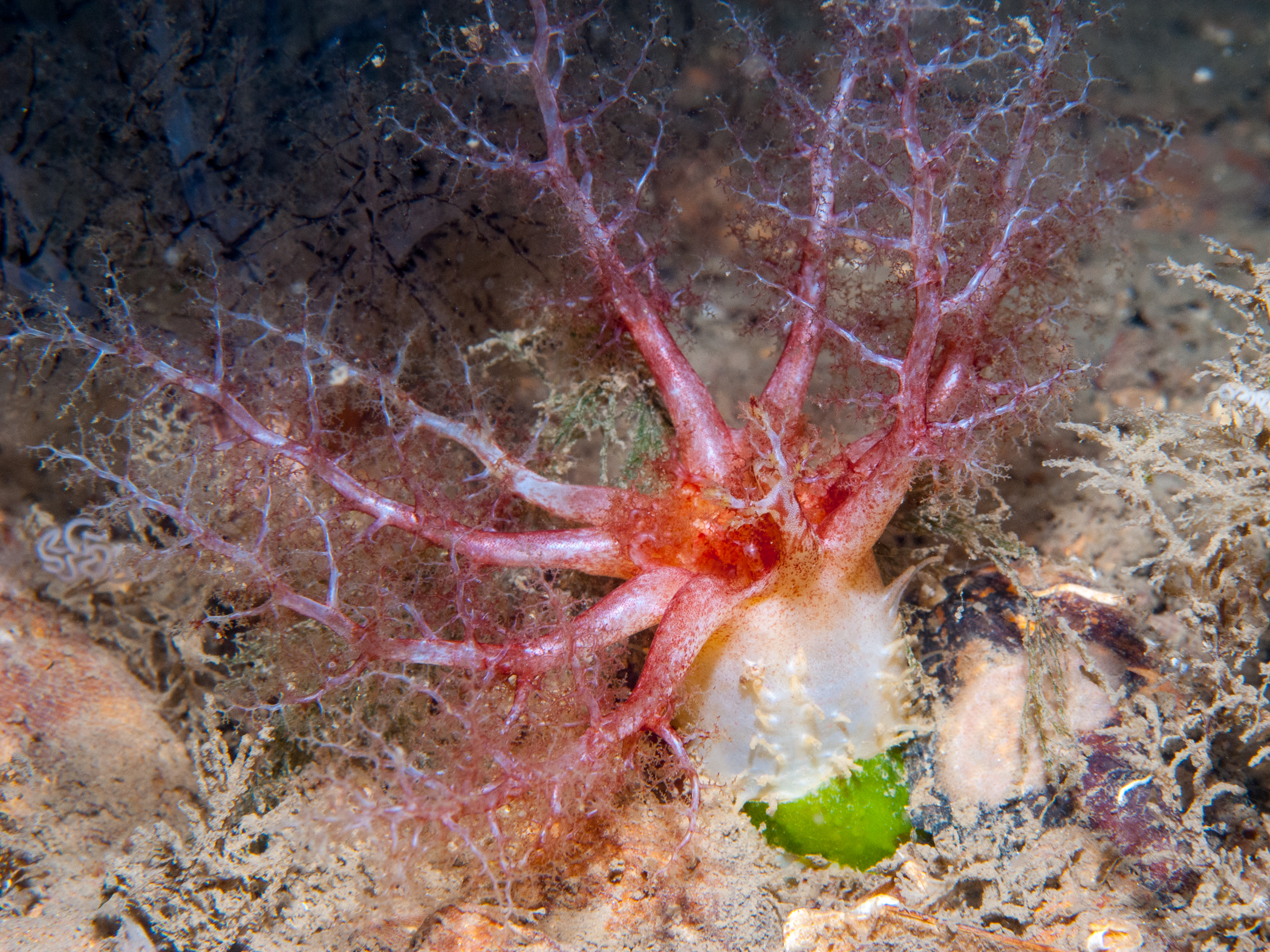 |
| Thyonidium drummondii |
Sea cucumbers are soft-bodied Echinoderms, an ancient group of animals which are entirely found in the sea. Thyonidium drummondi is of interest in a Northern Ireland context in being described originally from Strangford Lough, which is therefore called the type locality. This sea cucumber was a characteristic and moderately long-lived component of horse mussel beds in Strangford Lough but appears to have declined rapidly along with the horse mussel beds themsevles.
In brief
- In Northern Ireland this species was most abundant in horse mussel beds in Strangford Lough. These have decreased significantly in the last 30 years
- Lives in the sea at depths of 10-40 m and more with populations most common in sheltered sea loughs
- This species is scarce and has undergone rapid decline with Northern Ireland being the stronghold for the Irish population
- Threatened primarily by bottom fishing with trawls or dredges which disrupt the biogenic reef habitat
- Sensitive to climate change. As this species is more common farther north it may disappear if the water becomes warmer.
Species description: The body is white and thick-skinned, covered all over with tube feet and buried vertically in mud or muddy gravel. It extends large red or pink tentacles into the water column to feed on suspended particles or filter water for plankton. The tentacles are finely branched and may be dark red or lighter pink in colour, becoming white at the tips. There are two rings of tentacles — an outer ring of five pairs of large ones and an inner ring of five pairs of small ones. Spicules are absent except in the introvert and tentacles. The ones in the introvert are tables with a perforated disc and delicate spire. It is up to 25 cm in length.
Life cycle: Unknown.
Similar species: Thyonidium hyalinum is similar but smaller with a more transparent skin and spicules with a shorter spire.
How to see this species: This species is likely to be seen only by divers. It can be found amongst living horse mussels in Strangford Lough, where it was formerly a common member of this community.
Current status: Declining. Although it may be undergo a natural fluctuations in its populations it is likely to be being adversely affected by changing climate conditions and loss of suitable habitat. This species can be found amongst living horse mussels in Strangford Lough, where it was formerly a common member of this community. Investigations in 2003 confirmed that the horse mussel beds have declined considerably in the past 30 years and this species in particular seems to have become rare, it was not seen during the 2003 SLECI (Strangford Lough Ecological Change Investigation) fieldwork, but there was one sighting in 2005 during a Seasearch dive. Sea cucumbers are known to disappear beneath the surface for extended periods and it is possible that more specimens are present than have been observed. It is believed to have undergone rapid decline with Northern Ireland being the stronghold for the Irish population.
Why is this species a priority in Northern Ireland?
- Criterion 2: Decline based on available data and expert judgement.
- Criterion 3: Rare or restricted range – rare breeding species confined to 5 hectads or less (based on expert judgement)/
- Criterion 4: NI stronghold or endemic – both stronghold range/population and designation as ‘endemic’ subject to expert judgement.
- Criterion 5: Climate change sensitive.
Threats: In rapid decline, possibly due to physical impact of bottom fishing gear on its habitat, though initial observations on areas which had been recently dredged suggested that sea cucumbers were less affected than other species due to their burial in the bottom (Bernard Picton, personal observation). The target for the fishery is the queen scallop, Aequipecten opercularis, which lives in more open muddy patches between the horse mussel clumps, but requires stable biogenic reefs for successful recruitment. It is unclear whether direct impact from trawling has disrupted the mussel beds and encouraged predatory starfish, or whether smothering by stirred-up bottom sediments is more to blame for their decline.
This is also a northern species, so could see a reduction in range due to climate change.
Action: Records of new sites for this species, with details of habitat and population are always valuable. Observations with a photograph can be recorded using iNaturalist, find the MBDP-NI iNaturalist project here.
Alternatively these can be sent to CEDaR, National Museums Northern Ireland, 153 Bangor Road, Cultra, Holywood, County Down, BT18 0EU. Tel 028 9039 5257 or e-mail cedar.records@nationalmuseumsni.org, or via the online portal.
Objectives:
- Establish appropriate management on suitable historical sites
- Monitor numbers present in horse mussel beds in Strangford Lough
- Investigate recruitment and predation of this species.
Conservation:
- Strangford Lough is a Marine Protected Area with multiple designations.
- Implementation of the Northern Ireland habitat action plan for Horse Mussel Beds
Distribution Map from NBN: Thyonidium drummondii at National Biodiversity Network mapping facility, data for UK.
iNaturalist: Thyonidium drummondii at iNaturalist World Species Observations database.
WoRMS: Thyonidium drummondii at World Register of Marine Species. Accepted name: Thyonidium drummondii (Thompson, 1840). AphiaID: 124694.
Classification: Biota; Animalia; Echinodermata; Echinozoa; Holothuroidea; Actinopoda; Dendrochirotida; Cucumariidae; Thyonidium
| Previous species | Next species |
| Picton, B.E., Keatley, L. & Morrow, C.C. (2026). Thyonidium drummondii. (Thompson, 1840). [In] Priority species, Marine Biodiversity Portal NI. https://www2.habitas.org.uk/marbiop-ni/priorityaccounts.php?item=ZB5080. Accessed on 2026-09-13 |