
Northern Ireland Priority species (NIPS)
| ECHINODERMATA : Dendrochirotida : Cucumariidae | STARFISH, SEA URCHINS, ETC. |
Ocnus planci (Brandt, 1835)
Planc's sea cucumber
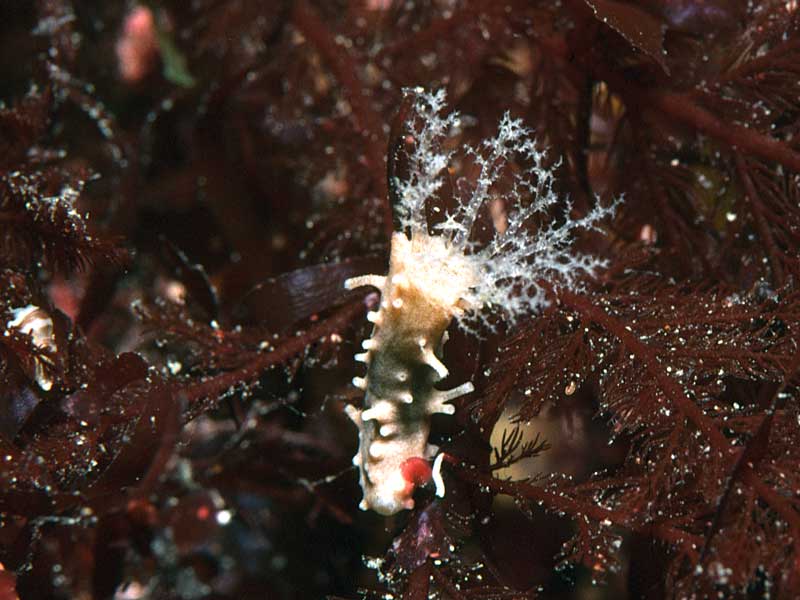 |
| Ocnus planci |
A rare sea cucumber: in Northern Ireland found only in Carlingford Lough and Strangford Lough. It is recorded as declining, and may be under threat from bottom fisheries.
In brief
- Found in Carlingford and Strangford Loughs.
- Habitat is epifaunal on weeds and other invertebrates, in areas of moderate to weak water flow.
- Can be found throughout the year.
- Listed as NIPS on account of its rarity and probable decline.
- Main threats likely to be from bottom fishing.
Species description: This is a brown or purple-brown sea cucumber reaching up to 15cm in length, 3.5 cm in diameter. Its body is tough and stiff, but it has a smooth skin. It bears eight large, and two small, tentacles and these are branched, almost leaf-like and paler than the body. The tube feet are arranged in two double rows, and these are also lighter in colour than the body. The spicules (skeletal structures in the body wall) are knobbly and have more than four holes.
There is also a neotenous form of this species (where adults retain some of the traits characteristic of juvenile individuals) that has been named O. brunneus. It only reaches about 2.5 cm length, is also brown, but bears only single rows of tube feet. It is believed to reproduce by transverse division. See also below for similar species to this form.
Life cycle: Asexual reproduction is achieved in the neotenous form reproducing by transverse division. In full adults, the sexes are separate, spawning occurs in March or April and fertilisation is external. Fertilized eggs are retained on the female’s tentacles where they develop directly into the adult form with no metamorphosis. This development is fuelled by the larva feeding directly off the yolk of its egg.
Similar species: The neotenous form O. brunneus is similar to Ocnus lacteus and Aslia lefevrei and examination of spicules and skin colour can avoid some confusion, but some authorities view present distribution maps with some scepticism because of likely misidentification. However, there is a suggestion that O. brunneus has a distribution more skewed to the north than its counterpart.
How to see this species: The species lives an epifaunal existence on algae, shells, worm tubes and other sessile invertebrates in sheltered localities with a moderate to weak water flow, soft muddy sediments intertidally down to depths up to 175 m. In Northern Ireland it can be found at four sites in Carlingford Lough and has been recorded from Strangford Lough. Elsewhere in Ireland it has been found in the south-western and southern coasts, most notably from Ballycotton to Dungarvan. Further afield, it occurs in western Scotland, Calf of Man, and in parts of the North Sea. It can be found throughout the year.
Current status: Declining. In Northern Ireland, known only from Carlingford Lough and Strangford Lough. The species has no legal protection.
Why is this species a priority in Northern Ireland?
- Criterion 2: Decline based on available data and expert judgement.
- Criterion 3: Rare or restricted range – rare breeding species confined to 5 hectads or less (based on expert judgement).
Threats: Habitat loss and disruption due to fishing activities. Potential habitat degradation due to polluation.
Action: Records of new sites for this species, with details of habitat and population are always valuable. Send these to CEDaR, National Museums Northern Ireland, 153 Bangor Road, Cultra, Holywood, County Down, BT18 0EU. Tel 028 9039 5257 or e-mail cedar.records@nationalmuseumsni.org, or via the online portal. You can also record observations including a photograph using iNaturalist, find the MBDP-NI iNaturalist project here.
Objectives:
- Maintain the number of viable populations of the species, and document new sightings.
- Maintain the range of the species.
- Establish appropriate management of known sites.
- Monitor the population at its known sites.
Conservation:
- Strangford Lough is a Marine Protected Area with multiple designations.
- The relevant Habitat Action Plans are Mud Habitats in Deep Water and Intertidal Underboulder Communities.
Distribution Map from NBN: Ocnus planci at National Biodiversity Network mapping facility, data for UK.
iNaturalist: Ocnus planci at iNaturalist World Species Observations database.
WoRMS: Ocnus planci at World Register of Marine Species. Accepted name: Ocnus planci (Brandt, 1835). AphiaID: 124647.
Classification: Biota; Animalia; Echinodermata; Echinozoa; Holothuroidea; Actinopoda; Dendrochirotida; Cucumariidae; Ocnus
| Previous species | Next species |
| Adapted from text by Allen & Mellon Environmental Ltd. (2026). Ocnus planci. (Brandt, 1835). [In] Priority species, Marine Biodiversity Portal NI. https://www2.habitas.org.uk/marbiop-ni/priorityaccounts.php?item=ZB4850. Accessed on 2026-09-13 |