
Northern Ireland Priority species (NIPS)
| ECHINODERMATA : Apodida : Synaptidae | STARFISH, SEA URCHINS, ETC. |
Leptosynapta bergensis (Ostergren, 1905)
Bergen synaptid sea cucumber
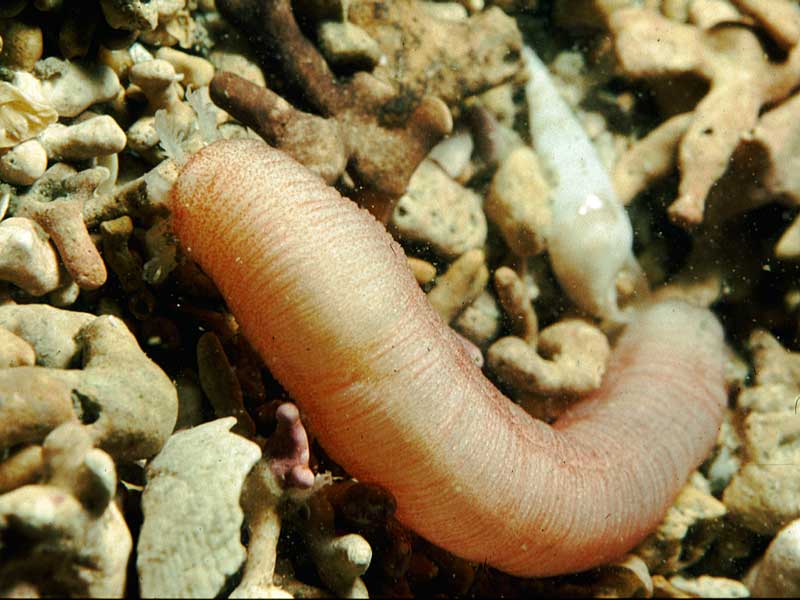 |
| Leptosynapta bergensis |
A burrowing sea cucumber known only the east or south-east coast in Northern Ireland, living buried in muddy sands. Its habitat has been heavily impacted by fishing.
In brief
- Found at scattered sites on the east and SE coast of Northern Ireland.
- Lives buried in muddy sands.
- Likely to be visible, through careful searching, throughout the year.
- Population is thought to be in decline.
- Main cause of decline is probably bottom trawling and dredging.
Species description: A rather worm-like sea cucumber (holothurian) ranging from 10 to 30 cm in length. It has a pinkish, transparent skin and body, and the five longitudinal muscles within show clearly. It has twelve pinnate (feather-like) tentacles, each of which has 8-11 pairs of digits, and these are somewhat longer towards the end of the tentacle. The animal lacks tube feet. The spicules (skeletal structures) are anchor in form, with pear-shaped plates.
Life cycle: Sexes are separate in this species, and spawning and fertilisation occurs externally. It has a planktonic life stage before metamorphosing into a juvenile of the adult form.
Similar species: All the British synaptids are similar, and need to be sorted by close examination of the tentacles and spicules (skeletal structures in the body wall).
How to see this species: It occurs buried in sublittoral muddy sands, and has been found at scattered locations around the east and SE coasts of Northern Ireland.
Current status: Rare. Previously there was believed to be only one known location in Northern Ireland, although it is now known to have a wider distribution. There are a few records from Ireland and it is recorded sparsely around a number of northern locations in Britain. The species has no legal protection. Northern Ireland appears to be a stronghold for this species.
Why is this species a priority in Northern Ireland?
- Criterion 3: Rare or restricted range – rare breeding species confined to 5 hectads or less (based on expert judgement).
Threats: This species is highly sensitive to bottom fishing, through causing disruption and loss of habitat. The species is also recorded as being sensitive to industrial waste and dumping.
Objectives:
- Maintain the number of viable populations of the species.
- Maintain the range of the species.
- Establish appropriate management known sites, and of any others that are discovered.
Conservation:
- Strangford Lough is a Marine Protected Area with multiple designations.
- Following concerns about the impact of fishing on key features of the lough, a study on ecological change was conducted in 2004, and following this a project to restore the Modiolus modiolus community has commenced. Use of mobile fishing gear in the lough has been banned.
- The relevant Northern Ireland Habitat Action Plans are for Horse Mussel Beds and for Mud Habitats in Deep Water.
Distribution Map from NBN: Leptosynapta bergensis at National Biodiversity Network mapping facility, data for UK.
iNaturalist: Leptosynapta bergensis at iNaturalist World Species Observations database.
WoRMS: Leptosynapta bergensis at World Register of Marine Species. Accepted name: Leptosynapta bergensis (Östergren, 1905). AphiaID: 124462.
Classification: Biota; Animalia; Echinodermata; Echinozoa; Holothuroidea; Paractinopoda; Apodida; Synaptidae; Leptosynapta
| Previous species | Next species |
| Adapted from text by Allen & Mellon Environmental Ltd. (2026). Leptosynapta bergensis. (Ostergren, 1905). [In] Priority species, Marine Biodiversity Portal NI. https://www2.habitas.org.uk/marbiop-ni/priorityaccounts.php?item=ZB5240. Accessed on 2026-09-13 |