
Northern Ireland Priority species (NIPS)
| ECHINODERMATA : Dendrochirotida : Cucumariidae | STARFISH, SEA URCHINS, ETC. |
Panningia hyndmani (Thompson, 1840)
Hyndman's sea cucumber
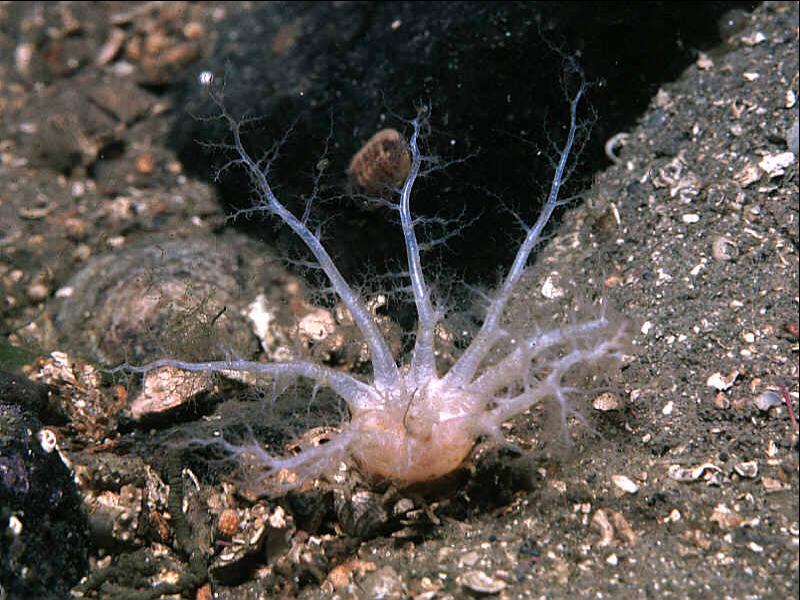 |
| Panningia hyndmani |
Sea cucumbers are soft-bodied Echinoderms, an ancient group of animals which are entirely found in the sea. This species has recently changed its name, being originally described as Cucumaria hyndmani and more recently known as Paracucumaria hyndmani. Panningia hyndmani is of interest in a Northern Ireland context in being described originally from Strangford Lough. This cucumber is found in Modiolus modiolus beds in Strangford Lough but appears to have declined rapidly in recent years.
In brief
- In Northern Ireland this species is most abundant in horse mussel beds in Strangford Lough, which have decreased significantly in the last 30 years.
- Lives in the sea at depths of 20-1150 m with populations most common in deep water.
- Individuals probably live for several years.
- Scarce in Northern Ireland but also found in Scottish Sea Lochs and from Norway to the Mediterranean.
- Threatened primarily by bottom fishing with trawls or dredges which disrupt the biogenic reef habitat.
Species description: A gherkin-shaped body with glistening white skin and five broad double rows of tube-feet are characteristic of this species. The tentacles are pale brown or pale pink in colour and small and sparsely branched. The body is usually covered with particles of shell and is buried in mud. The spicules are flat and irregular with numerous holes. Length up to 10 cm by 2 cm diameter.
Life cycle: Unknown.
Similar species: The smooth white skin between rows of tube feet is quite distinctive and only Pawsonia saxicola could be confused with this species. The latter is usually a rock crevice dweller, sometimes found beneath rocks on the lower shore.
How to see this species: This species can be found amongst living horse mussels in Strangford Lough, where it was formerly a common member of this community.
Current status: Rare. The current status of this species is not clear and it may be undergoing a natural fluctuation in its populations or may be declining. It has smaller tentacles than the other cucumbers present in the habitat and may be easily overlooked. Investigations in 2003 confirmed that the horse mussel beds have declined considerably in the past 30 years and this species in particular seems to have become rare, it was found only once during the 2003 SLECI fieldwork. Sea cucumbers are known to disappear beneath the surface for extended periods and it is possible that more specimens are present than have been observed. Northern Ireland is a stronghold for this species within Britain and Ireland.
Why is this species a priority in Northern Ireland?
- Criterion 3: Rare or restricted range – rare breeding species confined to 5 hectads or less (based on expert judgement).
- Criterion 4: NI stronghold or endemic – both stronghold range/population and designation as ‘endemic’ subject to expert judgement.
Threats: Loss of horse mussel reefs in Strangford Lough which seem to be the preferred habitat of this rare species.
Action: Records of new sites for this species, with details of habitat and population are always valuable. Send these to CEDaR, National Museums Northern Ireland, 153 Bangor Road, Cultra, Holywood, County Down, BT18 0EU. Tel 028 9039 5257 or e-mail cedar.records@nationalmuseumsni.org, or via the online portal. You can also record observations including a photograph using iNaturalist, find the MBDP-NI iNaturalist project here.
Objectives:
- Establish appropriate management on suitable historical sites.
- Monitor numbers present in horse mussel beds in Strangford Lough, if a population remains.
- Investigate recruitment and predation of this species.
Conservation:
- Strangford Lough is a Marine Protected Area with multiple designations.
- There is a Habitat Action Plan for Horse Mussel Beds..
Distribution Map from NBN: Panningia hyndmani at National Biodiversity Network mapping facility, data for UK.
iNaturalist: Panningia hyndmani at iNaturalist World Species Observations database.
WoRMS: Panningia hyndmani at World Register of Marine Species. Accepted name: Panningia hyndmani (Thompson, 1840). AphiaID: 848014.
Classification: Biota; Animalia; Echinodermata; Echinozoa; Holothuroidea; Actinopoda; Dendrochirotida; Cucumariidae; Panningia
| Previous species | Next species |
| Picton, B.E., Keatley, L. & Morrow, C.C. (2026). Panningia hyndmani. (Thompson, 1840). [In] Priority species, Marine Biodiversity Portal NI. https://www2.habitas.org.uk/marbiop-ni/priorityaccounts.php?item=ZB4690. Accessed on 2026-09-13 |