
Northern Ireland Priority species (NIPS)
| ECHINODERMATA : Amphilepidida : Amphiuridae | STARFISH, SEA URCHINS, ETC. |
Amphiura securigera (Düben & Koren, 1844)
Axe-bearing brittlestar
 |
| Amphiura securigera |
An inconspicuous and possibly under-recorded burrowing brittle star dwelling in subtidal gravels and shell debris. It is known from only two sites on the eastern coast of County Down.
In brief
- Found near Donaghadee, off the outer Ards peninsula and at the entrance to Strangford Lough.
- Can be found in sublittoral gravels and shells, and may be associated also with sea squirt assemblages and with horse mussels.
- Can be found throughout the year, but needs careful searching.
- Listed as NIPS because of its scarcity, possible decline, and lack of data.
- Main threats probably come from fisheries and use of mobile fishing gear.
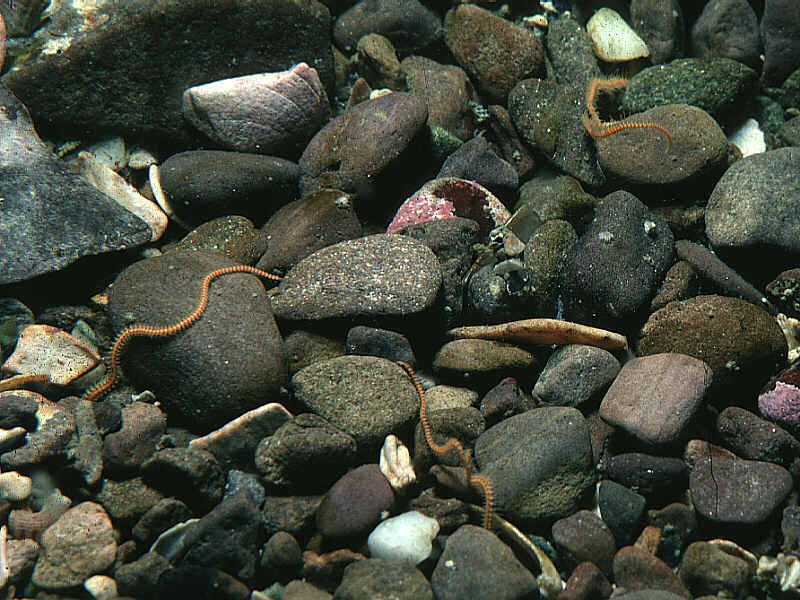
Species description: A small and inconspicuous burrowing brittle star, usually reddish-brown in colour, and often quite similar to the colour of the adjacent substrate. It has long coiled arms (usually 12-15 times diameter of disc, or central body, which are usually the only parts of the animal seen above the surface of the substrate. The upper and lower surfaces of the 5-8 mm diameter disc are naked and plain apart from radial shield plates on the upper surface. Small spines on the arms are much flattened.
Life cycle: There are few publications on the life cycle of this species, and Northern Ireland information is particularly sparse. Reproduction is likely to occur through release of eggs and sperms for external fertilisation, followed by development into planktonic larvae which will eventually settle on to suitable habitat; however, the timing of this in Northern Ireland waters is not documented.
Similar species: This is the only small brittle star found in coarse sediments. Amphiura incana is similar, but has scales on both sides of the disc, and has not been recorded around the island of Ireland to date.
How to see this species: In Northern Ireland the species has only been recorded from two sites; south-west of the Rigg Bank near Donaghadee, and in the Strangford Lough fairway. Further afield, in Ireland it has been recorded in Ardgroom Harbour (Cork), Kenmare River (Kerry), Hook Head (Waterford) and the Saltee Islands. It has also been recorded off the southern part of the Isle of Man, western Scotland, and western and southern coasts of England. Whilst it may most normally be found in coarse gravel or shell-gravel, it should be sought in related habitats; it often is associated with the gravel sea cucumber Neopentadactyla mixta. In the Saltee Islands it has been found in communities dominated by ascidians (sea squirts), and in Scotland it has been found associated with the horse mussel Modiolus modiolus where that species is abundant.
Current status: Rare. The species is known from only two sites in Northern Ireland, and a limited number of locations elsewhere in Ireland. Due to its inconspicuous appearance however, it may be under-recorded. There is a shortage of data on its status and trends.
Why is this species a priority in Northern Ireland?
- Criterion 3: Rare or restricted range – rare breeding species confined to 5 hectads or less (based on expert judgement).
Threats: The main threats to this species come from use of mobile bottom fishing gear like trawls and dredges which are known to disrupt, and in extreme cases destroy, seabed habitats. This species is particularly vulnerable to this occurring on gravels and shell beds, and the M. modiolus community in some areas (for example, Strangford Lough) has been almost completely destroyed by bottom trawling.
Action: Records of new sites for this species, with details of habitat and population are always valuable. Send these to CEDaR, National Museums Northern Ireland, 153 Bangor Road, Cultra, Holywood, County Down, BT18 0EU. Tel 028 9039 5257 or e-mail cedar.records@nationalmuseumsni.org, or via the online portal. You can also record observations including a photograph using iNaturalist, find the MBDP-NI iNaturalist project here.
Objectives:
- Maintain and increase the number of viable populations of the species
- Maintain the range of the species
- Target the species for particular recording.
Conservation:
- Strangford Lough is a Marine Protected Area with multiple designations.
- There is no Species Action Plan for this species, but the Subtidal Sands and Gravels Habitat Action Plan may be relevant, which has the objective of protect the extent and quality of a representative range of subtidal sand and gravel habitats and communities.
Distribution Map from NBN: Amphiura securigera at National Biodiversity Network mapping facility, data for UK.
iNaturalist: Amphiura securigera at iNaturalist World Species Observations database.
WoRMS: Amphiura securigera at World Register of Marine Species. Accepted name: Amphiura (Ophiopeltis) securigera (Düben & Koren, 1846). AphiaID: 125195.
Classification: Biota; Animalia; Echinodermata; Asterozoa; Ophiuroidea; Myophiuroida; Metophiurida; Ophintegrida; Amphilepidida; Gnathophiurina; Amphiuroidea; Amphiuridae; Amphiura
| Previous species | Next species |
| Adapted from text by Allen & Mellon Environmental Ltd. (2026). Amphiura securigera. (Düben & Koren, 1844). [In] Priority species, Marine Biodiversity Portal NI. https://www2.habitas.org.uk/marbiop-ni/priorityaccounts.php?item=ZB2900. Accessed on 2026-09-13 |