
Northern Ireland Priority species (NIPS)
| ECHINODERMATA : Valvatida : Solasteridae | STARFISH, SEA URCHINS, ETC. |
Solaster endeca (Linnaeus, 1771)
Purple sunstar
 |
| Solaster endeca |
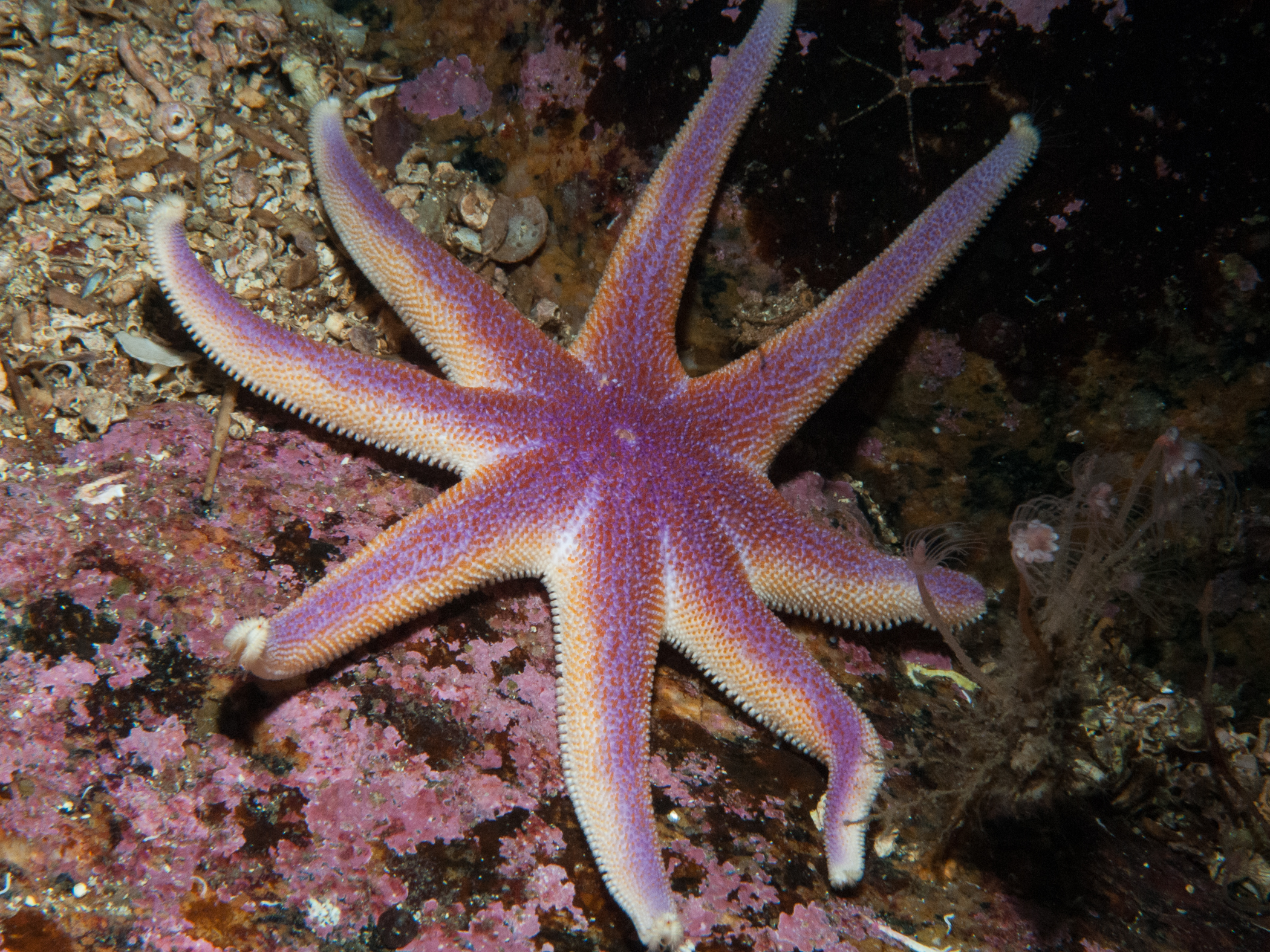
This starfish is distinctive in having more than the normal five arms, it is irregular in having normally nine. It is a well-known species which always occurs offshore but like many marine animals it can be found in shallower water in the northern part of its range, showing that it is constrained mostly by water temperature. On the West coast of Ireland it has been reported rarely and only from several hundred metres depth, but in Northern Ireland it used to be found uncommonly in Strangford Lough as shallow as 15 m. It has declined considerably in the last 30 years and this may be linked to global warming.
In brief
- In Northern Ireland this species was previously found most often close to the Narrows in Strangford Lough, however sightings within the lough are now extremely rare
- Lives in the sea at depths of 10-500 m or more in sea loughs and on open coasts
- May live for several years but may also be quite slow in breeding compared with most marine animals, due to its mode of reproduction
- Scarce in Northern Ireland but more common further north around Britain
- Threatened primarily by global warming which would be likely to push populations to the north
- Sensitive to climate change. As this species is more common farther north it may disappear if the sea water becomes warmer.
Species description: A starfish with normally nine or ten arms, but their number can vary from 7 to 13. The dorsal surface is rough, with a close-set armament of clusters of fine spinelets. Colour varies from a dirty cream colour to a beautiful pink-purple. The tips of the arms are often turned up and pale coloured. Up to 40 cm diameter, commonly 20 cm. It is a northern species, with Northern Ireland at the very southern end of its range.
Life cycle: This starfish has direct development, brooding eggs beneath the body which hatch into small starfish. This is unusual, most starfish release gametes into the water column and have an extended swimming larval stage which gives them high fecundity and considerable dispersal powers. A number of northern species share this direct development including the small cushion star Asterina phylactica and the Northern starfish, Leptasterias mulleri.
Similar species: Most starfish have five arms so this species is easily distinguished from most others simply on arm number. There is one other starfish in our waters with more arms than this, the common sunstar, Crossaster papposus, but it is easily distinguished by having long spines all over the back and having more than 10 arms which are shorter in relation to the size of the disk. It is typically red in colour but dull purple individuals can also be found.
How to see this species: This species is likely to be seen only by divers. Previously the most likely sites are in the vicinity of Ballyhenry Bay in Strangford Lough, where the water is well mixed and stable in temperature, however there are very few reliable recent records from within the lough. It can also be found around The Copelands and Ardglass on the Outer Ards Peninsula, although numbers are low.
Current status: Declining. This species seems to be quite rare in Northern Ireland and normally only single individuals are seen at irregular intervals. It appears to be declining as historic records seem to be more widespread than recent ones. In Northern Ireland this species was previously found most often close to the Narrows in Strangford Lough. Scattered records are known from the coasts of County Down and Antrim, from The Copelands and outer Ards peninsula. It is much more common on the west coast of Scotland and further north. Northern Ireland is a stronghold for Ireland, holding over 50% of the Irish population
Why is this species a priority in Northern Ireland?
- Criterion 4: NI stronghold or endemic – both stronghold range/population and designation as ‘endemic’ subject to expert judgement.
- Criterion 5: Climate Change Sensitive.
Threats: This species lives mostly in areas not subject to bottom fishing and feeds on other starfish so there are no obvious pressures on the populations from human activities. It is possible that it will be a sensitive indicator of global warming as Northern Ireland is at the southern limit of its shallow-water distribution. It probably has low fecundity and high genetic diversity due to its mode of reproduction.
Action: Records of new sites for this species, with details of habitat and population are always valuable. You can record observations including a photograph using iNaturalist, find the MBDP-NI iNaturalist project here.
Records can also be sent to CEDaR, National Museums Northern Ireland, 153 Bangor Road, Cultra, Holywood, County Down, BT18 0EU. Tel 028 9039 5257, via e-mail cedar.records@nationalmuseumsni.org, or via the online portal.
Objectives:
- Maintain the number of viable populations of the species
- Establish appropriate management on appropriate historic sites
- If refound, ensure that the population is maintained
- Investigate genetics using DNA techniques to establish how isolated Northern Ireland populations are from populations in Scotland, Scandinavia and Canada.
Conservation:
- Strangford Lough is a Marine Protected Area with multiple designations.
- Sites with previous records were surveyed in 2003 by the Strangford Lough Ecological Change Investigation.
- Survey work has been carried out in 2006 by the Ulster Museum to try to establish the current status of this species.
Distribution Map from NBN: Solaster endeca at National Biodiversity Network mapping facility, data for UK.
iNaturalist: Solaster endeca at iNaturalist World Species Observations database.
WoRMS: Solaster endeca at World Register of Marine Species. Accepted name: Solaster endeca (Linnaeus, 1771). AphiaID: 124160.
Classification: Biota; Animalia; Echinodermata; Asterozoa; Asteroidea; Ambuloasteroidea; Neoasteroidea; Valvatacea; Valvatida; Solasteridae; Solaster
| Previous species | Next species |
| Picton, B.E., Keatley, L. & Morrow, C.C. (2026). Solaster endeca. (Linnaeus, 1771). [In] Priority species, Marine Biodiversity Portal NI. https://www2.habitas.org.uk/marbiop-ni/priorityaccounts.php?item=ZB1430. Accessed on 2026-09-13 |