
Northern Ireland Priority species (NIPS)
| ECHINODERMATA : Valvatida : Asterinidae | STARFISH, SEA URCHINS, ETC. |
Anseropoda placenta (Pennant, 1777)
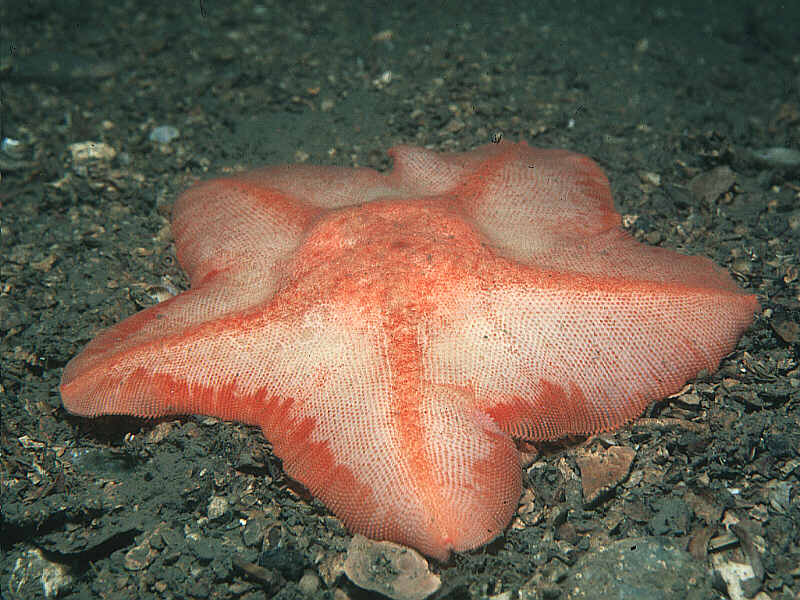
Goosefoot starfish
 |
| Anseropoda placenta |
This starfish is distinctive in having its five arms connected by webs of tissue. It is a well-known species due to its very distinctive appearance. It lives on sand or gravel seabeds mostly offshore and is widespread in UK waters.
In brief
- In Northern Ireland this species has been found at a few sites on the Antrim coast and at the Copeland Islands.
- Lives in the sea at depths of 10-200 m or more in sea loughs and on open coasts.
- It has undergone rapid decline and is scarce in Northern Ireland, as well as in a wider Britain and Ireland context.
- Threatened primarily by bottom fishing.
- May live for several years but little is known about the biology of this species.
Species description: It is a very thin, leaf-like, flat starfish with short webbed arms. The dorsal surface has a granular texture of small plates. The colour is white with five radiating red lines, one down the centre of each arm. The centre of the disc is red and there are red margins to the arms. The red colouration may be more developed in some individuals and may cover most of the dorsal surface. It is up to 20 cm across and is known to feed on small crustaceans, crabs and hermit crabs.
Life cycle: Unknown.
Similar species: It is unlikely to be mistaken for any other species.
How to see this species: This species is likely to be seen only by divers. The most likely sites are in the vicinity of Larne or the east coast of Rathlin Island on the Antrim coast. Scattered records are known from the coasts of Counties Down and Antrim and it is not uncommon in the Irish Sea.
Current status: Rare, declining. This species seem to be quite rare in Northern Ireland and normally only single individuals are seen at irregular intervals. It appears to be declining. Northern Ireland is the Irish stronghold holding over half of the Irish population.
Why is this species a priority in Northern Ireland?
- Criterion 2: Decline based on available data and expert judgement.
- Criterion 3: Rare or restricted range – rare breeding species confined to 5 hectads or less (based on expert judgement).
- Criterion 4: NI stronghold or endemic – both stronghold range/population and designation as ‘endemic’ subject to expert judgement.
Threats: This species lives in areas subject to bottom fishing for scallops and flatfish. It is vulnerable to damage by fishing gear.
Action: Records of new sites for this species, with details of habitat and population are always valuable. Send these to CEDaR, National Museums Northern Ireland, 153 Bangor Road, Cultra, Holywood, County Down, BT18 0EU. Tel 028 9039 5257 or e-mail cedar.records@nationalmuseumsni.org, or via the online portal. You can also record observations including a photograph using iNaturalist, find the MBDP-NI iNaturalist project here.
Objectives:
- Maintain the number of viable populations of the species
- Establish appropriate management on suitable historical sites.
Conservation:
- Implementation of the Northern Ireland Habitat Action Plan for Subtidal Sands and Gravels.
Distribution Map from NBN: Anseropoda placenta at National Biodiversity Network mapping facility, data for UK.
iNaturalist: Anseropoda placenta at iNaturalist World Species Observations database.
WoRMS: Anseropoda placenta at World Register of Marine Species. Accepted name: Anseropoda placenta (Pennant, 1777). AphiaID: 123985.
Classification: Biota; Animalia; Echinodermata; Asterozoa; Asteroidea; Ambuloasteroidea; Neoasteroidea; Valvatacea; Valvatida; Asterinidae; Anseropoda
| Previous species | Next species |
| Bernard Picton (2026). Anseropoda placenta. (Pennant, 1777). [In] Priority species, Marine Biodiversity Portal NI. https://www2.habitas.org.uk/marbiop-ni/priorityaccounts.php?item=ZB1190. Accessed on 2026-09-13 |