
Northern Ireland Priority species (NIPS)
| ECHINODERMATA : Paxillosida : Astropectinidae | STARFISH, SEA URCHINS, ETC. |
Astropecten irregularis (Pennant, 1777)
Sandstar
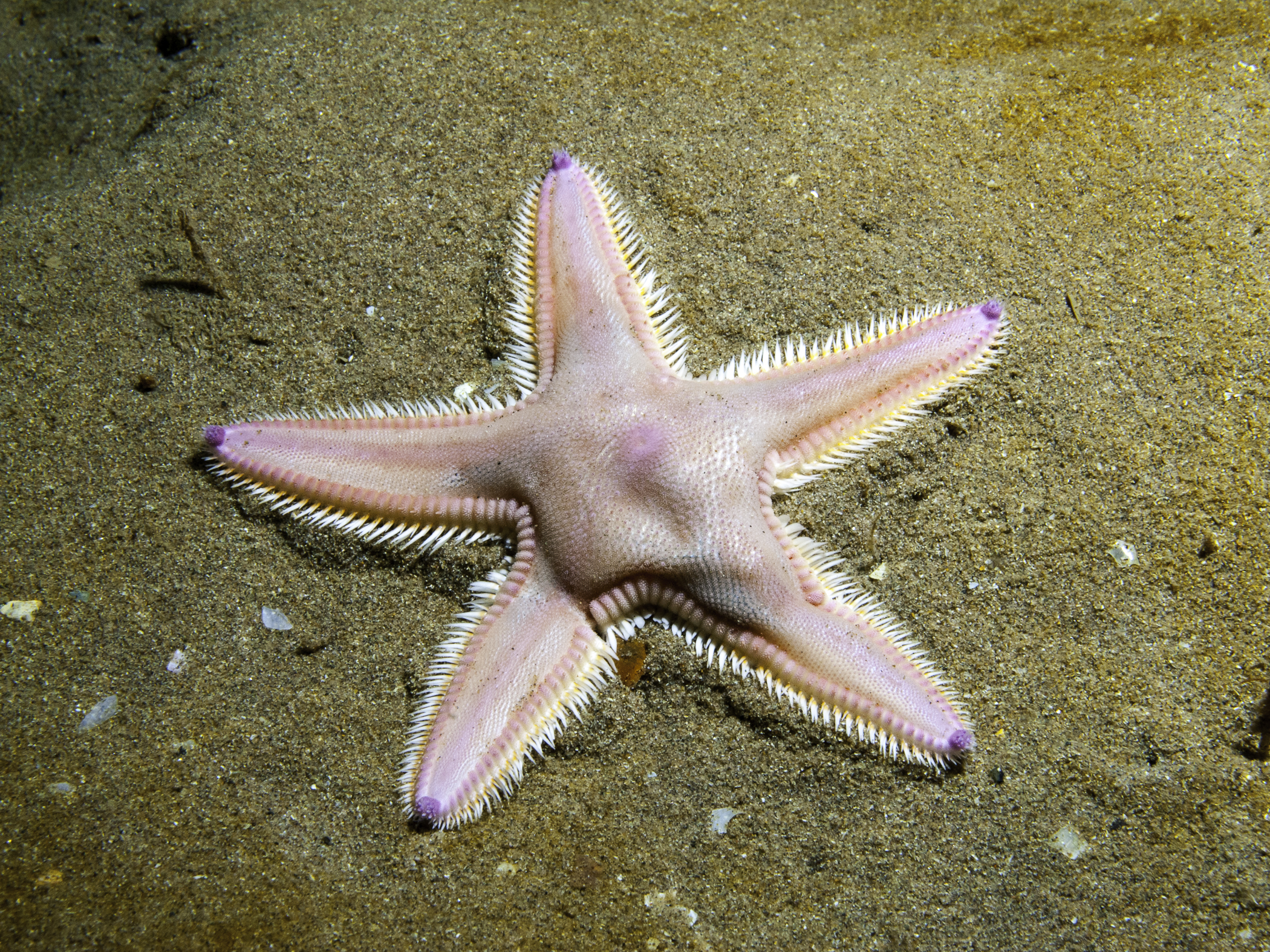 |
| Astropecten irregularis |
A burrowing starfish that lives on sands and muddy sands, particularly on Northern Ireland’s eastern coast. It has declined rapidly, probably due to impact from bottom fishing.
In brief
- Can be found off Rathlin, in Strangford Lough, and around the south-east Co. Down coast.
- Habitat is sands and muddy sands where it usually buries itself.
- Can be seen the year round but probably is more numerous in summer.
- Has undergone a rapid decline.
- Main threats — bottom fisheries, and disruption of habitat.
Species description: This is a classically shaped starfish, although with a rather flat profile, with five tapering arms. At the edge of each arm there is a double series of marginal plates, each of the upper of these has a long pointed spine. The tube feet are pointed and lack suckers. The upper surface of the starfish has a rather sandy texture, and the whole animal is sandy or pinkish-brown in colour, although the underside is somewhat paler. The arms have purple tips and there is often a purple spot in the centre of the animal on the upper surface. The total diameter is usually 50-150 mm, but it may reach 200 mm. The starfish feeds on shellfish, crustaceans and worms within the sediment, but may come to the surface at dawn and dusk to feed as well. It can bury itself within about 30 seconds, settling into the sediment vertically. When buried, it maintains surface contact through the tips of its arms.
Life cycle: The population appears to vary seasonally, reaching a maximum in summer, minimum in winter, but this may well be explained by migration of many individuals into deeper water during winter. The high summer densities may represent spawning aggregations or availability of suitable prey. Spawning has been recorded in late spring or early summer, and redevelopment of gonads takes place through the winter and into spring.
Similar species: None in shallow, divable waters.
How to see this species: In Northern Ireland the species can be found in most locations where sublittoral sands or muddy sands occur, and elsewhere it can be found down to 1,000 m depth. Recorded sites include off Rathlin Island’s southern coast, in Strangford Lough, off Ardglass, in Dundrum Bay and off the coast from Annalong to the Hellyhunter Rock. Many similar habitats in the Republic of Ireland also support the species, including sites in Donegal, Mayo, Galway, Clare and Cork, as well as the Lambay Deep off Dublin. In Britain it has a primarily westerly distribution, but also occurs off Orkney, Shetland, and in the North Sea.
Current status: Declining. Known from a wide range of sites around Northern Ireland, particularly off the east coast. The species has no legal protection. It has undergone rapid decline as a result of bottom fishing and habitat disruption.
Why is this species a priority in Northern Ireland?
- Criterion 2: Decline based on available data and expert judgement.
Threats: The habitat of this species is under considerable pressure from the deployment of mobile bottom fishing gear which disrupts the sediments in which it lives, and which probably has an impact on its food species as well.
Action: Records of new sites for this species, with details of habitat and population are always valuable. Send these to CEDaR, National Museums Northern Ireland, 153 Bangor Road, Cultra, Holywood, County Down, BT18 0EU. Tel 028 9039 5257 or e-mail cedar.records@nationalmuseumsni.org, or via the online portal. You can also record observations including a photograph using iNaturalist, find the MBDP-NI iNaturalist project here.
Objectives:
- Maintain the number of viable populations of the species.
- Maintain the range of the species.
- Establish appropriate management on suitable historical sites with a view to targeted recovery.
- Monitor the population at key locations.
Conservation:
- Rathlin Island is a Marine Protected Area with multiple designations.
- Strangford Lough is a Marine Protected Area with multiple designations.
- There is no Species Action Plan for Astropecten irregularis, but the NI Habitat Action Plan for Subtidal Sands and Gravel has the objective of protecting the extent and quality of a representative range of subtidal sand and gravel habitats and communities.
Distribution Map from NBN: Astropecten irregularis at National Biodiversity Network mapping facility, data for UK.
iNaturalist: Astropecten irregularis at iNaturalist World Species Observations database.
WoRMS: Astropecten irregularis at World Register of Marine Species. Accepted name: Astropecten irregularis (Pennant, 1777). AphiaID: 123867.
Classification: Biota; Animalia; Echinodermata; Asterozoa; Asteroidea; Ambuloasteroidea; Neoasteroidea; Valvatacea; Paxillosida; Astropectinidae; Astropecten
| Previous species | Next species |
| Adapted from text by Allen & Mellon Environmental Ltd. (2026). Astropecten irregularis. (Pennant, 1777). [In] Priority species, Marine Biodiversity Portal NI. https://www2.habitas.org.uk/marbiop-ni/priorityaccounts.php?item=ZB410. Accessed on 2026-09-13 |