
Northern Ireland Priority species (NIPS)
| ECHINODERMATA : Comatulida : Antedonidae | STARFISH, SEA URCHINS, ETC. |
Antedon petasus (Düben & Koren, 1846)
Broad-crowned feather star
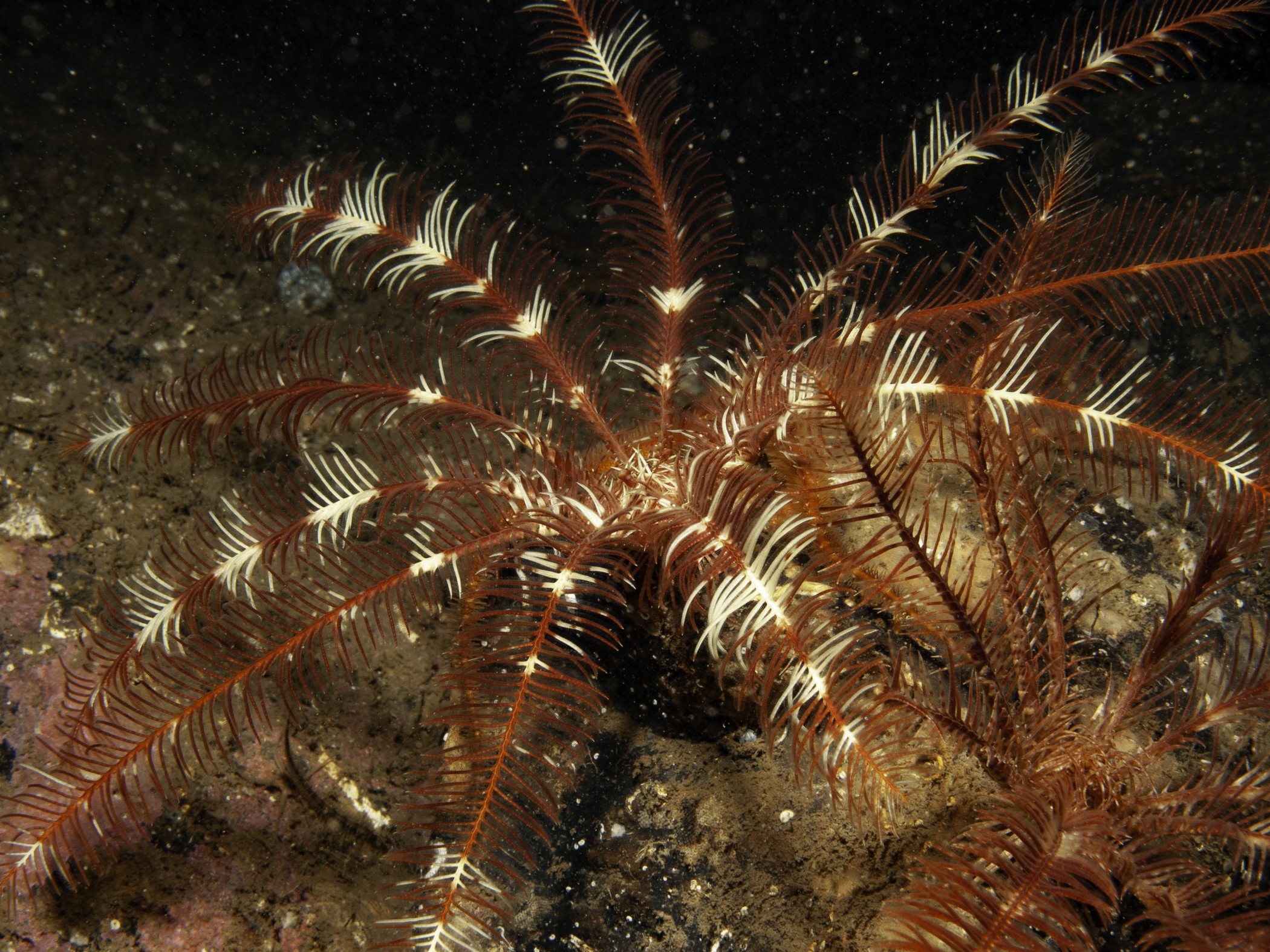 |
| Antedon petasus |
Large, colourful featherstar found mainly in deeper or more northern waters.
In brief
- Large featherstar, generally found in deeper water.
- Northern species, which is likely to be impacted by climate change.
- Most records for Northern Ireland are around Rathlin Island, however it is found all around the coast in lower abundances.
Species description: This feather star is larger than Antedon bifida and has a neater appearance and different coloration. The arms are either brown or red and white with the colour in large patches rather than the freckled appearance of Antedon bifida. There are more cirri, about 50-100 arising around a low hemispherical plate, and the lower side of the arm has an almost smooth outline. Arms typically 7-10cm in length.
Life cycle: Larvae have a brief free-swimming stage before settling and developing into a sessile stalked pentacrinoid. Finally these develop into the mobile adults. Lifespan is unknown, but it is estimated (based on similar species) that sexual maturity isn't reached until individuals are at least one year old.
Similar species: Similar to Antedon bifida but replaces this species in the north and in deeper water.
How to see this species: Found mostly in sheltered habitats attached to kelp, sessile animals or directly to wrecks or boulders. There are records all around the coast of Northern Ireland, but it is especially frequent around Rathlin Island. This is a northern species in the Britain and Ireland, at least in shallow water, frequent in the northern part of the Irish Sea and inshore in the west of Scotland, also around Shetland.
Current status: Unknown. Northern Ireland is a stronghold within Britain and Ireland. This northern species is likely to be affected by climate change.
Why is this species a priority in Northern Ireland?
- Criterion 4: NI stronghold or endemic – both stronghold range/population and designation as ‘endemic’ subject to expert judgement.
- Criterion 5: Climate Change Sensitive
Threats: Reduction of range due to climate change, resulting in suitable habitat becoming rarer. NI is a stronghold for this species and current populations should be maintained if possible.
Action: Records of new sites for this species, with details of habitat and population are always valuable. Send these to CEDaR, National Museums Northern Ireland, 153 Bangor Road, Cultra, Holywood, County Down, BT18 0EU. Tel 028 9039 5257 or e-mail cedar.records@nationalmuseumsni.org, or via the online portal. You can also record observations including a photograph using iNaturalist, find the MBDP-NI iNaturalist project here.
Objectives:
- Monitor and maintain current population levels.
- Existing, and future, records should be verified with a photograph(s) where possible to eliminate confusion with Antedon bifida and clarify true range of this species.
Conservation:
- Rathlin Island is a Marine Protected Area with multiple designations.
Distribution Map from NBN: Antedon petasus at National Biodiversity Network mapping facility, data for UK.
iNaturalist: Antedon petasus at iNaturalist World Species Observations database.
WoRMS: Antedon petasus at World Register of Marine Species. Accepted name: Antedon petasus (Düben & Koren, 1846). AphiaID: 124210.
Classification: Biota; Animalia; Echinodermata; Crinozoa; Crinoidea; Articulata; Comatulida; Antedonoidea; Antedonidae; Antedoninae; Antedon
| Previous species | Next species |
| Picton, B.E., Keatley, L. & Morrow, C.C. (2026). Antedon petasus. (Düben & Koren, 1846). [In] Priority species, Marine Biodiversity Portal NI. https://www2.habitas.org.uk/marbiop-ni/priorityaccounts.php?item=ZB120. Accessed on 2026-09-13 |