
Northern Ireland Priority species (NIPS)
| BRYOZOA : Cheilostomatida : Bitectiporidae | SEA MATS |
Pentapora foliacea (Ellis & Solander, 1786)
Rose coral, Potato crisp bryozoan
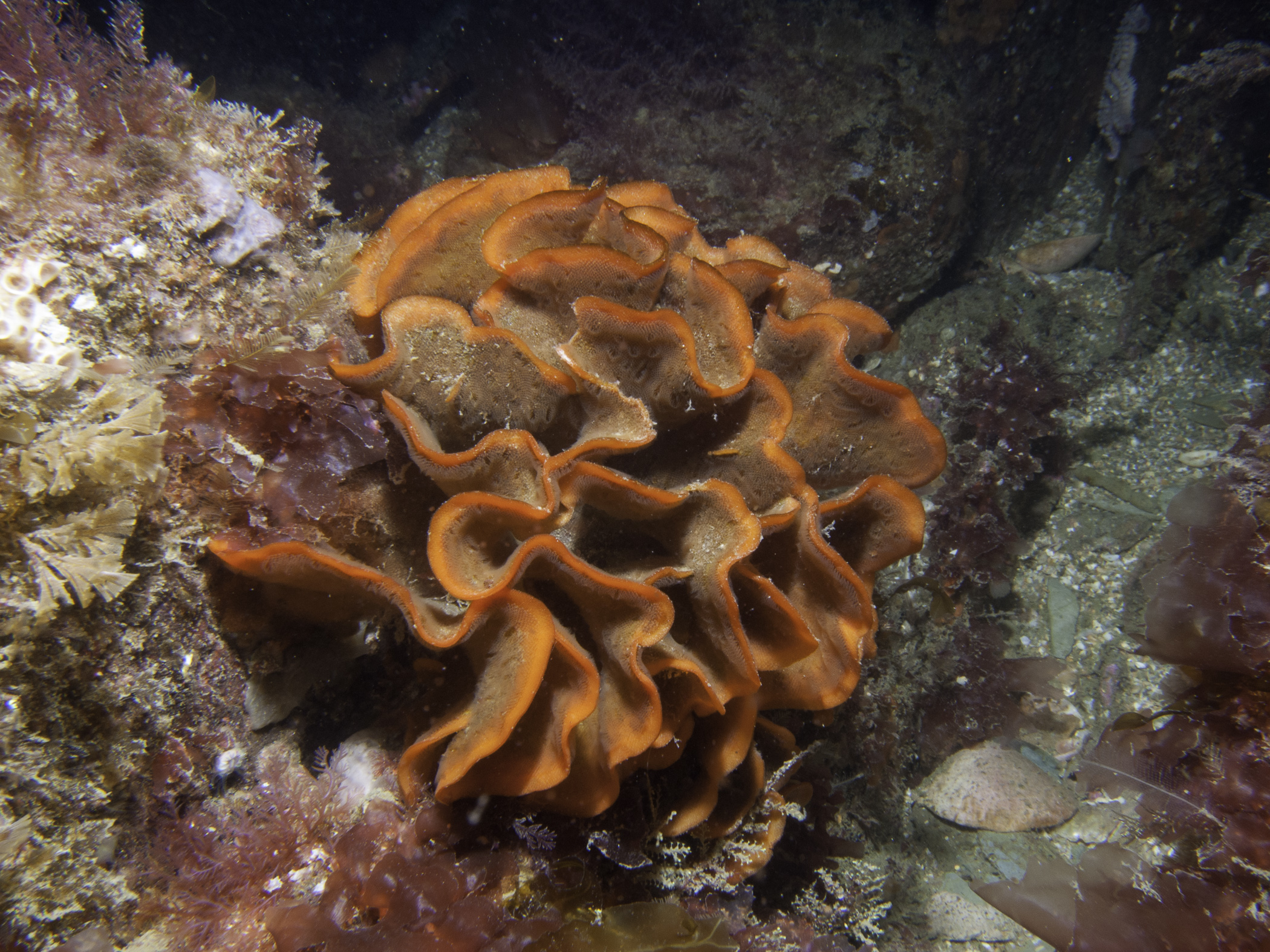 |
| Pentapora foliacea |
Large, erect bryozoan found on bedrock and boulders. Key habitat enhancing species, creating additional structure on bedrock and boulders and providing shelter for other species.
In brief
- Largest bryozoan found in this region, up to 40 cm or more.
- Colonies are thought to live 5-10 years or more, with estimated 2 cm per year growth rate.
- Fragile, erect colonies are at risk of damaging from some fishing practices or anchoring.
- Most Northern Irish records are from the north coast or Rathlin Island.
Species description: This is the largest bryozoan to be found around Northern Irish coasts, growing to 40 cm or more across. The colony consists of a series of brittle plates joined to each other to form a domed or hemispherical colony. Small colonies start by encrusting the rock and then growing a series of upright plates.
Life cycle: There is currently a lack of detailed information about the life cycle of this species. Colonies are estimated to have a lifespan from 5 - 10 years, or more (based on available information about closely related species). They are thought to be reproductive in late August - September, based on the visible presence of ovicells in colonies. Sexual maturity is reached relatively quickly with colonies less than 3 cm recorded bearing ovicells. Larvae settle on suitable substrate and begin a brief encrusting phase composed of the earliest growth before upright growth begins. Growth rate is slow, and estimated to be around 2 cm per year.
Similar species: No other species in the area forms upright lamellate colonies so it is unlikely to be confused with anything else.
How to see this species: This species is most common in sand-scoured habitats attached to bedrock or boulders, often surrounded by coarse gravel. In Northern Ireland most records are from Rathlin Island and The Maidens. It is a common species in the southern part of Ireland and the British Isles, becoming more scarce in Scotland, but recorded as far north as Lewis in the Outer Hebrides.
Current status: Scarce. Mostly recorded around the north coast, Rathlin Island and The Maidens in Northern Ireland.
Why is this species a priority in Northern Ireland? TBC.
Threats: These fragile colonies are at risk from any activities using lines or anchoring (e.g. some fishing practices or anchoring of boats). Fishing activities such as potting are often viewed as benign but these are potentially highly damaging to fragile, erect species, especially those that are slow growing and long lived.
Action: Records of new sites for this species, with details of habitat and population are always valuable. Send these to CEDaR, National Museums Northern Ireland, 153 Bangor Road, Cultra, Holywood, County Down, BT18 0EU. Tel 028 9039 5257 or e-mail cedar.records@nationalmuseumsni.org, or via the online portal. You can also record observations including a photograph using iNaturalist, find the MBDP-NI iNaturalist project here.
Objectives:
- Monitor existing population.
- Maintain current population levels, and ensure suitable quality habitat remains for expansion of current population.
- Ensure adequate habitat protection, e.g. restricting fishing and anchoring at key sites.
Conservation:
- Rathlin Island is a Marine Protected Area with multiple designations.
- There is a Habitat Action Plan for Fragile Sponge and Anthozoan Communities on Rocky Habitats.
Distribution Map from NBN: Pentapora foliacea at National Biodiversity Network mapping facility, data for UK.
iNaturalist: Pentapora foliacea at iNaturalist World Species Observations database.
WoRMS: Pentapora foliacea at World Register of Marine Species. Accepted name: Pentapora foliacea (Ellis & Solander, 1786). AphiaID: 150672.
Classification: Biota; Animalia; Bryozoa; Gymnolaemata; Cheilostomatida; Flustrina; Smittinoidea; Bitectiporidae; Pentapora
| Previous species | Next species |
| Picton, B.E., Keatley, L. & Morrow, C.C. (2026). Pentapora foliacea. (Ellis & Solander, 1786). [In] Priority species, Marine Biodiversity Portal NI. https://www2.habitas.org.uk/marbiop-ni/priorityaccounts.php?item=Y3510. Accessed on 2026-09-13 |