
Northern Ireland Priority species (NIPS)
| MOLLUSCA : Venerida : Arcticidae | SNAILS, SLUGS, ETC. |
Arctica islandica (Linnaeus, 1767)
Ocean quahog
 |
| Arctica islandica |
A.islandica, commonly known as the ocean quahog occurs buried in sediment on sandy and muddy sand from the low intertidal down to 482 m. It was nominated for inclusion on the OSPAR list with particular reference to decline, sensitivity with information also provided on threat, and as priority for OSPAR Region II (Greater North Sea).
In brief
- This bivalve mollusc can be found all around the coasts of Northern Ireland where there is suitable sandy sediment.
- Listed by OSPAR as in decline.
- Mechanical damage and incidental catch of A.islandica from bottom fishing gear is known to damage shells and lead to direct mortality.
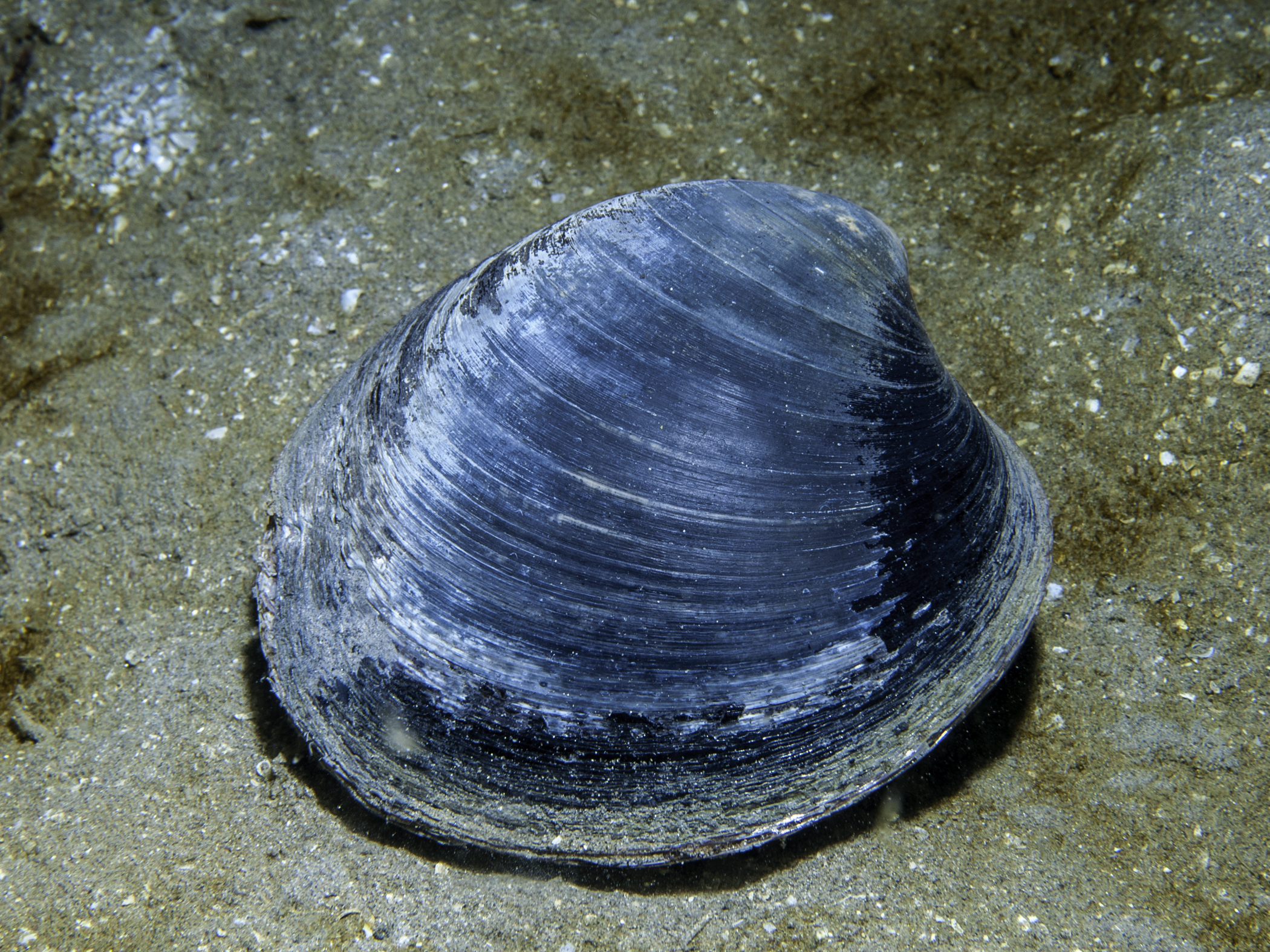
Species description: A large bivalve (up to 12 cm long) which lives just below the surface of muddy sand. It is known to be long-lived, with reported ages of up to 400-500 years. The shell is broadly oval, with prominent ridges. The shell is a dull white but this is mostly covered with thick periostracum; in younger animals this is a glossy chestnut-brown and in older animals it ranges from greenish-brown to black.
Life cycle: Ocean quahogs are gonochoristic (having separate sexes) and reproduce by releasing millions of eggs and sperm into the water column during the summer. Once fertilized, embryos develop into free-swimming ciliated trochophore larvae. These transition into the veliger stage, forming a miniature bivalve shell as they drift with ocean currents. The veliger larvae settle onto the ocean floor, burying themselves vertically into the sand with their siphons reaching the surface. They reach sexual maturity relatively late (ages 5–11) and grow very slowly. Adults live subtidally, often alternating between filtering organic matter at the surface and burying themselves several centimetres deep to respire anaerobically.
The ocean quahog is reported to be the longest-lived non-colonial animal known to science.
Similar species: There is only one species of Arctica found in Britain and Ireland.
How to see this species: Shells are commonly found washed up on beaches around the north east coast of Northern Ireland, particularly after storms.
Current status: Scarce/in decline in Greater North Sea region. Belfast Lough noted as a stronghold for this species.
Why is this species a priority in Northern Ireland?
- Criterion 1: Internationally listed species.
- Criterion 4: NI stronghold or endemic – both stronghold range/population and designation as ‘endemic’ subject to expert judgement.
Threats: Bottom fishing is the main threat to populations of Arctica islandica.
Action: Records of new sites for this species, with details of habitat and population are always valuable. Observations with a photograph can be recorded using iNaturalist, find the MBDP-NI iNaturalist project here.
Alternatively, records can be sent to CEDaR, National Museums Northern Ireland, 153 Bangor Road, Cultra, Holywood, County Down, BT18 0EU. Tel 028 9039 5257, e-mail cedar.records@nationalmuseumsni.org, or via the online portal.
Objectives:
- Management options to reduce the threat to this species include limiting or prohibiting disturbance by bottom fishing.
- Establish appropriate management on appropriate historical sites.
- Maintain, and if biologically possible, increase the number of viable populations of the species.
- Maintain, and if biologically possible, increase the range of the species.
Conservation:
- Strangford Lough is a Marine Protected Area with multiple designations.
Distribution Map from NBN: Arctica islandica at National Biodiversity Network mapping facility, data for UK.
iNaturalist: Arctica islandica at iNaturalist World Species Observations database.
WoRMS: Arctica islandica at World Register of Marine Species. Accepted name: Arctica islandica (Linnaeus, 1767). AphiaID: 138802.
Classification: Biota; Animalia; Mollusca; Bivalvia; Autobranchia; Heteroconchia; Euheterodonta; Imparidentia; Venerida; Arcticoidea; Arcticidae; Arctica
| Previous species | Next species |
| Picton, B.E., Keatley, L. & Morrow, C.C. (2026). Arctica islandica. (Linnaeus, 1767). [In] Priority species, Marine Biodiversity Portal NI. https://www2.habitas.org.uk/marbiop-ni/priorityaccounts.php?item=W21250. Accessed on 2026-09-13 |