
Northern Ireland Priority species (NIPS)
| MOLLUSCA : Cardiida : Cardiidae | SNAILS, SLUGS, ETC. |
Cerastoderma glaucum (Bruguière, 1789)
Lagoon cockle
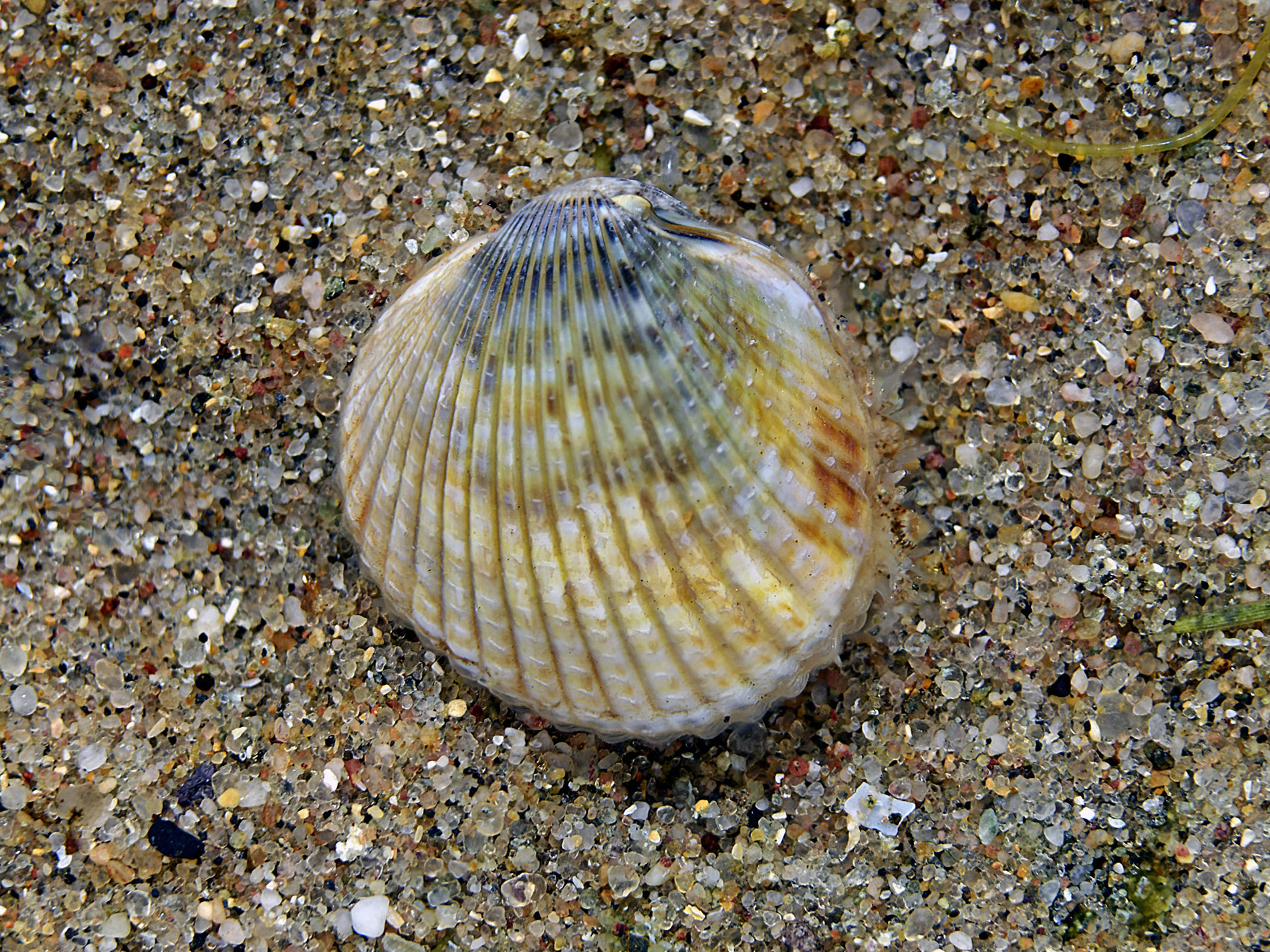 |
| Cerastoderma glaucum |
The shell is markedly eccentric, although generally rounded and globular with 20-24 conspicuous radiating ribs, each with scale-like spines, up to 5cm in size. The shell is thin and off-white, yellowish, light brown or greenish in colour with dark brown areas, with a dark brown periostracum over most of its surface. The margin is crenulate except along the posterior. The inside of the shell is generally dull white or brown, with the ribs visible as distinct grooves throughout the whole of the shell.
In brief
- The species as an adult has only been found in Glynn Lagoon, Larne Lough and Castle Espie Lagoon, Strangford Lough.
- It lives in saline lagoons and is present throughout the year.
- It has undergone rapid decline and is rare.
- Its habitat, the saline lagoon, is vulnerable to disturbance, and natural fluctuation of environmental factors.
Species description: The shell is markedly eccentric, although generally rounded and globular with 20-24 conspicuous radiating ribs, each with scale-like spines, up to 5 cm in size. The shell is thin and off-white, yellowish, light brown or greenish in colour with dark brown areas, with a dark brown periostracum over most of its surface. The margin is crenulate except along the posterior. The inside of the shell is generally dull white or brown, with the ribs visible as distinct grooves throughout the whole of the shell.
Life cycle: There are separate sexes. Gametogenesis occurs in early spring, and spawning takes place from May to July. The veliger larvae have a pelagic life of from 11 to 30 days. Spat settlement takes place in July/August, with the newly-settled young attaching to filamentous algae by means of byssus threads. Adults migrate to free-living lifestyle in sediments. Individuals live for about five years.
Similar species: There are several similar species: Cerastoderma edule and the Parvicardium spp. C. glaucum has ribs visible on the inner surface of the shell as grooves extending to the region below the umbones unlike C. edule, Parvicardium scabrum and P. exiguum. The right valve of C. glaucum has two posterior lateral teeth, whereas Parvicardium minimum and P. ovale have one posterior lateral tooth only.
How to see this species: This species is present at three sites in Northern Ireland – Longfield Level and Glynn Lagoon, Larne Lough and Castle Espie Lagoon, Strangford Lough. The species lies on the surface or just buried in soft sediment, submerged in a few centimetres of water to only a few metres depth in brackish waters, usually saline lagoons. The closely similar C. edule is unable to tolerate the more brackish and variable conditions of the lagoon. It is a filter feeding bivalve, present at all times of year. Relevant access permissions should always be sought prior to visiting any site.
Current status: Rare. This species is present at three sites in Northern Ireland — a single juvenile at Longfield Level in 1994, with the only mature bed of adults at Glynn Lagoon, Larne Lough, last seen 2001. A visit in early 2006 discovered that the bed was no longer in existence, and only a few scattered individuals and one juvenile were found. Other lagoon species such as tassel weeds Ruppia sp. were also absent. Shell trauma observed on those animals found in 2006 suggested that the event causing the loss of the bed occurred about one year previously. More recently it was found in Castle Espie Lagoon, Strangford Lough in 2020. The only other location for the Lagoon Cockle in the northern half of the island of Ireland is Mulroy Bay; but it is common in lagoons in the southern half of Ireland. It is known positively only from the southern parts of Britain, from East Anglia to south Wales, but is probably present elsewhere. It is recorded from many parts of western Europe, the Mediterranean and Black Sea.
Why is this species a priority in Northern Ireland?
- Criterion 2: Decline based on available data and expert judgement.
- Criterion 3: Rare or restricted range – rare breeding species confined to 5 hectads or less (based on expert judgement).
Threats: The species has high sensitivity to substratum loss; smothering; desiccation; and changes in emergence regime, water flow rate, wave exposure, nutrient levels and oxygenation. Small isolated populations are prone to catastrophic destruction, due to rapid changes in conditions in their habitat of saline lagoons. Distribution is believed to be restricted by the damaging effect of wave action on newly-settled spat.
Action: Records of new sites for this species, with details of habitat and population are always valuable. Observations with a photograph can be recorded using iNaturalist, find the MBDP-NI iNaturalist project here.
Alternatively, records can be sent to CEDaR, National Museums Northern Ireland, 153 Bangor Road, Cultra, Holywood, County Down, BT18 0EU. Tel 028 9039 5257, e-mail cedar.records@nationalmuseumsni.org, or via the online portal.
Objectives:
- Perform targeted surveys to ascertain the current status and enhance mapping coverage of the species in Northern Ireland.
- Establish appropriate management on historical sites, particularly monitoring of the known site at Glynn Lagoon and Castle Espie Lagoon.
- Maintain, if biologically feasible, and increase the number of viable populations of the species.
Conservation:
- Implementation of the Northern Ireland Habitat Action Plan for Saline Lagoons.
Distribution Map from NBN: Cerastoderma glaucum at National Biodiversity Network mapping facility, data for UK.
iNaturalist: Cerastoderma glaucum at iNaturalist World Species Observations database.
WoRMS: Cerastoderma glaucum at World Register of Marine Species. Accepted name: Cerastoderma glaucum (Bruguière, 1789). AphiaID: 138999.
Classification: Biota; Animalia; Mollusca; Bivalvia; Autobranchia; Heteroconchia; Euheterodonta; Imparidentia; Cardiida; Cardioidea; Cardiidae; Lymnocardiinae; Cerastodermatini; Cerastoderma
| Previous species | Next species |
| Adapted from text by Dr Julia Nunn (2026). Cerastoderma glaucum. (Bruguière, 1789). [In] Priority species, Marine Biodiversity Portal NI. https://www2.habitas.org.uk/marbiop-ni/priorityaccounts.php?item=W19920. Accessed on 2026-09-13 |