
Northern Ireland Priority species (NIPS)
| PORIFERA : Axinellida : Raspailiidae | SPONGES |
Eurypon coronula (Bowerbank, 1874)
 |
| Eurypon coronula |
This is an extremely rare sponge that was recorded only once, in Strangford Lough, has not been seen since, and whose habitat has been severely disrupted by bottom fishing.
In brief
- Recorded in Bird Island Passage, Strangford Lough.
- It was found on sublittoral muddy shells and gravels.
- It can probably be found throughout the year if it is still present.
- It is listed as a NIPS on account of its extreme rarity; it may even have been lost.
- The main threat to its only location comes from loss of habitat from use of mobile bottom fishing gear.
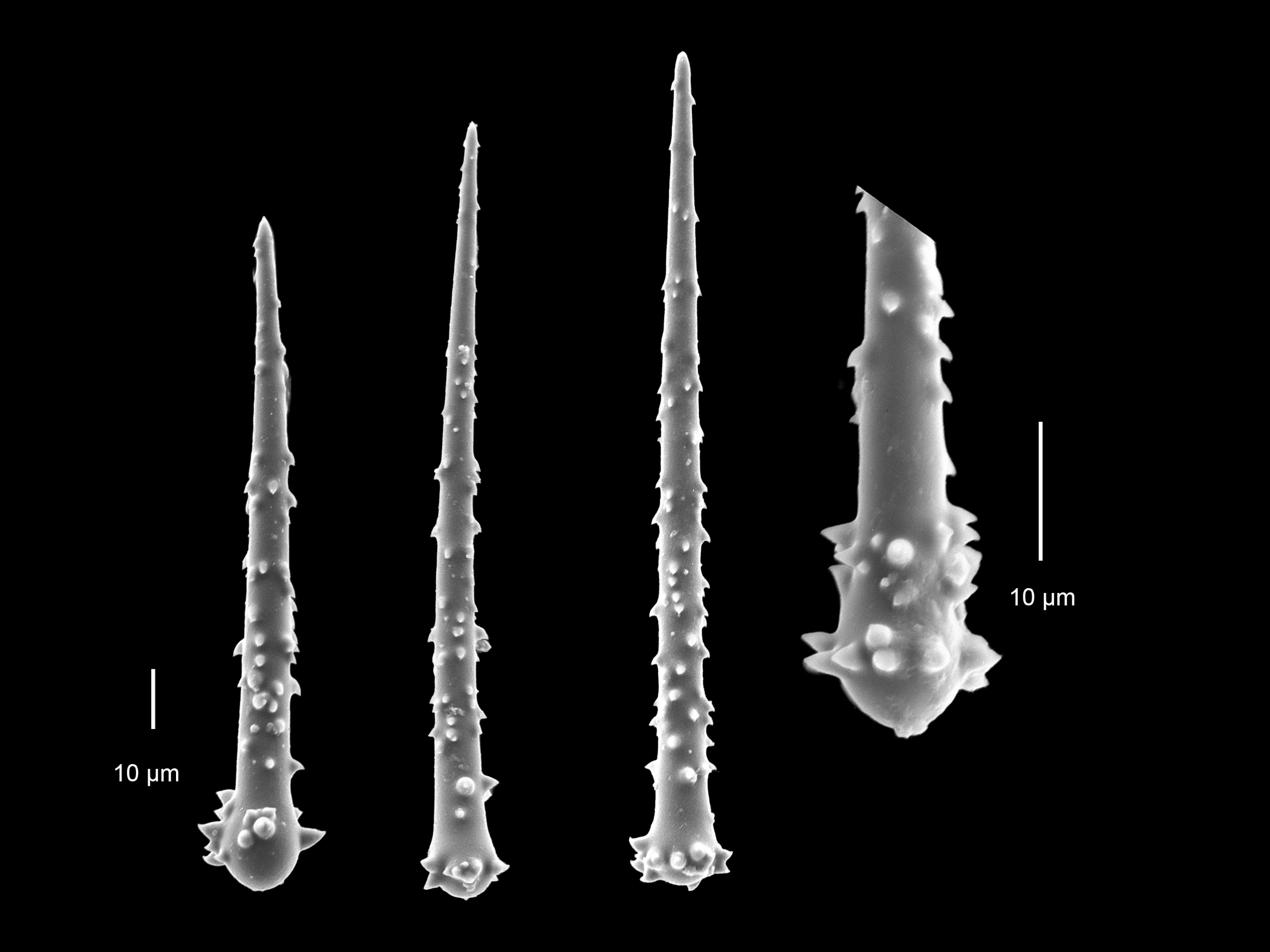
Species description: An encrusting sponge, possibly reddish in colour, with needle-shaped spicules (skeletal structures), pointed at one end and bulbous at the other.
Life cycle: Sponges have either separate sexes or are hermaphrodite. In the case of the latter, self-fertilisation is avoided by eggs and sperms maturing at different rates within the same individual, so when spawning takes place and sperms are released through exhalent openings, it is unlikely that the eggs will be fertilised by the same individual. In the case of this species it is likely that eggs are released, fertilised externally, and develop into planktonic larvae. Asexual reproduction may also be achieved by budding, whereby a small unit of the sponge separates and develops as an independent entity.
Similar species: Possible specimens of this sponge should be subject to detailed examination and comparison with the type specimen.
How to see this species: This sponge has only one recorded location in both Northern Ireland and in the Republic of Ireland, and that is Bird Island Passage in Strangford Lough, and the only specimen from here has been checked against the type specimen, from Shetland, in the Natural History Museum. Here it was on sublittoral muddy shell and gravel areas at depths of about 15 m, but has not been found since, despite extensive searching. Elsewhere, it is found in a few dispersed locations off southern England and there is one site off Anglesey, but it has been recorded in other much deeper waters in the NE Atlantic, but there is uncertainty as to whether the latter record is actually of the same species.
Current status: Bird Island Passage is the only known Irish location for this species. Even here it may possibly be declining, or even lost. Data deficient.
Why is this species a priority in Northern Ireland?
- Criterion 2: Decline based on available data and expert judgement.
- Criterion 3: Rare or restricted range – rare breeding species confined to 5 hectads or less (based on expert judgement).
Threats: The only location of this species has been subject to heavy impact by bottom trawling gear which has caused major disruption to its habitat. It has potentially be lost.
Action: Records of new sites for this species, with details of habitat and population are always valuable. Observations with a photograph can be recorded using iNaturalist, find the MBDP-NI iNaturalist project here.
Alternatively, records can be sent to CEDaR, National Museums Northern Ireland, 153 Bangor Road, Cultra, Holywood, County Down, BT18 0EU. Tel 028 9039 5257, e-mail cedar.records@nationalmuseumsni.org, or via the online portal.
Objectives:
- Maintain the only known location for this species, and maintain any others that may be found.
- If rediscovered, monitor the population(s)regularly.
- If rediscovered, assess taxonomic status in light of latest research.
Conservation:
- Strangford Lough is a Marine Protected Area with multiple designations.
Distribution Map from NBN: Eurypon coronula at National Biodiversity Network mapping facility, data for UK.
iNaturalist: Eurypon coronula at iNaturalist World Species Observations database.
WoRMS: Eurypon coronula at World Register of Marine Species. Accepted name: Eurypon coronula (Bowerbank, 1874). AphiaID: 133108.
Classification: Biota; Animalia; Porifera; Demospongiae; Heteroscleromorpha; Axinellida; Raspailiidae; Raspailiinae; Eurypon
| Previous species | Next species |
| Adapted from text by Allen & Mellon Environmental Ltd. (2026). Eurypon coronula. (Bowerbank, 1874). [In] Priority species, Marine Biodiversity Portal NI. https://www2.habitas.org.uk/marbiop-ni/priorityaccounts.php?item=C4520. Accessed on 2026-09-13 |