
Northern Ireland Priority species (NIPS)
| PORIFERA : Axinellida : Raspailiidae | SPONGES |
Hymeraphia breeni Picton & Goodwin, 2007
 |
| Hymeraphia breeni |
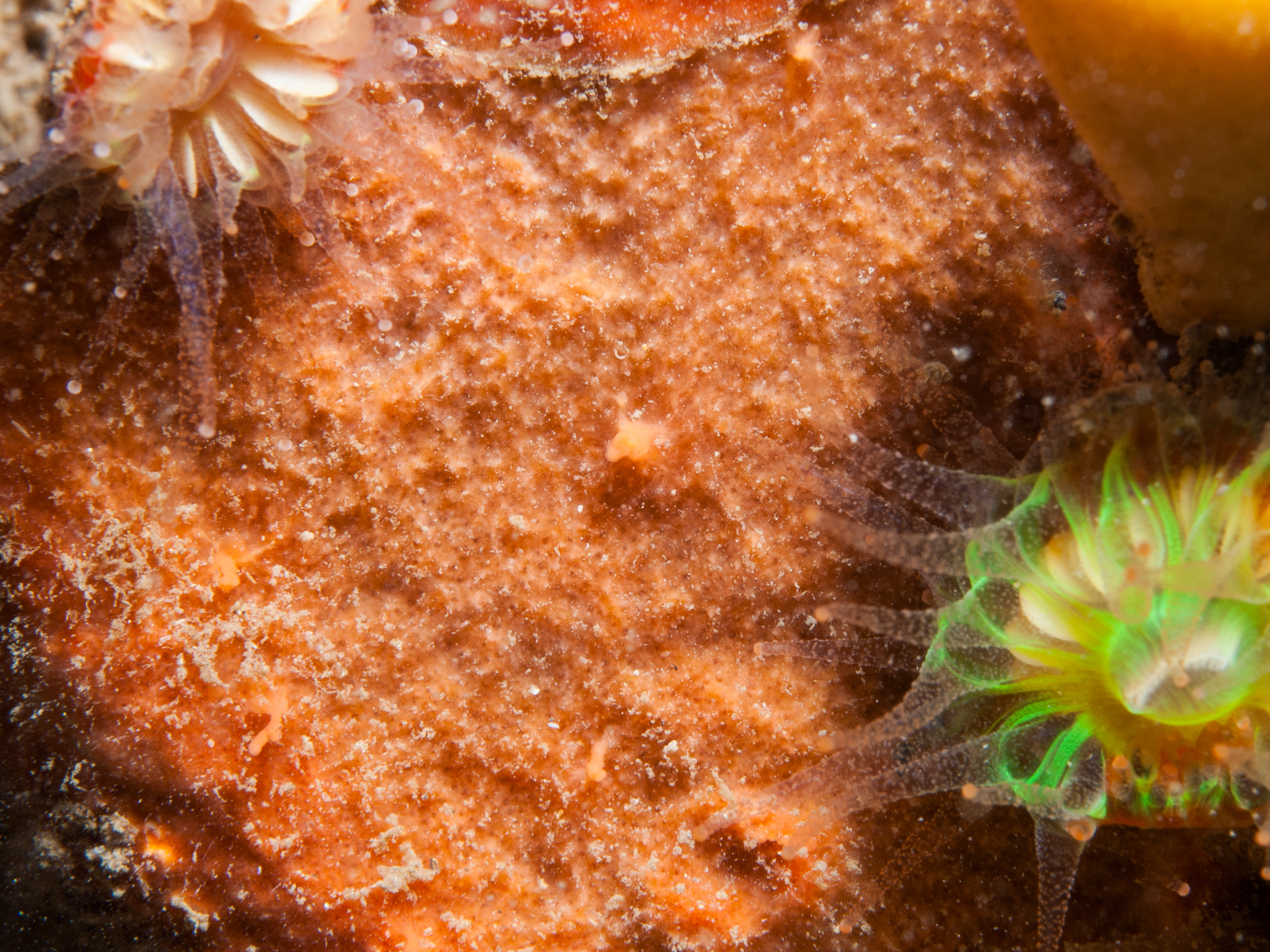
This is a bright red/orange thin encrusting sponge with a hispid appearance. It is mostly found at depths below 30 metres on vertical or overhanging moderatley exposed and tide swept circalittoral bedrock.
In brief
- This species was only relatively recently described in 2007 from Rathlin Island (Picton & Goodwin, 2007).
- So far, it is only reliably known from its type locality (Rathlin Island) and The Maidens (Larne).
- Listed as a Northern Ireland Priority Species on account of its rarity and Northern Ireland being the only known area where this species occurs.
- Main threats are likely to be deterioration of water quality.
Species description: Bright red/orange thin crust with a hispid appearance, caused by the projection of long styles. Silt is often present over sponge surface. Oscules are present at the end of raised papillae, these are fairly evenly spaced over the surface but are less prominent and may not be easily visible when closed.
Life cycle: Nothing is known about the lifecycle of this sponge, however raspailiid sponges predominantly reproduce through an oviparous sexual strategy, releasing eggs and sperm directly into the water column for external fertilization. Like most marine demosponges, they also utilize passive asexual mechanisms to colonize habitats and survive physical damage.
Similar species: Very similar to Hymeraphia stellifera however in H. stellifera the stellate proximal ends of the acanthostyles are neat and aster-like in form, whereas in H. breeni the spines are large, comparatively few in number and may straggle down the length of the shaft (Picton & Goodwin, 2007).
How to see this species: This sponge does is normally found at depths below 25 m on areas on vertical and overhanging bedrock that are subject to strong tidal currents. In Northern Ireland it may be found at the White Cliffs area on the south side of Rathlin Island and near Bruce's Cave on the north east corner of the Island and at the Maidens (Larne).
Current status: Rare. The species is known from only Rathlin Island and The Maidens (Larne) in Northern Ireland, and is always very scarce where it occurs. It has no legal protection. Northern Ireland is a stronghold for this species.
Why is this species a priority in Northern Ireland?
- Criterion 3: Rare or restricted range – rare breeding species confined to 5 hectads or less (based on expert judgement).
- Criterion 4: NI stronghold or endemic – both stronghold range/population and designation as ‘endemic’ subject to expert judgement.
Threats:
- The main threat to this species is degradation of water quality due to increased turbidity, pollution or nutrient enrichment.
- Inorganic silt clogs sponges making them unable to filter feed and such silt is artificially suspended into the water column by bottom-fishing activities.
- Some species of sponge can actively clean their surfaces to some extent and may become competitively able to displace other species if there is a shift in water quality.
- Polluted water may cause sponges to become diseased and may benefit some species at the expense of others by providing more bacteria and less plankton as food.
- Nutrient enrichment may have similar effects by changing the amounts of different types of plankton on which the sponges feed.
Action: Records of new sites for this species, with details of habitat and population are always valuable. Observations with a photograph can be recorded using iNaturalist, find the MBDP-NI iNaturalist project here.
Alternatively, records can be sent to CEDaR, National Museums Northern Ireland, 153 Bangor Road, Cultra, Holywood, County Down, BT18 0EU. Tel 028 9039 5257, e-mail cedar.records@nationalmuseumsni.org, or via the online portal.
Objectives:
- Maintain the number of viable populations of the species.
- Maintain the range of the species.
- Establish appropriate management on appropriate historic sites.
- Encourage sustainable use of the seas by avoiding consumption of fish and shellfish captured by bottom dredging and bottom trawling.
Conservation:
- Rathlin Island is a Marine Protected Area with multiple designations.
- There is Habitat Action Plan for Fragile Sponge and Anthozoan Communities on Rocky Habitats.
- The Maidens are a Marine Protected Area with multiple designations.
Distribution Map from NBN: Hymeraphia breeni at National Biodiversity Network mapping facility, data for UK.
iNaturalist: Hymeraphia breeni at iNaturalist World Species Observations database.
WoRMS: Hymeraphia breeni at World Register of Marine Species. Accepted name: Hymeraphia breeni Picton & Goodwin, 2007. AphiaID: 255167.
Literature:
Picton, B.E. and Goodwin, C.E. (2007). Sponges of Rathlin Island. Journal of the Marine Biological Association of the United Kingdom 87(6): 1441-1458.
Classification: Biota; Animalia; Porifera; Demospongiae; Heteroscleromorpha; Axinellida; Raspailiidae; Raspailiinae; Hymeraphia
| Previous species | Next species |
| Picton, B.E., Keatley, L. & Morrow, C.C. (2026). Hymeraphia breeni. Picton & Goodwin, 2007. [In] Priority species, Marine Biodiversity Portal NI. https://www2.habitas.org.uk/marbiop-ni/priorityaccounts.php?item=C4655. Accessed on 2026-09-13 |