
Northern Ireland Priority species (NIPS)
| PORIFERA : Axinellida : Axinellidae | SPONGES |
Axinella damicornis (Esper, 1794)
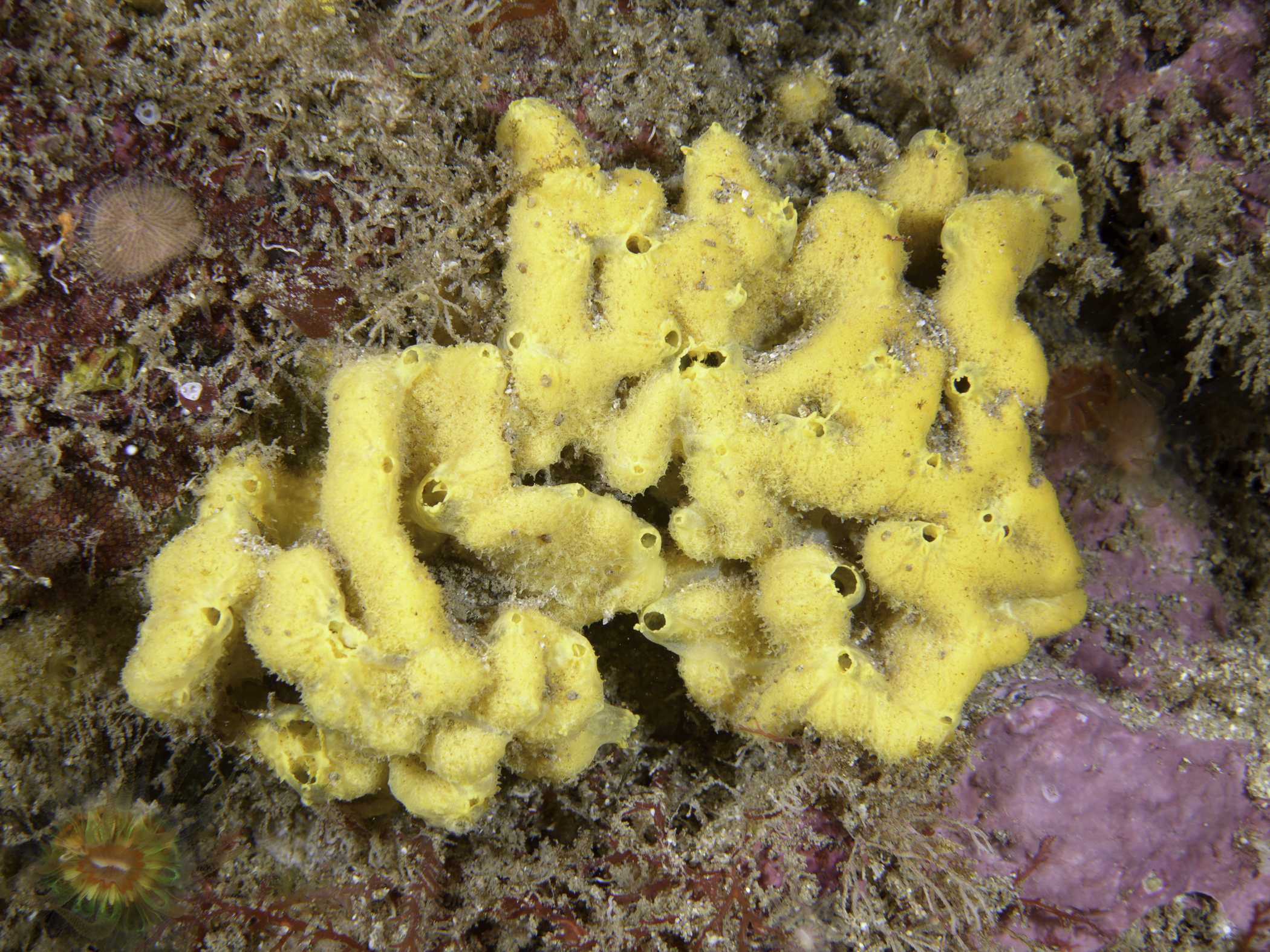 |
| Axinella damicornis |
A small (up to 10 cm tall, but more typically 5 cm) branching-erect sponge with a short stalk. The branches are compressed and 'webbed' together. The colour is bright to deep yellow. In Northern Ireland this species is has been recorded from Rathlin Island; Skerries (Portrush); Causeway coast and The Maidens (Larne). It is usually very scarce apart from one area at the White Cliffs on Rathlin Island which is often referred to as 'Damicornis Bay'. It occurs on sloping, lower circalittoral bedrock and stable boulders in areas exposed or semi-exposed to wave action and tidal streams. Several studies using molecular data have shown that this species is not an axinellid and recommended its transfer to Hymerhabdia: Agelasida (Morrow et al., 2012; Morrow & Cardenas, 2015).
In brief
- Found at Rathlin Island, Skerries (Portrush), Causeway coast and the Maidens (Larne).
- occurs on sloping, lower circalittoral bedrock and stable boulders in areas exposed or semi-exposed to wave action and tidal streams. Listed as Northern Ireland Priority Species (NIPS) due to its scarcity and restricted range and Rathlin Island being a stronghold for this species.
Species description: A small (up to 10 cm tall, but more typically 5 cm) branching-erect sponge with a short stalk. The branches are compressed and 'webbed' together. The colour is bright to deep yellow, verging sometimes towards deep orange at the margins. It is distinctively 'bright'. The surface has a characteristic 'mealy' appearance, as though dusted with small yellow particles. Small oscules are borne on the apices of the branches. When alive, the open oscules are partially surrounded by a small triangular 'flap' of tissue.
Life cycle: Axinella damicornis is an oviparous sponge releasing eggs and sperm directly into the water column. In the Mediterranean it has a prolonged reproductive period, releasing eggs over 7–8 month period in Autumn to Spring (Riesgo & Maldonado, 2009). Its reproduction in British or Irish waters has not been studied.
Similar species: The overall form is similar to Stelligera montagui but the mealy appearance of the surface and bright yellow colour are characteristic. Most readily confused with Axinella verrucosa, so far only recorded as far north as Roscoff and the Channel Islands.
How to see this species: This sponge is normally found at depths between 25–40 m on circalittoral bedrock and stable boulders that are subject to moderate wave exposure and tidal streams. In Northern Ireland it may be found at scattered sites around Rathlin Island but it is particularly frequent at a site off the White Cliffs, commonly referred to 'Damicornis Bay'. There are also records of it from Skerries (Portrush), Causeway coast and the Maidens.
Current status: The species is known from only four locations in Northern Ireland, and is regarded as rare throughout Britain and Ireland. It has no legal protection. Northern Ireland is a Stronghold for this species.
Why is this species a priority in Northern Ireland?
- Criterion 3: Rare or restricted range – rare breeding species confined to 5 hectads or less (based on expert judgement).
- Criterion 4: NI stronghold or endemic – both stronghold range/population and designation as ‘endemic’ subject to expert judgement.
Threats: This erect sponge is vulnerable to bottom fishing and potting activities. It is especially vulnerable due to its dependence on a very small number of sites in Northern Ireland.
Action: Records of new sites for this species, with details of habitat and population are always valuable. Observations with a photograph can be recorded using iNaturalist, find the MBDP-NI iNaturalist project here.
Alternatively, records can be sent to CEDaR, National Museums Northern Ireland, 153 Bangor Road, Cultra, Holywood, County Down, BT18 0EU. Tel 028 9039 5257, e-mail cedar.records@nationalmuseumsni.org, or via the online portal.
Objectives:
- Maintain the number of viable populations of this species.
- Maintain the range of this species.
- Monitor the populations (or a sample of them) from key sites.
Conservation:
- Rathlin Island is a Marine Protected Area with multiple designations, and has a ban on bottom fishing.
- The Maidens are a Marine Protected Area with multiple designations.
- There is a Habitat Action Plan for Fragile Sponge and Anthozoan Communities on Rocky Habitats.
Distribution Map from NBN: Axinella damicornis at National Biodiversity Network mapping facility, data for UK.
iNaturalist: Axinella damicornis at iNaturalist World Species Observations database.
WoRMS: Axinella damicornis at World Register of Marine Species. Accepted name: Axinella damicornis (Esper, 1794). AphiaID: 132472.
Literature:
Morrow, C.; Picton, B.; Erpenbeck, D.; Boury-Esnault, N.; Maggs, C.; Allcock, A. (2012). Congruence between nuclear and mitochondrial genes in Demospongiae: A new hypothesis for relationships within the G4 clade (Porifera: Demospongiae). Molecular Phylogenetics and Evolution. 62(1): 174-190.
Morrow, C.; Cárdenas, P. (2015). Proposal for a revised classification of the Demospongiae (Porifera). Frontiers in Zoology. 12: 7.
Riesgo, A.; Maldonado, M. (2009). Ultrastructure of oogenesis of two oviparous demosponges: Axinella damicornis and Raspaciona aculeata (Porifera). Tissue and Cell. 41(1): 51-65.
Classification: Biota; Animalia; Porifera; Demospongiae; Heteroscleromorpha; Axinellida; Axinellidae; Axinella
| Previous species | Next species |
| Picton, B.E., Keatley, L. & Morrow, C.C. (2026). Axinella damicornis. (Esper, 1794). [In] Priority species, Marine Biodiversity Portal NI. https://www2.habitas.org.uk/marbiop-ni/priorityaccounts.php?item=C3510. Accessed on 2026-09-13 |