Voles
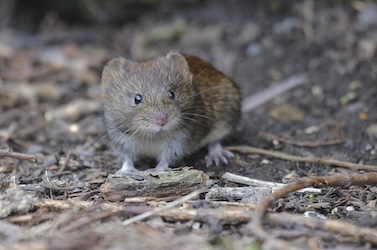
Ireland’s ecosystem just got a bit more diverse, but unfortunately not necessarily for the better. Two vole species are now found in NI: the bank vole (Myodes glareolus) and the field vole (Microtus agrestis - also known as the short-tailed vole). While both species are present throughout England, Scotland and Wales, they are not native in Northern Ireland, and their effects on our ecosystem are yet to be completely understood.
After being originally brought into County Limerick during the construction of the Shannon Hydroelectric Scheme in the late 1920s, the bank vole has continuously spread across Ireland and has now found its way to Crumlin, County Down, Northern Ireland. The field vole is a much more recent arrival, with its origin still unknown, but was first sighted in north Antrim in 2011 and has also been found throughout the Belfast Hills and south Belfast around the Giant's Ring.
While we are still determining the extent of effects these invasive small mammals have, they are likely negative. Bank voles have caused the loss of the native wood mouse across much of the Republic of Ireland and have triggered declines in invertebrate biodiversity. The field vole’s impacts are yet to be studied, but they are known to ring bark young saplings which harms tree health. This behaviour may affect our agriculture sector, especially orchards.
Queen’s University Belfast and Ulster Wildlife are gathering more information and welcome sightings of both species.


Verifying Voles from rodent relatives
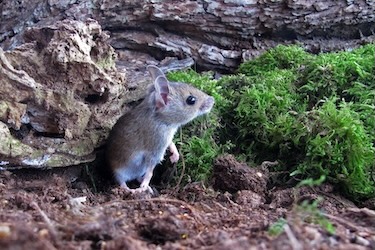
While at first glance, a vole may look incredibly similar to our native wood mouse, there are a few key differences that help to distinguish them:
Wood mice tend to have tails as long as their body whereas vole species have much shorter tails
Vole snouts are much more rounded compared to the wood mouse which has a more pointed snout
Wood mice have much more protrusive and larger ears than voles
Wood mice have much larger eyes than voles
Differentiating voles
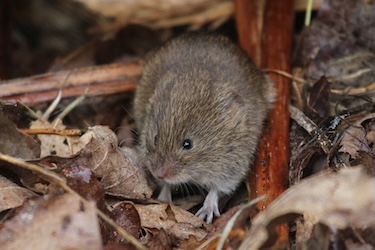
While both of our new vole species look incredibly similar, especially when compared to the wood mouse, there are a few key differences you can take to tell which vole you’re looking at:
The field vole has a shorter tail than the bank vole. The field vole’s tail is about 30% of its total body length as opposed to the bank vole which has a tail 50% its body length
Field voles tend to have a shaggier greyer coat, whereas bank voles are browner with a smoother coat
Field vole ears are less visible