
| PORIFERA : Homosclerophorida : Oscarellidae | SPONGES |
Oscarella sp.
 |
| Oscarella sp. |
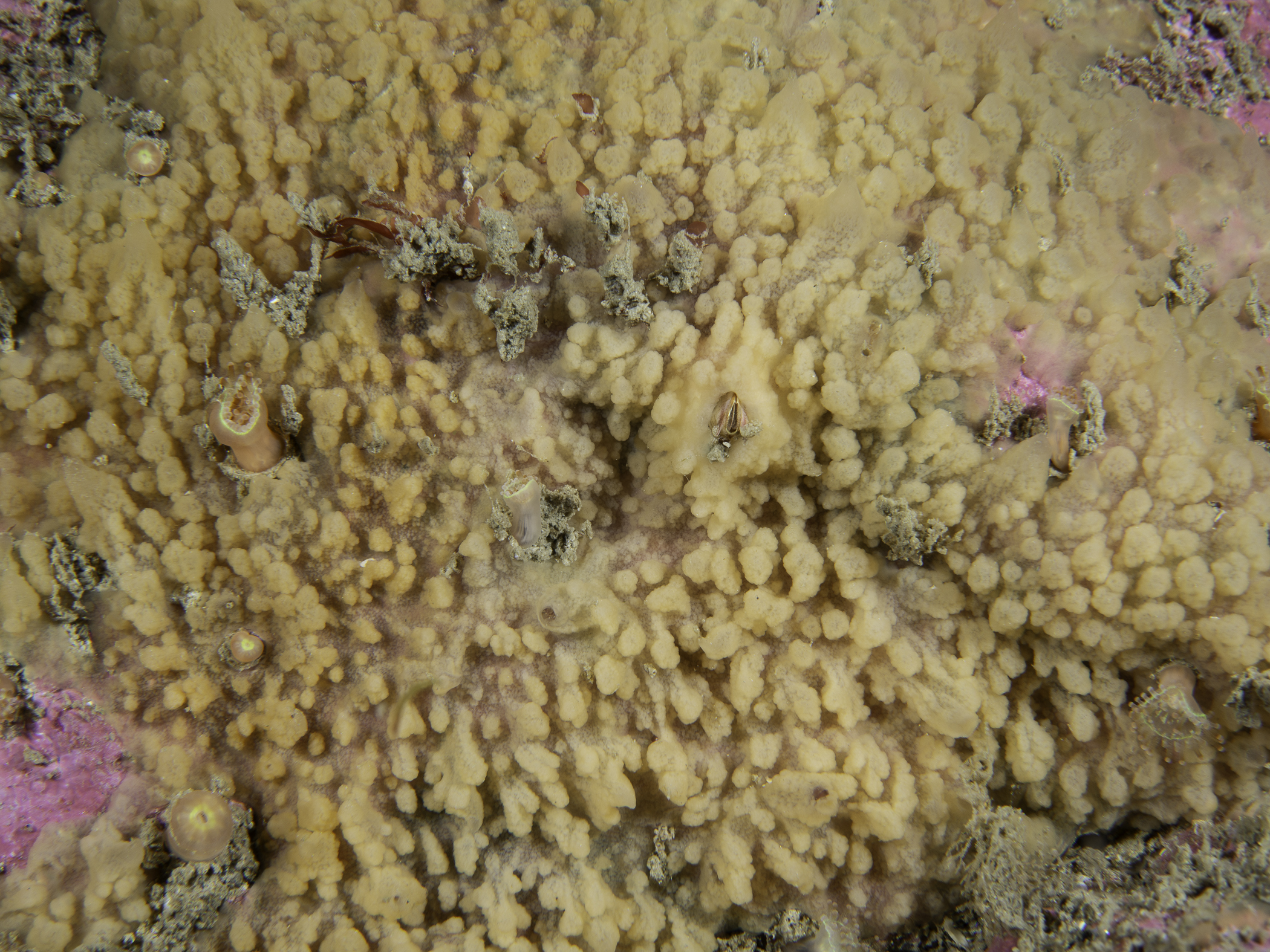
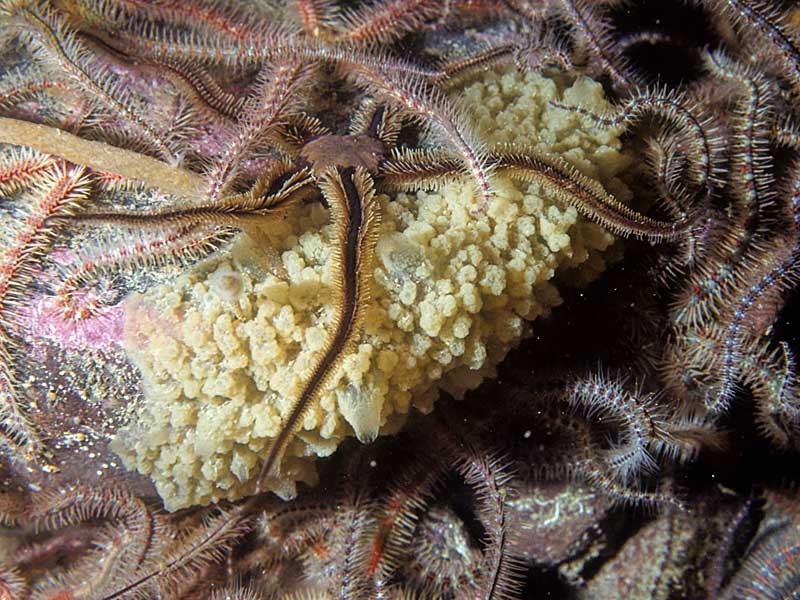
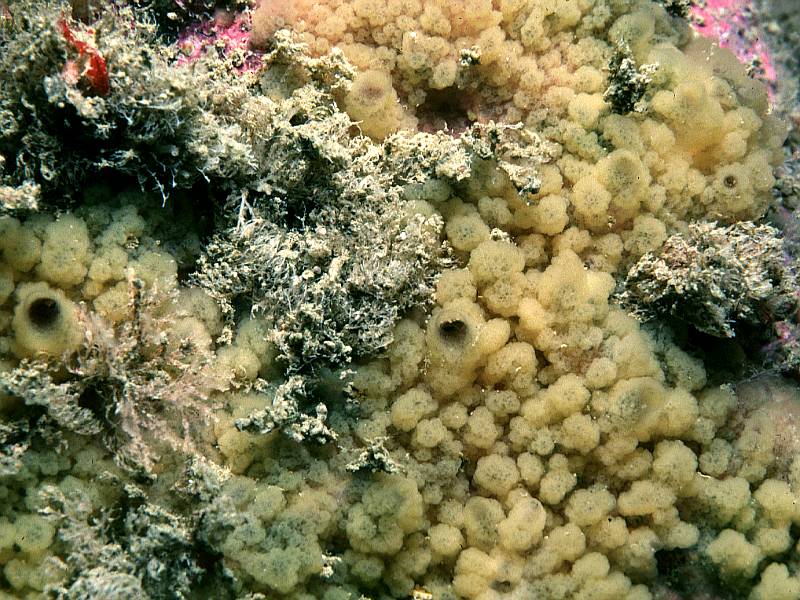
Form: A thin 'bubbly' sheet over boulders or rock faces. Small patches 4cm across to large patches 30cm or more across.
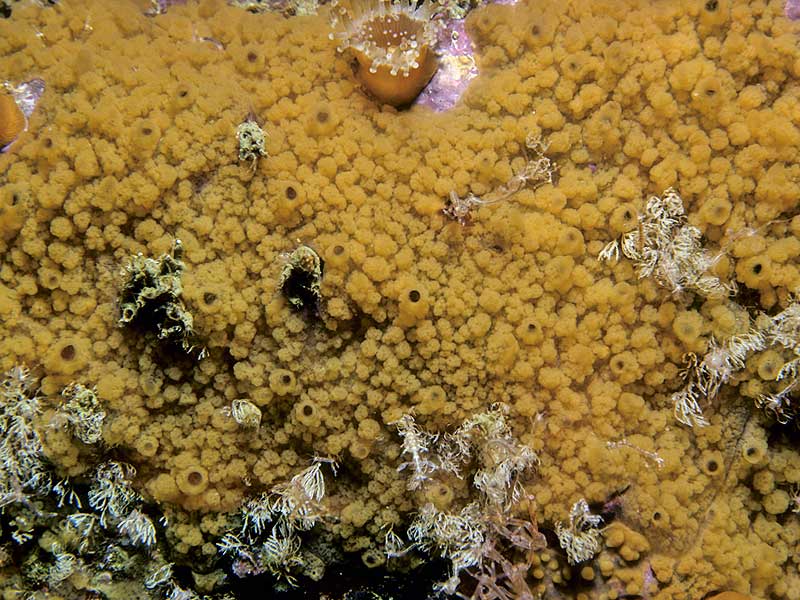
Colour: Pale yellow, orange, sometimes with red pigment on surfaces exposed to light or in shallow water. Colour varieties including red, brown, green, blue and violet have been reported from the Mediterranean, but recent work by Muricy et al. (1996) has shown that some of this variation is due to the presence of several distinct species.
Smell: None.
Consistency: Very soft and fragile, "gelatinous".
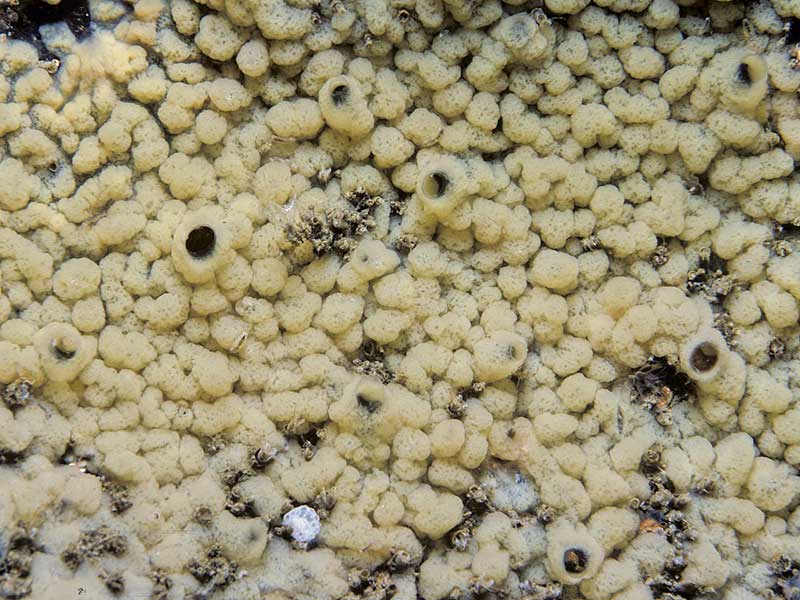
Surface: Covered with bubble-like projections - lobulate. These lobules measure 0.5 - 1cm in diameter. Translucent when alive. 'Slippery'.
Apertures:
- Widely scattered large oscules with a delicate chimney-like structure, which collapses and is lost in preservation.
Contraction:
- When collected it becomes a thin opaque sheet and loses its lobulate appearance.
 |
 |
 |
 |
[ More images ] |
Synonyms: Halisarca lobularis Schmidt, 1862:80.
Internal characters
Skeleton: None. Without spicules, spongin fibres or foreign inclusions which might strengthen the soft matrix. Large cavities and lacunae permeate the body.
Spicules: None.
Habitat: "Littoral to 300m+". Covering tops of boulders in sheltered areas of moderate current, e.g. Strangford Lough. On vertical rock faces in Lough Hyne; and on chalk and clay cliff faces of moderate current in Sussex. Sometimes found in sheltered conditions with little current or wave action, e.g. Summer Isles. Found abundantly on fully exposed bare rockfaces at St. Kilda, overgrowing Lithothamnion.
Distribution: A common species in the British Isles. "Arctic; Belgium; France; Mediterranean", Azores. In the U.K. known recently from Strangford Lough; Lough Hyne; Summer Isles; Sussex; Dorset, St Kilda, W. Scotland.
Identity: The lobulate surface together with delicate oscular chimneys, combined with a delicate texture and lack of skeleton, is diagnostic underwater. The only other common British sponge which lacks a mineral or spongin skeleton is Halisarca dujardini (q.v.), which can be distinguished with a microscope from Oscarella by its large and elongate choanocyte chambers, with the flagella sometimes visible. However differences in external appearance (presence of a cuticle and lack of lobules, giving a smooth, rather slimy, toffee-like appearance) probably are great enough to make confusion unlikely. A species of Hexadella has recently been found near Rathlin Island, N. Ireland. It differs from Oscarella in having a surface with radiating fibre-like lines and also has no spicules.
Distribution Map from NBN: Oscarella sp. at National Biodiversity Network mapping facility, data for UK.
iNaturalist: Oscarella sp. at iNaturalist World Species Observations database.
WoRMS: Oscarella sp. at World Register of Marine Species. Accepted name: Oscarella Vosmaer, 1884. AphiaID: 131979.
Classification: Biota; Animalia; Porifera; Homoscleromorpha; Homosclerophorida; Oscarellidae; Oscarella
Voucher: BELUM : Mc324. Strangford Lough, Down.
Editors: D. Moss, B.E. Picton.
| Previous species | Next species |
| Picton, B.E. & Morrow, C.C. (2023). Oscarella sp.. . [In] Sponges of Britain and Ireland. https://www2.habitas.org.uk/marbiop-ni/sponges.php?item=C950. Accessed on 2026-06-13 |