
| PORIFERA : Chondrillida : Chondrillidae | SPONGES |
Thymosia guernei Topsent, 1895
 |
| Thymosia guernei |
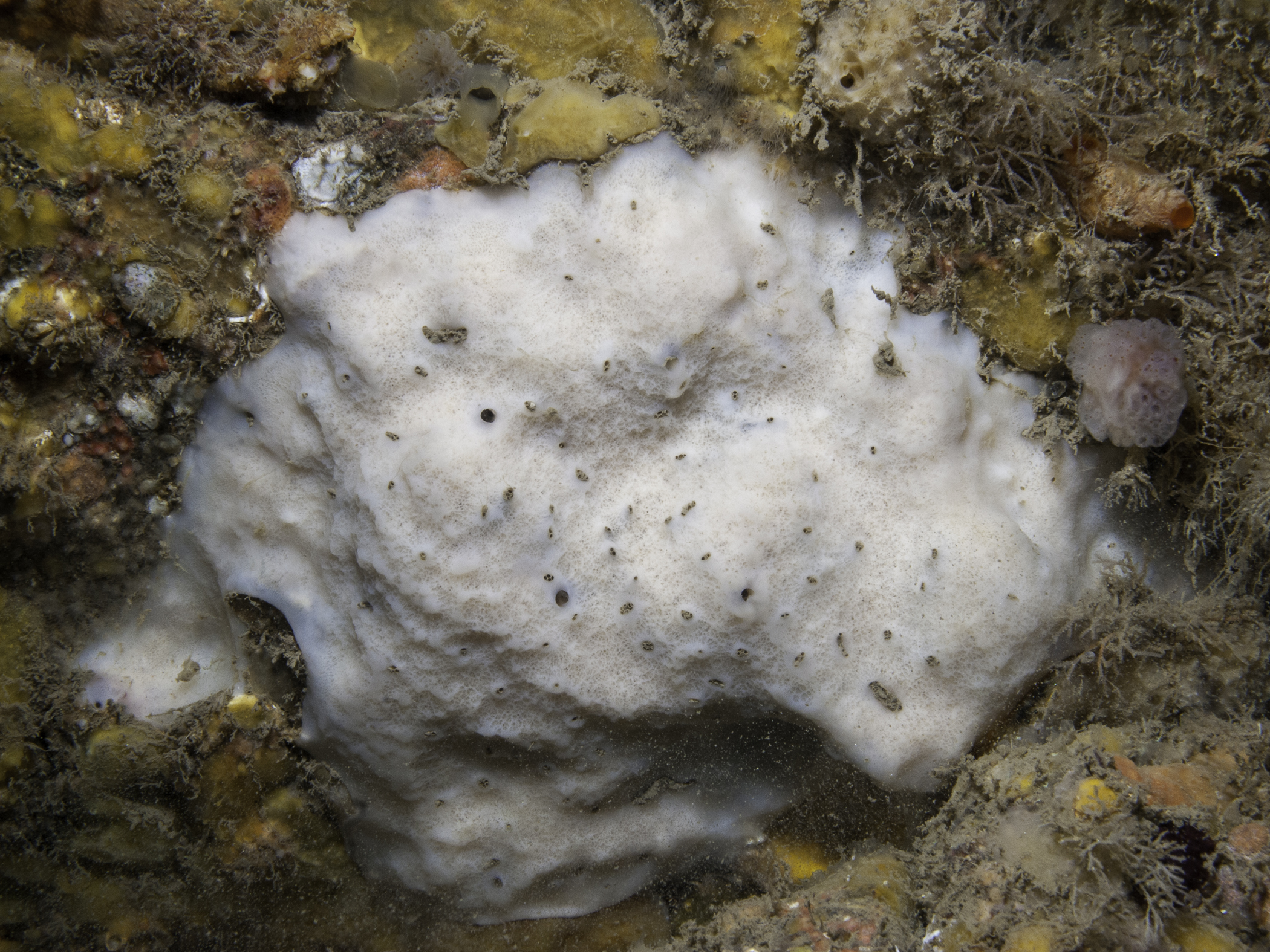
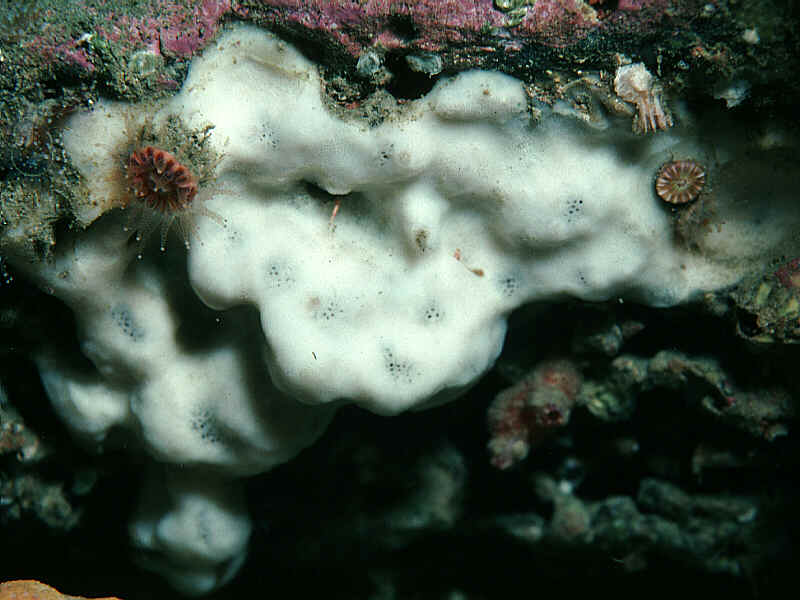
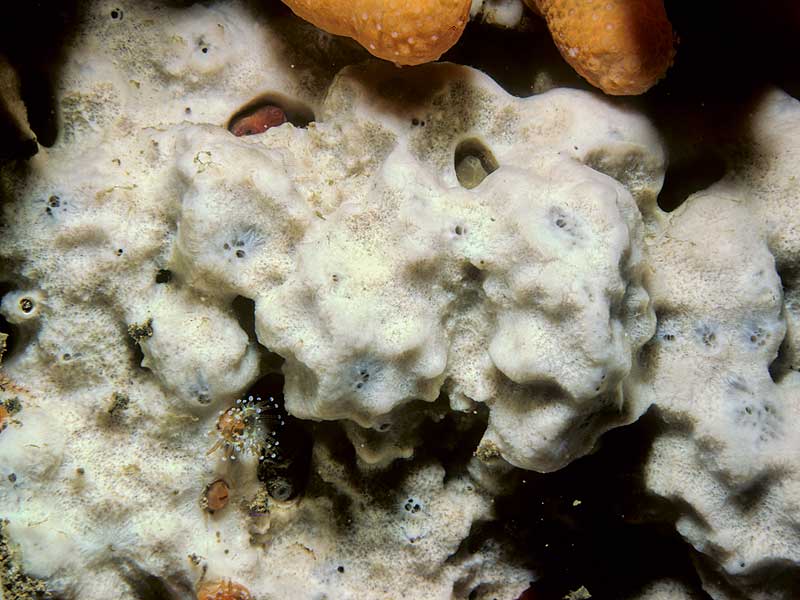
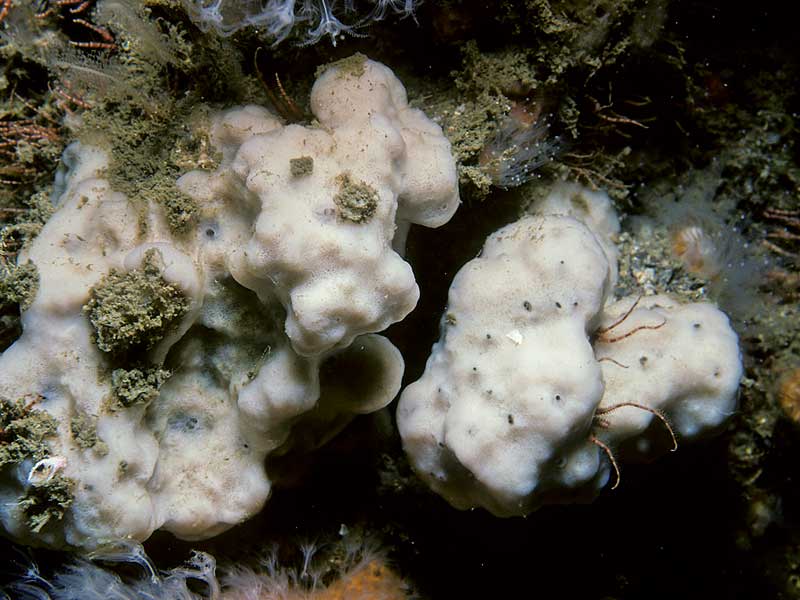
Form: Thin sheets to low, spreading, massive-lobose forms (forming patches up to 60cm across). Firmly attached by a broad encrusting base. Overall appearance like cold mashed potato.
Colour: Off-white surface, pale grey-orange interior.
Smell: Slight. Slime : A thin covering, which only becomes apparent when silt falls out of suspension onto the surface of the sponge, where it becomes trapped and forms mucous 'threadlets', which are then caught in the passing current and removed. It is very sli
Consistency: A solid, rubbery texture.
Surface: Clean, smooth and undulating. Sometimes raised up into angular projections where other sedentary organisms have become engulfed (e.g. hydroids, barnacles, etc.). Often, double openings of the mud-lined burrows of the polychaete worm Polydora are seen at the surface.
Apertures:
- A few, small oscules (1-2mm openings) are scattered singly along the tops of ridges and lobes; these are often occupied by crustaceans and brittle stars. Countless microscopic pores cover the surface except in the vicinity of the oscules. In mature sponges these pores are concentrated at the base of the deep hollows formed by the steep-sided lobes. They are difficult to see with the naked eye on the living animal, especially when the 'skin' is tightly stretched. They are more easily seen as puckered wrinkles in the hollows, when the surface is relaxed on preservation.
Contraction:
- Not noticeable.
 |
 |
 |
| [ More images ] |
Internal characters
Skeleton: There is no mineral skeleton. Instead it has a thick cortex which is plentifully reinforced by fibrillar collagen which serves to strengthen the otherwise soft matrix. Spongin fibres, with unusual kidney-shaped swellings, further strengthen the matrix, by running vertically through the body to the surface. These branch and anastomose at intervals and are very distinctive in sections.
Spicules: None.
Habitat: This sponge favours flowing water conditions in habitats which are semi-exposed to waves and current. It is usually found on fissured, vertical rock (gullies and cliff faces), set back in recesses, or under overhangs or inside caves. It is only occasionally found out on open rock faces, which are exposed to the full force of the moving water. Very occasionally it is found on horizontal surfaces. Littoral to ca. 30m (optimum depth range between 15 and 25m ?).
Distribution: Considered to be rare. Recently found off a number of islands off SW Britain and western Ireland: Aran Islands, Co. Galway; Clare Island Co. Mayo; Skokholm; Lundy. Also occasionally off the mainland: N. Pembrokeshire (off Abereiddy): St. Johns Point, Co. Donegal; France (Concarneau); Portugal (Algarve).
Identity: The irregular surface, tiny oscules and white colour in a massive sponge are quite distinctive. The identity is easily confirmed by the lack of spicules and distinctive skeletal fibres.
Distribution Map from NBN: Thymosia guernei at National Biodiversity Network mapping facility, data for UK.
iNaturalist: Thymosia guernei at iNaturalist World Species Observations database.
WoRMS: Thymosia guernei at World Register of Marine Species. Accepted name: Thymosia guernei Topsent, 1895. AphiaID: 134113.
Classification: Biota; Animalia; Porifera; Demospongiae; Verongimorpha; Chondrillida; Chondrillidae; Thymosia
Voucher: BELUM : Mc737. St. John's Pt, Donegal.
Editors: D. Moss, B.E. Picton.
| Previous species | Next species |
| Picton, B.E. & Morrow, C.C. (2023). Thymosia guernei. Topsent, 1895. [In] Sponges of Britain and Ireland. https://www2.habitas.org.uk/marbiop-ni/sponges.php?item=C2070. Accessed on 2026-06-11 |