
| PORIFERA : Leucosolenida : Syconidae | SPONGES |
Sycon ciliatum (Fabricius, 1780)
 |
| Sycon ciliatum |
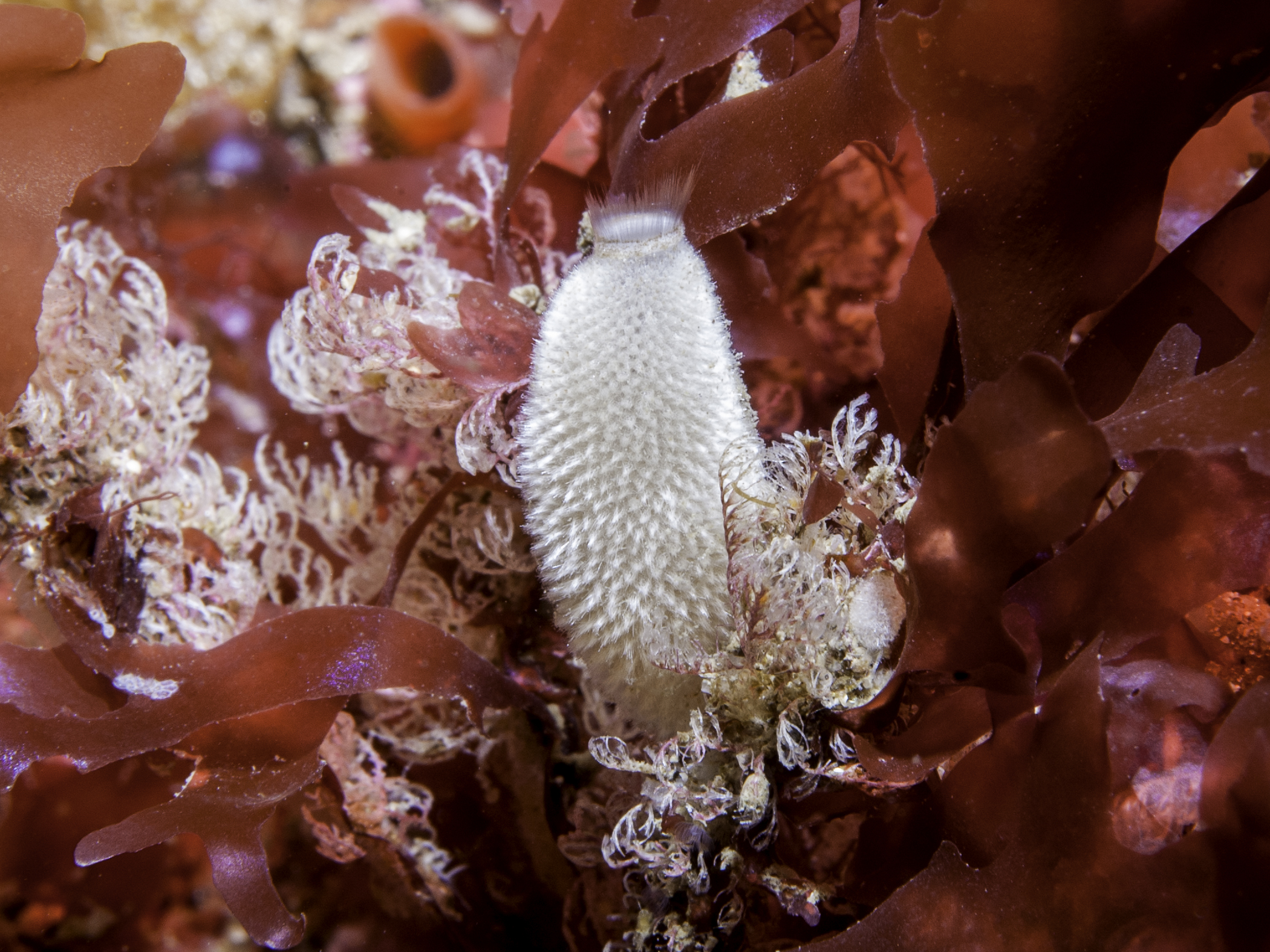
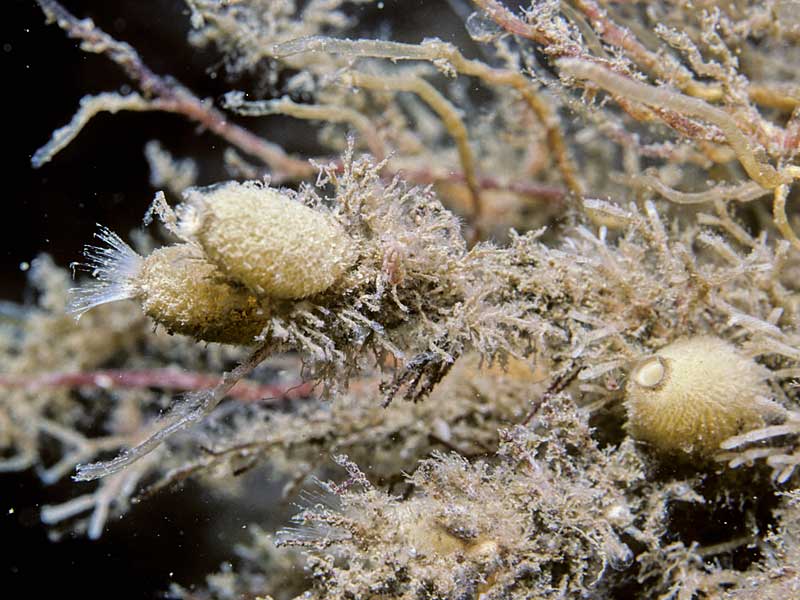
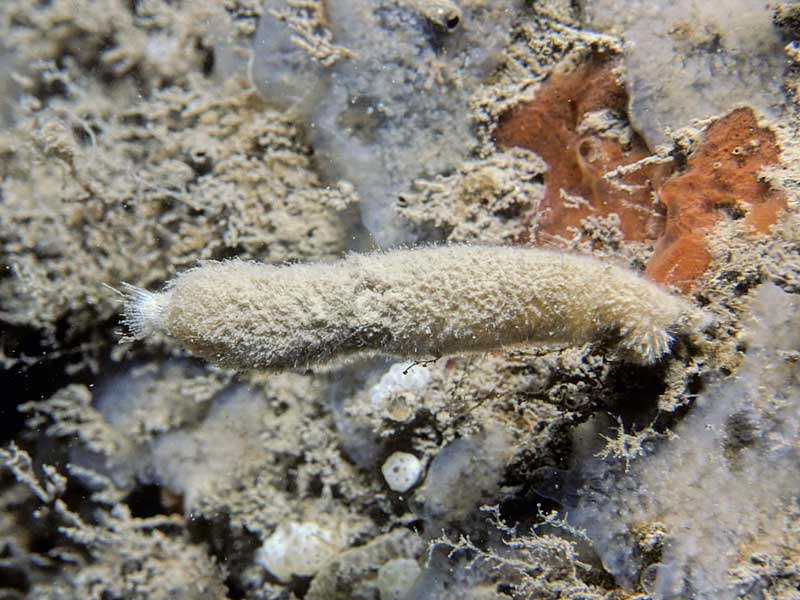
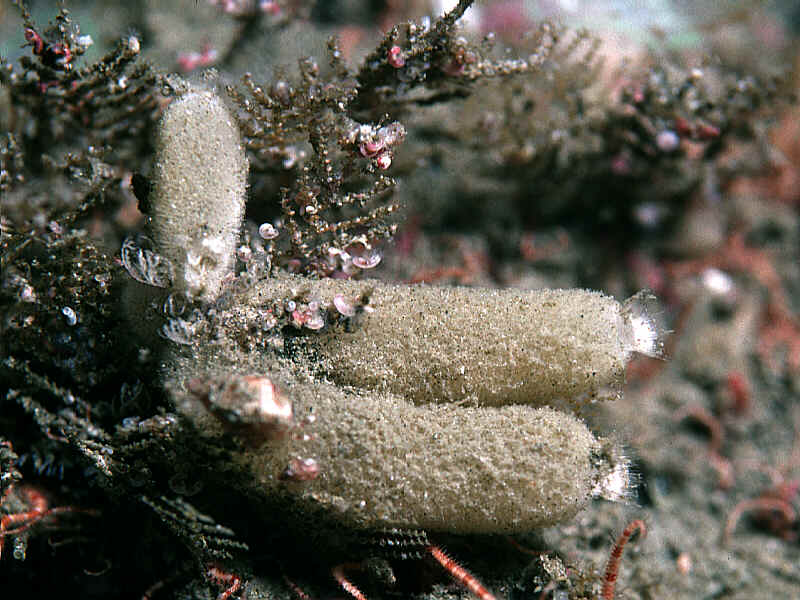
Form: Tubular, usually single, but clusters of separate individuals often occur together, up to 9cm long (though usually 1 - 3 cm).
Colour: Off white, grey or brown.
Smell: None
Consistency: Moderately soft, though can be firmer.
Surface: Usually finely papillate and hairy, though occasionally smooth. If smooth it may be impossible to separate from Grantia compressa (q.v.).
Apertures:
- There is a single terminal oscule, which is normally fringed with a crown of spicules.
Contraction:
- Not noticeable.
 |
 |
 |
| [ More images ] |
Synonyms: In Burton (1963) this is one of a number of 'Named Forms' grouped under Scypha ciliata. As with Burton's other groupings of forms in the Calcarea it may turn out to consist of a number of distinct species.
Internal characters
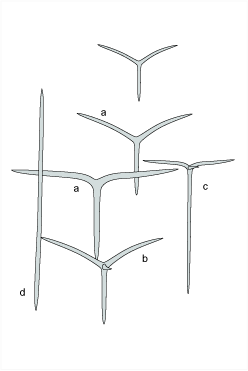 |
Skeleton: The ectosomal skeleton is a tangential layer of small triradiates with long straight oxea projecting beyond the surface. The skeleton of the chamber layer consists of regularly overlapping quadriradiates. There is an endosomal skeleton of larger triradiates. A crown of oxea surrounds the terminal osculum.
Spicules: Triradiates (a) are of several size classes, with larger ones in the endosomal layer. Quadriradiates of the chamber layer, are of two types, (b) with apical rays pointing into the ectosome, and (c) with short curved apical rays projecting into the central atrium. Oxea (d), are long and thin, straight, and tapering gradually to pointed extremities.
Habitat: Mainly on the shore, under overhangs near low water. Common in shallow sublittoral, present in deeper water.
Distribution: Arctic to Gibraltar.
Identity: Identifications by eye are usually correct, though beware of the species listed below. Outer surface must be finely papillate (use x10 hand lens). In this species the papillae are the free ends of the water pumping (flagellate) chambers. The species described below may be confused with Scypha ciliata (see also Burton, 1963:359-442). Grantia compressa (q.v.). : Scypha ciliata (normally finely papillate) may have a smooth surface and G. compressa (normally flat) may be cylindrical. There seems to be an overlap in external appearance between these two species. Both are common on most shores, in the same sort of habitats. Leuconia johnstoni (q.v). : This species has tubular chimney-like lobes but these are joined by a common base, and there are short rims to the terminal oscules.
Distribution Map from NBN: Sycon ciliatum at National Biodiversity Network mapping facility, data for UK.
iNaturalist: Sycon ciliatum at iNaturalist World Species Observations database.
WoRMS: Sycon ciliatum at World Register of Marine Species. Accepted name: Sycon ciliatum (Fabricius, 1780). AphiaID: 132251.
Classification: Biota; Animalia; Porifera; Calcarea; Calcaronea; Leucosolenida; Syconidae; Sycon
Voucher: BELUM : Mc7. Strangford Lough, Down.
Editors: J.D. Guiterman. D. Moss, B.E. Picton.
| Previous species | Next species |
| Picton, B.E. & Morrow, C.C. (2023). Sycon ciliatum. (Fabricius, 1780). [In] Sponges of Britain and Ireland. https://www2.habitas.org.uk/marbiop-ni/sponges.php?item=C350. Accessed on 2026-06-13 |