
| PORIFERA : Leucosolenida : Leucosoleniidae | SPONGES |
Leucosolenia variabilis Haeckel, 1870
 |
| Leucosolenia variabilis |
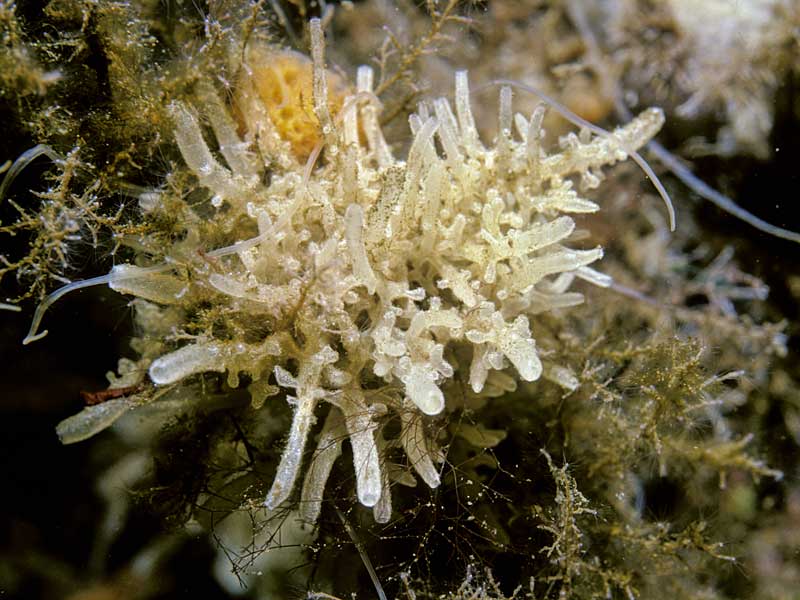
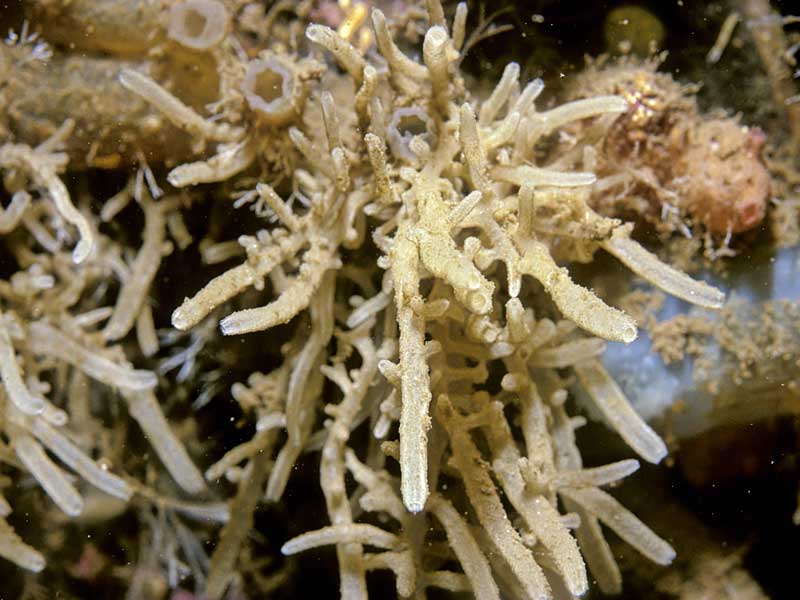
Form: This sponge consists of a basal reticulation of thin-walled tubes which creep and anastomose over the substrate, from which arise numerous very (up to 2cm) long, free-standing, closely-set, oscular tubes showing "little or no tendency to throw out lateral diverticula except near their base". "It occurs as a spreading form and as a straggly bushy form" (never as an arborescent form (?).
Colour: "White, yellow or grey when alive."
Smell: None.
Consistency: Very delicate and soft, but perhaps not as fragile as L. complicata which easily breaks when handled (?).
Surface: That of the tubes is soft and smooth; "minutely hispid".
Apertures:
- Oscules are terminal on erect tubes. "The oscular rims are long" [longer than in L. complicata]. "Oscular tubes show no tendency to anastomose." (?)
Contraction:
- The tubes cling together by surface tension when out of the water. Otherwise no noticeable contraction takes place.
 |
[ More images ] |
Synonyms: None in common use. Treated by Burton (1963:173) as being one of several 'Named Forms' comprising Leucosolenia botryoides (Ellis and Solander, 1786:190), the name which he regarded as valid for the whole complex.
Internal characters
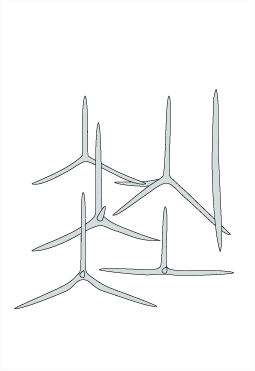 |
Skeleton: The skeleton of the chamber layer is of triradiates. The endosomal skeleton is of quadriradiates, which also line the atrial cavity. Oxea are present.
Spicules: Triradiates (a) have rays 80-100 μm long x 7-8 μm thick; the basal ray generally is shorter, 65-83 μm long x 6-7 μm thick. Peculiarly modified triradiates termed "brackets" by Minchin regularly occur which have the short basal ray curved out of the facial plane in which the paired rays lie (same sizes). Quadriradiates (b) with rays of similar size to the triradiates and with apical ray ca. 80 μm long. Oxea (c) are of 2 sizes; the larger have lanceolate distal ends with more or less straight shafts, 80-320 x 2-9 μm thick; the smaller are less abundant with distinct lanceolate endings, 70-110 μm long x 2-3 μm thick. Occasionally, large, bayonet-like, oxea can occur with a sharp bend in the middle, up to 200 μm long x 7-10 μm thick.
Habitat: This sponge tends to grow in the shallow sublittoral, where it is characteristic of mixed sediments, growing upright (?) in small patches on shells and ascidians, and on horizontal rock; often found in sea lochs. It has been recorded as "often half buried in mud and sediment"- which induces longer oscular tubes (?). On the shore it may be found in situations where it is "left dry at all tides" (?).
Distribution: "Arctic; Atlantic coasts of Europe; Mediterranean; etc."
Identity: Superficially it can be confused with several other branched species of Leucosolenia (see note under L. complicata).
Distribution Map from NBN: Leucosolenia variabilis at National Biodiversity Network mapping facility, data for UK.
iNaturalist: Leucosolenia variabilis at iNaturalist World Species Observations database.
WoRMS: Leucosolenia variabilis at World Register of Marine Species. Accepted name: Leucosolenia variabilis Haeckel, 1870. AphiaID: 132233.
Classification: Biota; Animalia; Porifera; Calcarea; Calcaronea; Leucosolenida; Leucosoleniidae; Leucosolenia
Voucher: BELUM : Mc3. Arranmore, Donegal.
Editors: D. Moss, B.E. Picton.
| Previous species | Next species |
| Picton, B.E. & Morrow, C.C. (2023). Leucosolenia variabilis. Haeckel, 1870. [In] Sponges of Britain and Ireland. https://www2.habitas.org.uk/marbiop-ni/sponges.php?item=C270. Accessed on 2026-06-13 |