
Northern Ireland Priority species (NIPS)
| MAMMALIA : Cetartiodactyla : Delphinidae | MAMMALS |
Tursiops truncatus (Montagu, 1821)
Bottlenose dolphin
 |
| Tursiops truncatus |
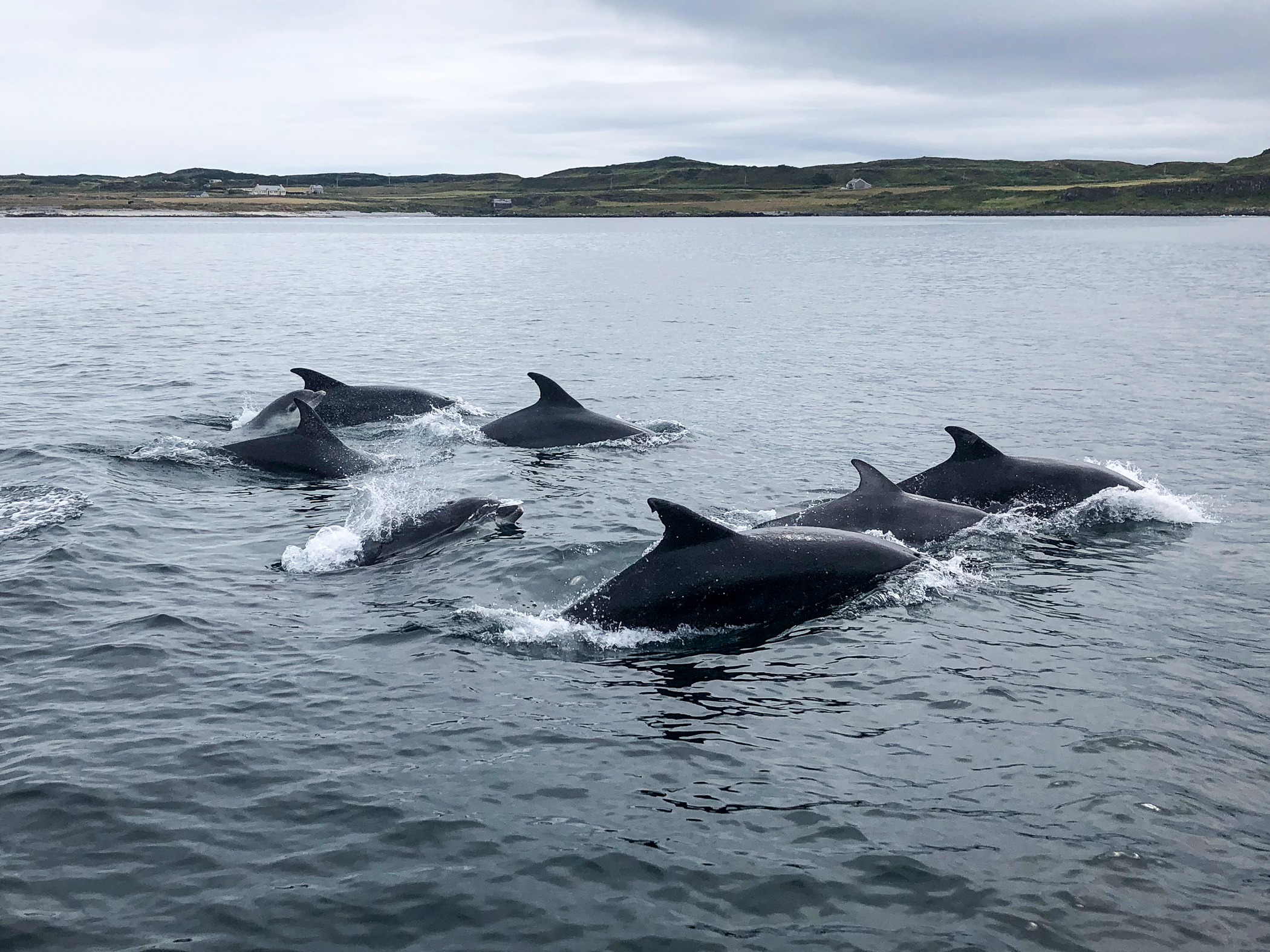
Bottlenose dolphins are found in temperate and tropical waters throughout the world. They are regularly seen in the coastal waters of Northern Ireland, usually in groups or pods of 5-30 individuals. Famous for their friendly disposition towards people, bottlenose dolphins often approach boats to bow-ride.
In brief
- Found in the seas around Northern Ireland.
- Can be seen all year round.
- Currently two male dolphins seem to be resident in Strangford Lough.
- Main threats to the population are accidental capture and drowning in commercial fishing equipment (by-catch) and pollution.
Species description: Adult bottlenose dolphins are 2.5-4 m long. Their sturdy, streamlined bodies are dark to light grey on the back and sides, fading to pale grey or white on the lower jaw, throat and belly. The beak is short but noticeable with a lower jaw that sticks out slightly more than the upper jaw. There are between 18 and 26 pairs of pointed, cone-shaped teeth present in the upper and lower jaw. The mouth line curves upward at the back, giving the animal a smiling appearance. The tall, sickle-shaped dorsal fin is located midway along the back.
Life cycle: Bottle-nose dolphins eat 8-15kg of food daily: mainly fish but squid, shrimps and crabs are also taken. Groups of dolphins will often cooperate when hunting and catching schools of fish. Bottle-nose dolphins produce a number of different sounds to communicate with each other; every individual has its own unique identifying whistle. They also use echolocation to determine the shape, size, speed, distance and structure of objects in their surroundings. High frequency sound waves are projected as clicks - when they hit an object, they bounce back to the dolphin who can interpret the returning echo. Mating takes place after a short courtship. Pregnancy lasts for 12 months and a single calf (around 1m long) is born in the summer. Dolphins can live for 25-30 years.
Similar species: Bottlenose dolphins may be confused with Risso’s dolphin. Both species are grey, however Risso’s dolphin is usually heavily scarred and has a rounded head with no beak.
How to see this species: Sightings off the coast of Northern Ireland are possible at all times of the year. The best places to see dolphins are headlands and bays when the sea is calm. Along the County Antrim coastline, from Whitehead to Portrush, in Dundrum Bay and Newcastle (both in County Down). The north coast, including Rathlin Island is usually a good spot to take a wildlife boat tour. There are also two male dolphins that have taken up residence in Strangford Lough, and are frequently seen playing at mooring buoys or following the Strangford Lough Ferry.
Current status: Local populations are thought to be in decline, and long term prospects are problematic. The total population of bottle-nose dolphins in the seas around Britain is about 8,000 individuals. The population around the island of Ireland is approximately 17,500. Recent studies have shown that some inshore bottle-nose dolphins use the entire Irish coast and are not confined to a particular coastal area. There have been three Irish populations identified and one larger wide-ranging coastal population linking Ireland to Britain.
Why is this species a priority in Northern Ireland?
- Criterion 1: Internationally listed species.
- Criterion 4: NI stronghold or endemic – both stronghold range/population and designation as ‘endemic’ subject to expert judgement.
Threats:
- Reduction in fish numbers due to commercial fishing.
- Entanglement in fishing gear (by-catch).
- Disturbance and/or injury by sea vessels. This is especially a problem for solitary dolphins that tend to interact more with vessels.
- Pollution (chemical and noise).
Action: Records of new sites for this species, with details of habitat and population are always valuable. Observations with a photograph can be recorded using iNaturalist, find the MBDP-NI iNaturalist project here.
Alternatively, records can be sent to CEDaR, National Museums Northern Ireland, 153 Bangor Road, Cultra, Holywood, County Down, BT18 0EU. Tel 028 9039 5257, e-mail cedar.records@nationalmuseumsni.org, or via the online portal.
Objectives:
- Reduce or eliminate accidental harm to whales and dolphins when present in Northern Ireland waters.
- Contribute to international measures for the conservation of whales and dolphins.
- Monitor population and maintain current levels.
Conservation:
- Post mortem and tissue studies are carried out on stranded dolphins to establish the cause of death and condition of the animals at the time of death.
- In 2008 the Northern Ireland Environment Agency initiated a cetacean monitoring programme to provide information on the distribution and relative abundance of cetaceans in Northern Ireland waters. The information collected will enable the future selection of marine protected areas for cetaceans.
- They are protected under Schedule 5 of the Wildlife (Northern Ireland) Order 1985.
- Protected under Bern Convention (Convention on the Conservation of European Wildlife and Natural Habitats) Appendix II.
- Listed in Appendix II of the Convention on the Conservation of Migratory Species (The Bonn Convention).
- Listed in Part II and III of The Conservation (Natural Habitats, etc.) Regulations (Northern Ireland) 1995.
- Listed in Annex II & Annex IV (Animal and Plant Species of Community Interest in Need of Strict Protection) of the EC Habitats Directive.
- Listed in Annex A of EU Council Regulation 338/97 and therefore treated by the EU as if they are on CITES, Appendix I.
- Covered by the terms of the Agreement on the Conservation of Small Cetaceans of the Baltic, North East Atlantic, Irish and North Seas (ASCOBANS).
Distribution Map from NBN: Tursiops truncatus at National Biodiversity Network mapping facility, data for UK.
iNaturalist: Tursiops truncatus at iNaturalist World Species Observations database.
WoRMS: Tursiops truncatus at World Register of Marine Species. Accepted name: Tursiops truncatus (Montagu, 1821). AphiaID: 137111.
Classification: Biota; Animalia; Chordata; Vertebrata; Gnathostomata; Tetrapoda; Mammalia; Theria; Cetartiodactyla; Cetancodonta; Cetacea; Odontoceti; Delphinidae; Tursiops
| Previous species | Next species |
| Adapted from text by Angela Ross (2026). Tursiops truncatus. (Montagu, 1821). [In] Priority species, Marine Biodiversity Portal NI. https://www2.habitas.org.uk/marbiop-ni/priorityaccounts.php?item=ZK530. Accessed on 2026-09-13 |