
Northern Ireland Priority species (NIPS)
| MAMMALIA : Cetartiodactyla : Delphinidae | MAMMALS |
Delphinus delphis Linnaeus, 1758
Common dolphin
 |
| Delphinus delphis |
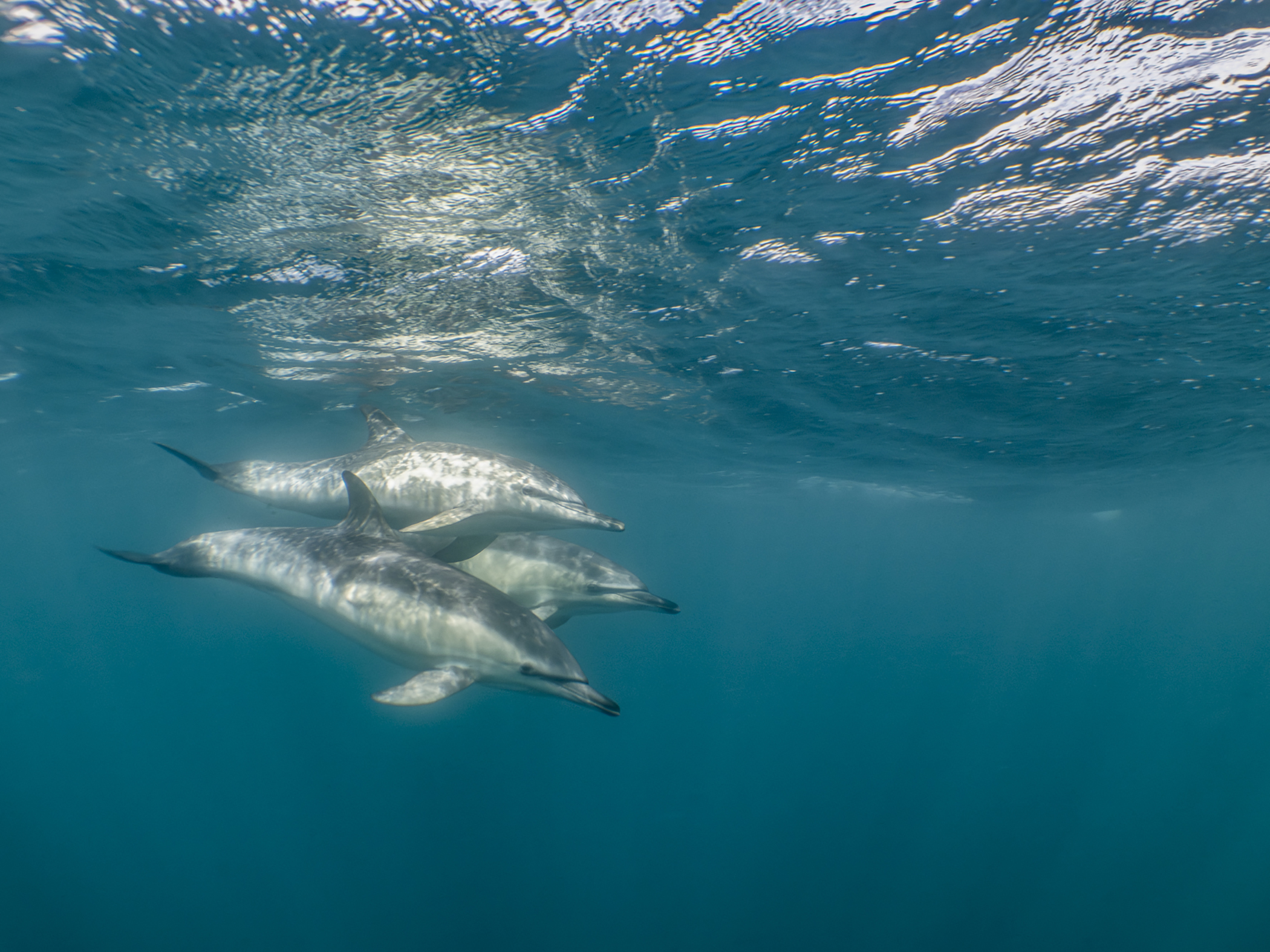
Common dolphins, as their name suggests, are one of the most plentiful dolphin species in the world. They are found mainly in deep, temperate and tropical offshore waters throughout the world but can occasionally be seen in the coastal waters off Northern Ireland. A distinctive pale yellow and grey, hour-glass pattern on both sides of the body allows the common dolphin to be easily recognized. Well known for their acrobatic displays, they will approach boats and are often seen bow-riding.
In brief
- Occasionally seen in the seas around Northern Ireland.
- Distinctive hour-glass pattern on both sides of the body.
- Very acrobatic dolphin; often seen bow-riding.
- Main threats to the population are accidental capture and drowning in commercial fishing equipment (by-catch) and pollution.
Species description: The common dolphin is small (adults are 1.7-2.6 m long), with a slim and streamlined body. The back, fins and beak are dark greyish-black and the underside is white. There is a distinctive hourglass pattern on the sides made up of patches of pale yellow/tan and light grey. The eye is surrounded by a black ring with a dark stripe that runs from the eye to the front of the head (above the beak). A second dark stripe runs from below the beak to the pectoral fin. The short, narrow beak is easily seen. Between 40 and 55 pairs of small, pointed, cone-shaped teeth are present in the upper and lower jaw. The dorsal fin is in the middle of the back.
Life cycle: Common dolphins live in groups or pods that can range in size from a few individuals to several hundred. They feed mainly on schooling fish, such as herring, but will also take squid, shrimps and crabs. Groups of dolphins will often cooperate when hunting and catching schools of fish. They regularly feed in deep water and can dive to 280 m. Like many dolphin species, they use echolocation to determine the shape, size, speed, distance and structure of objects in their surroundings. Common dolphins are very vocal, producing a variety of clicks and whistles that can occasionally be heard above the water. They are fast swimmers, very acrobatic and will often approach boats to bow-ride. A single calf is born in the summer.
Similar species: There are no similar species in Northern Ireland coastal waters.
How to see this species: There have been a few sightings of common dolphins in the coastal waters off Northern Ireland in recent years. The coastline around Larne/Islandmagee, the waters off Rathlin Island (both in County Antrim) and the Copeland Islands, County Down are all areas where you may be lucky enough to see this species.
Current status: Possibly under-recorded in Northern Ireland. Overall species trends currently unknown for Northern Ireland, but recently there has been an increase in number of stranded individuals which may require investigation. The estimated population of common dolphins in the North Atlantic is approximately 640,000 individuals (North Atlantic Marine Mammal Commission (NAMCO), 2023).
Why is this species a priority in Northern Ireland?
- Criterion 1: Internationally listed species.
Threats:
- Entanglement in fishing gear (by-catch).
- Reduction in fish numbers due to commercial fishing.
- Disturbance and/or injury by sea vessels.
- Pollution chemical and noise)
Action: Records of new sites for this species, with details of habitat and population are always valuable. Observations with a photograph can be recorded using iNaturalist, find the MBDP-NI iNaturalist project here.
Alternatively, records can be sent to CEDaR, National Museums Northern Ireland, 153 Bangor Road, Cultra, Holywood, County Down, BT18 0EU. Tel 028 9039 5257, e-mail cedar.records@nationalmuseumsni.org, or via the online portal.
Objectives:
- Avoid accidental harm to whales and dolphins when present in Northern Ireland waters
- Monitor number of strandings, and if required investigate. Seem to be on the increase in recent years, this should be quantified.
- In 2008 the Northern Ireland Environment Agency initiated a cetacean monitoring programme to provide information on the distribution and relative abundance of cetaceans in Northern Ireland waters. The information collected will enable the future selection of marine protected areas for cetaceans
- Post mortem and tissue studies are carried out on stranded dolphins to establish the cause of death and condition of the animals at the time of death.
- Contribute to international measures for the conservation of whales and dolphins.
Conservation:
- They are protected under Schedule 5 of the Wildlife (Northern Ireland) Order 1985.
- Listed under The Conservation of Habitats and Species Regulations 2010 - Part 2 and Part 3.
- Protected under Bern Convention (Convention on the Conservation of European Wildlife and Natural Habitats)Appendix III.
- Listed in Appendix II of the Convention on the Conservation of Migratory Species (The Bonn Convention).
- Covered by the terms of the Agreement on the Conservation of Small Cetaceans of the Baltic, North East Atlantic, Irish and North Seas (ASCOBANS).
- Listed in Appendix II of CITES
- Listed in Annex A of EU Council Regulation 338/97 and therefore treated by the EU as if they are on CITES, Appendix I
- Listed in Annex IV (Animal and Plant Species of Community Interest in Need of Strict Protection) of the EC Habitats Directive
- Listed in Part II and III of The Conservation (Natural Habitats, etc.) Regulations (Northern Ireland) 1995
Distribution Map from NBN: Delphinus delphis at National Biodiversity Network mapping facility, data for UK.
iNaturalist: Delphinus delphis at iNaturalist World Species Observations database.
WoRMS: Delphinus delphis at World Register of Marine Species. Accepted name: Delphinus delphis Linnaeus, 1758. AphiaID: 137094.
Classification: Biota; Animalia; Chordata; Vertebrata; Gnathostomata; Tetrapoda; Mammalia; Theria; Cetartiodactyla; Cetancodonta; Cetacea; Odontoceti; Delphinidae; Delphinus
| Previous species | Next species |
| Picton, B.E., Keatley, L. & Morrow, C.C. (2026). Delphinus delphis. Linnaeus, 1758. [In] Priority species, Marine Biodiversity Portal NI. https://www2.habitas.org.uk/marbiop-ni/priorityaccounts.php?item=ZK480. Accessed on 2026-09-13 |