
Northern Ireland Priority species (NIPS)
| MAMMALIA : Carnivora : Phocidae | MAMMALS |
Halichoerus grypus (Fabricius, 1791)
Grey seal
 |
| Halichoerus grypus |
Relatively large seal found all around the coasts of Northern Ireland. Pups have distinctive white coats when very young. Can be found mixed with common seals as well as in single species groups.
In brief
- Large seal found all around Northern Ireland.
- Best places to see include The Maidens, Strangford Lough, Rathlin Island or The Copelands.
- Main threats are from entanglement, over fishing reducing prey availability and disturbance.
- Also under pressure from climate change, with more severe weather events and changes in prey distributions.
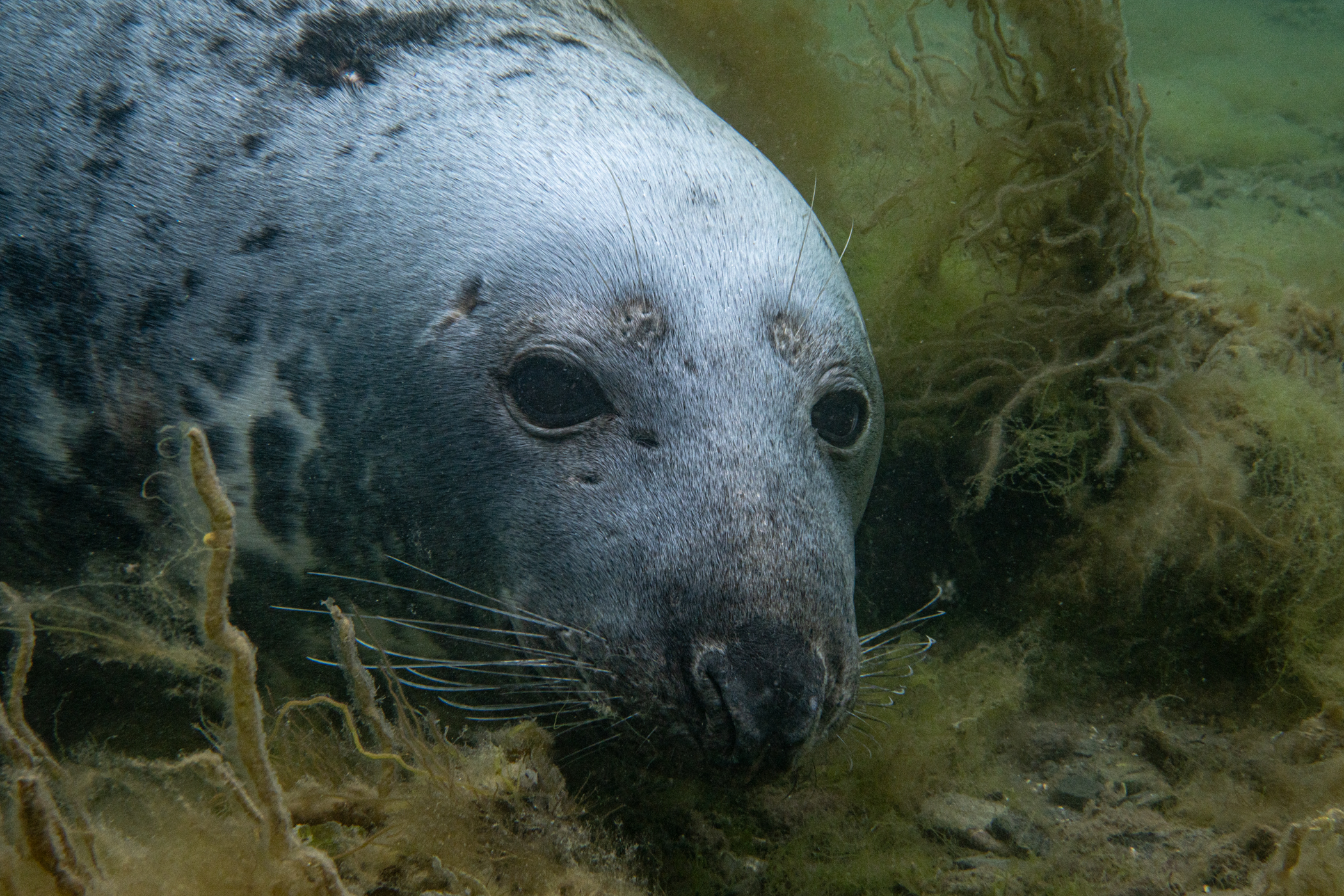
Species description: This is a large, robust seal growing 2.6 m, adult males are much larger than females, with males reaching up 300 kg and females up to 200 kg. They have a long muzzle, that is wide towards the end and large almost parallel nostrils. They are dark grey on their back and lighter underneath, with males often having darker colouration. They are covered in irregular blotches and spots. Their flippers are relatively short and wide.
Life cycle: Average lifespan is 30-40 years. Females reach maturity at 3-5 years old, males at around 6 years old. Gestation lasts about 11.5 months and females usually give birth to one pup per year. Pups have a fluffy white coat when they are born and cannot immediately enter the water and swim. They remain on land for 2-3 weeks after birth as their fluffy white coat is not waterproof.
Similar species: Could be confused with the common/harbour seal Phoca vitulina, however they are much smaller, with a shorter head and v-shaped nostrils.
How to see this species: Grey seals can be seen all year round in Northern Ireland, with large colonies around Rathlin Island, The Copelands, Strangford Lough and The Maidens. They can be seen both in the water and hauled out although if they are hauled out and resting care should be taken to observe from a distance so as not to disturb them. They will occasionally approach divers underwater, especially curious juveniles. May also pproach kayaks and paddle boards. They can sometimes be found mixed with common seals.
Current status: Northern Ireland population thought to be increasing in recent years but this is anecdotal and needs assessment. Currently listed as Least Concern both on European and Global Red List. Overall population trend appears to be increasing.
Why is this species a priority in Northern Ireland?
- Criterion 1: Internationally listed species.
- Criterion 4: NI stronghold or endemic – both stronghold range/population and designation as ‘endemic’ subject to expert judgement.
Threats:
- Reduction in fish stocks due to overfishing and causing food supply to be limited, or causing animals to have to travel further to gather enough.
- Conflict with fishing and aquaculture industries, which can lead to occasional illegal shootings. Rarely DAERA may issue a licence but this is only under exceptional circumstances.
- Pollution affecting water quality for both seal and prey.
- Entanglement in fishing gear or recreational plastic toys such as flying rings.
- Disturbance - hauled out seals need time to rest and can be easily disturbed by both intentional and unintentional approaches. Approaches can lead to panic and stress, and even the abandonment of pups in severe cases.
- Risk from infection/disease. Potential risk from Avian Influenza although this is currently thought to be low.
- Climate change which is both leading to more severe weather events
Action: Records of new sites for this species, with details of habitat and population are always valuable. Observations with a photograph can be recorded using iNaturalist, find the MBDP-NI iNaturalist project here.
Alternatively, records can be sent to CEDaR, National Museums Northern Ireland, 153 Bangor Road, Cultra, Holywood, County Down, BT18 0EU. Tel 028 9039 5257, e-mail cedar.records@nationalmuseumsni.org, or via the online portal.
Objectives:
- Maintain current population distribution and range.
Conservation:
- One of the primary designation features of The Maidens Special Area of Conservation.
- Strangford Lough and Rathlin Island are both Marine Conservation Zones.
- Protected by the Wildlife (Northern Ireland) Order 1985 Section 5.
- Protected under the Wildlife and Natural Environment (WANE) Act (Northern Ireland) 2011.
- Protected under The Conservation (Natural Habitats, etc.) Regulations (Northern Ireland) 1995, Part III.
- Listed under Habitats Directive, Annex II and V.
- Protected under Bern Convention (Convention on the Conservation of European Wildlife and Natural Habitats) Appendix III.
- Listed in Appendix II of the Convention on the Conservation of Migratory Species (The Bonn Convention).
Distribution Map from NBN: Halichoerus grypus at National Biodiversity Network mapping facility, data for UK.
iNaturalist: Halichoerus grypus at iNaturalist World Species Observations database.
WoRMS: Halichoerus grypus at World Register of Marine Species. Accepted name: Halichoerus grypus (Fabricius, 1791). AphiaID: 137080.
Classification: Biota; Animalia; Chordata; Vertebrata; Gnathostomata; Tetrapoda; Mammalia; Theria; Carnivora; Caniformia; Pinnipedia; Phocidae; Halichoerus
| Picton, B.E., Keatley, L. & Morrow, C.C. (2026). Halichoerus grypus. (Fabricius, 1791). [In] Priority species, Marine Biodiversity Portal NI. https://www2.habitas.org.uk/marbiop-ni/priorityaccounts.php?item=ZK250. Accessed on 2026-09-13 |