
Northern Ireland Priority species (NIPS)
| ECHINODERMATA : Apodida : Synaptidae | STARFISH, SEA URCHINS, ETC. |
Labidoplax media (Ostergren, 1905)
Common synaptid
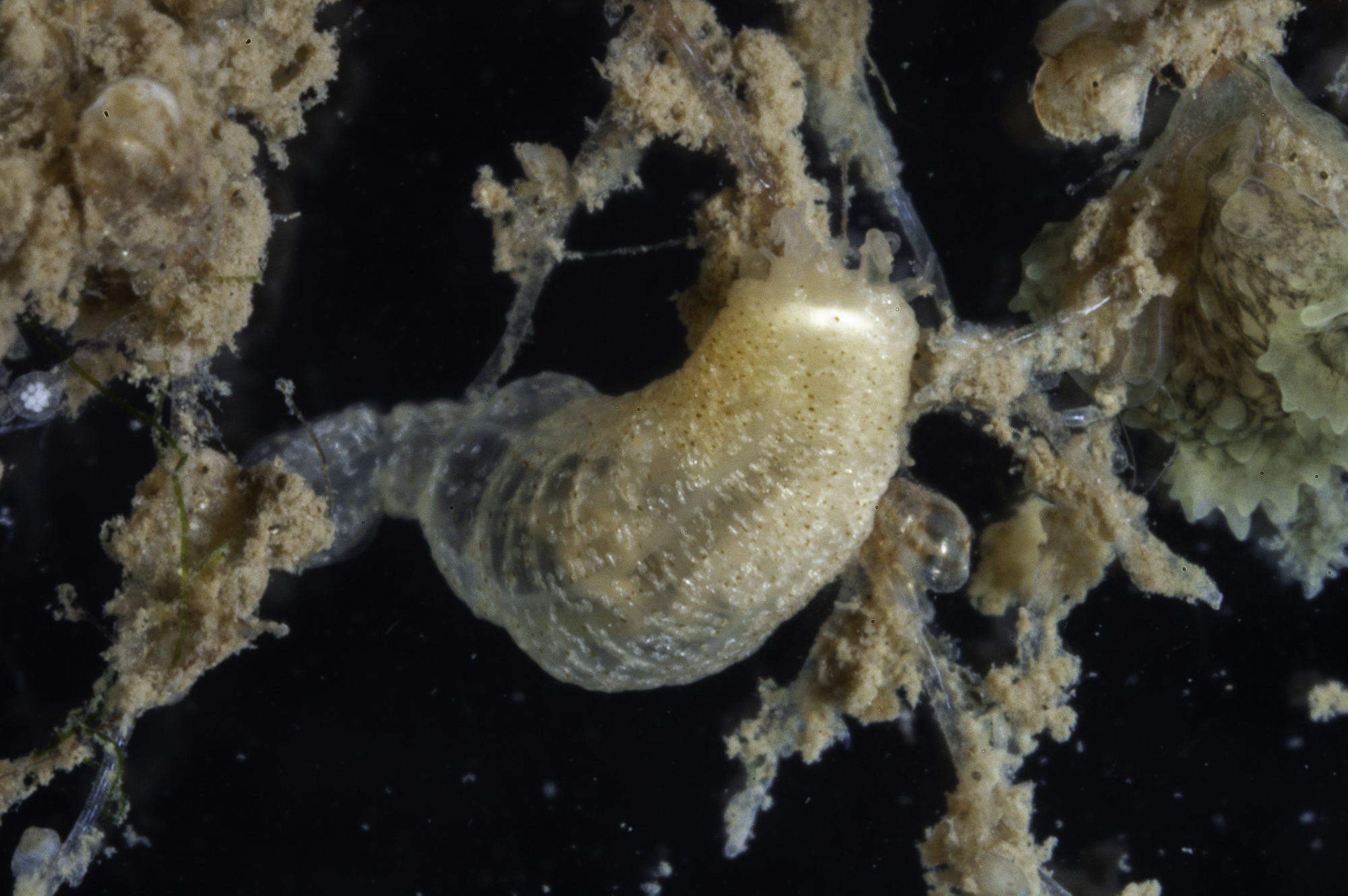 |
| Labidoplax media |
A small and almost transparent burrowing sea cucumber in Northern Ireland known only from three sites in Strangford Lough, all of which have been badly affected by fishing activities.
In brief
- Found in three sites in the central regions of Strangford Lough, and some scattered locations around the Northern Irish coast.
- Lives on the surface or slightly below, fine muds and silts.
- Can be found throughout the year.
- Thought to have declined, and there are no records from Ireland.
- Main threats likely to come from fishing and use of mobile bottom gear.
Species description: First reported in British and Irish waters in 1972, this is a very small, almost obscure sea cucumber (or holothurian) that lives on, or slightly below, the surface of very soft muds and silts. It is about 2-4 cm in length, and is almost transparent, such that the five longitudinal muscle bands can be seen through the skin. However, it also has brown glandular papillae appearing as dots on the surface. It is equipped with twelve tentacles, each ending with four digits. The spicules (small skeletal structures within the body wall) are anchor-shaped, narrowing into distinct ‘handles’. The species lacks tube feet or respiratory trees (branched structures).
Life cycle: It has been suggested that this species starts life as a male, and then with increasing size is able to switch to being a female. They may also brood the fertilised eggs internally, giving rise to a type of live birth situation.
Similar species: Labidoplax buski is very similar, but has eleven tentacles, each with a central long terminal digit and a part of lateral digits. However, it has been suggested that the two species are synonymous.
How to see this species: Labidoplax media can be found in Northern Ireland at three sites in Strangford Lough (Bird Island Passage, Town Rock, and the Quoile estuary), or from a few other scattered locations around the coast of Northern Ireland. It can be on the surface or just below, very soft, watery or glutinous muds and silts in very sheltered locations. It has been found within the Modiolus modiolus community in Strangford lough. For some time Strangford was regarded as the only location for this species in the British Isles, but it has since been found in other locations around Northern Ireland and in sheltered lochs of the outer Hebrides and similar sites on the west coast of the Scottish mainland. It was originally discovered in Scandinavia.
Current status: Declining. Northern Ireland is the Irish stronghold. It is a northern species, likely to be affected by climate change. Several known sites for this species have been badly affected by bottom fishing.
Why is this species a priority in Northern Ireland?
- Criterion 2: Decline based on available data and expert judgement.
- Criterion 3: Rare or restricted range – rare breeding species confined to 5 hectads or less (based on expert judgement).
- Criterion 4: NI stronghold or endemic – both stronghold range/population and designation as ‘endemic’ subject to expert judgement.
- Criterion 5: Climate change sensitive.
Threats: This species has been badly affected by fishing activities, particularly bottom trawling and dredging.
Action: Records of new sites for this species, with details of habitat and population are always valuable. Send these to CEDaR, National Museums Northern Ireland, 153 Bangor Road, Cultra, Holywood, County Down, BT18 0EU. Tel 028 9039 5257 or e-mail cedar.records@nationalmuseumsni.org, or via the online portal. You can also record observations including a photograph using iNaturalist, find the MBDP-NI iNaturalist project here.
Objectives:
- Maintain the number of viable populations of the species.
- Maintain the range of the species.
- Establish appropriate management of known sites.
- Proactively search for new sites containing appropriate habitats.
Conservation:
- Strangford Lough is a Marine Protected Area with multiple designations.
- There is no Species Action Plan for this species, but the relevant Habitat Action Plans are Horse Mussel Beds and Mud habitats in deep water.
Distribution Map from NBN: Labidoplax media at National Biodiversity Network mapping facility, data for UK.
iNaturalist: Labidoplax media at iNaturalist World Species Observations database.
WoRMS: Labidoplax media at World Register of Marine Species. Accepted name: Labidoplax media Östergren, 1905. AphiaID: 124457.
Classification: Biota; Animalia; Echinodermata; Echinozoa; Holothuroidea; Paractinopoda; Apodida; Synaptidae; Labidoplax
| Previous species | Next species |
| Adapted from text by Allen & Mellon Environmental Ltd. (2026). Labidoplax media. (Ostergren, 1905). [In] Priority species, Marine Biodiversity Portal NI. https://www2.habitas.org.uk/marbiop-ni/priorityaccounts.php?item=ZB5340. Accessed on 2026-09-13 |