
Northern Ireland Priority species (NIPS)
| MOLLUSCA : Littorinimorpha : Hydrobiidae | SNAILS, SLUGS, ETC. |
Ecrobia ventrosa (Montagu, 1803)
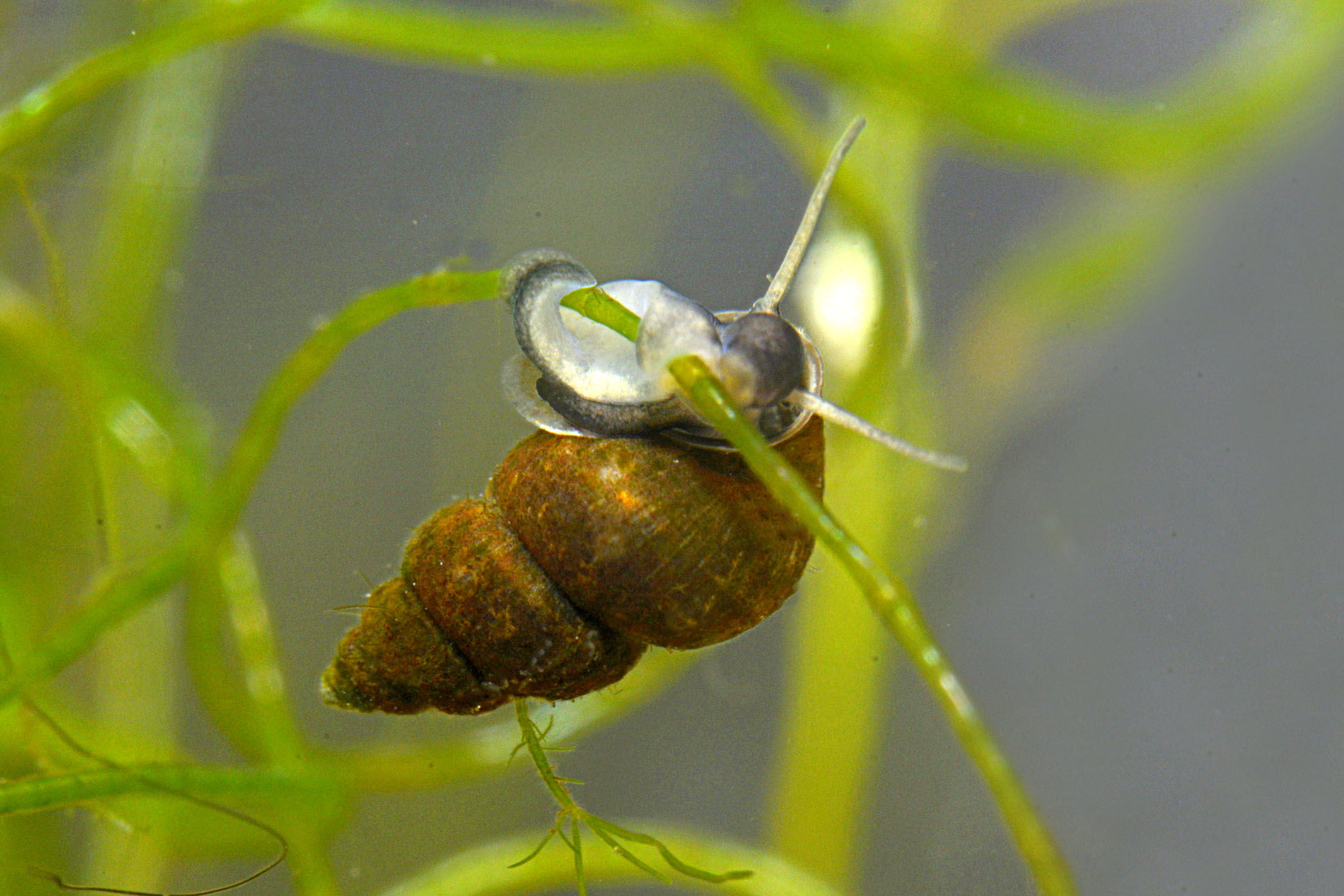 |
| Ecrobia ventrosa |
Ecrobia ventrosa is a minute mud snail found in brackish water along the coast. Despite their small size, some mud snails are important sources of food for migrating and overwintering birds in sea bays and inlets. An example is Peringia ulvae (Pennant) which occurs in vast numbers on the foreshore of Strangford Lough in fully saline conditions. In smaller inlets where sea water is diluted by fresh water coming in off the land, several rarer species occur. Ecrobia ventrosa is one of these and has declined sharply since the early nineteenth century due to land reclamation for agriculture and to changes in salinity in existing habitats.
In brief
- Found at only a single site, Cadew Point on Strangford Lough
- Historically known from at least three sites in Northern Ireland
- Confined to semi-saline lagoons
- Lagoons are amongst the most endangered habitats in Northern Ireland.
- It has declined and is rare.
- The cause of recent decline is a combination of reclamation and changes in the salinity of previously occupied habitats, for example, Strand Lough at Killough was formerly occupied but is now too fresh due to a new barrage.
Species description: Ecrobia ventrosa belongs to the family Hydrobiidae. The British Hydrobiidae were formerly all included in the genus Hydrobia but this has now been split into several genera although the individual species are superficially very alike. Ecrobia ventrosa is small at about 4-6 mm, has a sharp spire, is dark in colour and has a small, horny flap called an operculum which closes the entrance to the shell. The animal’s head behind the eyes is dark in colour, its tentacles are a uniform pale grey or white, and its fore-body (snout) is a uniform mid-grey. The shell differs from that in related hydrobiids by its relatively rounded whorls and deep sutures (lines separating the whorls).
Life cycle: Like all hydrobiids this species occurs all the year round crawling in mud in its favoured habitat. Reproduction is mainly sexual, that is, some individuals are male and some female and these mate to produce fertile eggs which hatch in the female’s body before emerging as young snails. Technically the species is ovoviviparous – eggs hatching before being laid by the female. It can occur in great numbers, with individuals at all stages of development, in suitable habitats.
Similar species: There are a total of five British and Irish mud snails:
- Potamopyrgus antipodarum has a small, black shell similar to that of Ecrobia ventrosa but it lives in fresh water. It differs from Ecrobia in its tentacles which are dark grey with a distinct pale line down the centre.
- Heleobia stagnorum has not been found in Ireland and is very rare in northern Europe. There is one English locality. It occupies fresher, less saline water than either Hydrobia acuta or Ecrobia ventrosa, the two other brackish species. It is distinguished by possessing a very pale, almost white shell and the animal has pale grey tentacles and a mid-grey snout.
- Hydrobia acuta neglecta is a northern European subspecies of a common Mediterranean mud snail and is rarer than Ecrobia ventrosa and prefers more saline habitats. It has a similar tall-spired dark shell, but pale tentacles with a distinct black mark or ring near the tip, and a dark snout with two large, pale spots. There may also be dark spots at the base of the tentacles, in front of the eyes.
- Ecrobia ventrosa differs from Hydrobia acuta neglecta in possessing uniformly pale tentacles and a dark snout without spots. It lives in similar brackish habitats.
- Peringia ulvae is an entirely marine species which is very common around the British Isles. It has a much more solid shell than the other species and and this is usually yellowish-brown in colour, with very flat sutures. The animal has similar dark-ringed pale tentacles to Hydrobia acuta, but the snout is uniformly dark.
How to see this species: The only viable colony known in Northern Ireland is in Cadew Point lagoon near Whiterocks on Strangford Lough. It lives in sandy mud in shallow water separated from the open sea by a sea wall or impoundment and feeds on sand algae and algae living on the fronds of sea grass (Zostera).
Current status: This is a very rare and declining species in Northern Ireland because of historical factors such as massive marine reclamation for agriculture in the nineteenth century.
Only a single site is now known in Northern Ireland. Elsewhere in Ireland and Britain the situation is not so grave but it is declining everywhere because of damage to saltmarshes and to sea walls from erosion and sea level rise, to reclamation for building and agriculture and to increasing organic pollution.The species was feared extinct in Northern Ireland until the discovery of the Cadew Point colony in 2001. There are exceedingly few suitable habitats remaining in our area despite the wide expanse of sheltered marine waters in Strangford and Carlingford Loughs and the Foyle. Former habitats at Glynn Lagoon, Magheramorne and Strand Lough appear to have been lost due, respectively, to intermittent organic pollution, to quarrying infill and to the construction of a new, over-efficient, barrage. The remaining habitat (Cadew Point) is of small size and extremely vulnerable to pollution and to structural and salinity changes.
Why is this species a priority in Northern Ireland?
- Criterion 2: Decline based on available data and expert judgement
Threats:
- Reclamation and infill, mainly from the agricultural sector but also from construction projects near towns and single dwellings elsewhere.
- Sea level rise and the salination (increased sea water incursion) of some habitats.
- Organic pollution of estuaries.
- Damaging freshening of some habitats by prevention of sea water incursions through over-efficient barrages.
Action: Records of new sites for this species, with details of habitat and population are always valuable. Observations with a photograph can be recorded using iNaturalist, find the MBDP-NI iNaturalist project here.
Alternatively, records can be sent to CEDaR, National Museums Northern Ireland, 153 Bangor Road, Cultra, Holywood, County Down, BT18 0EU. Tel 028 9039 5257, e-mail cedar.records@nationalmuseumsni.org, or via the online portal.
Objectives:
- The status of Ecrobia ventrosa will be surveyed and monitored and appropriate conservation action undertaken if required.
Conservation:
- Strangford Lough is a Marine Protected Area with multiple designations.
Distribution Map from NBN: Ecrobia ventrosa at National Biodiversity Network mapping facility, data for UK.
iNaturalist: Ecrobia ventrosa at iNaturalist World Species Observations database.
WoRMS: Ecrobia ventrosa at World Register of Marine Species. Accepted name: Ecrobia ventrosa (Montagu, 1803). AphiaID: 238104.
Classification: Biota; Animalia; Mollusca; Gastropoda; Caenogastropoda; Littorinimorpha; Truncatelloidea; Hydrobiidae; Hydrobiinae; Ecrobia
| Previous species | Next species |
| Adapted from text by Dr Roy Anderson (2026). Ecrobia ventrosa. (Montagu, 1803). [In] Priority species, Marine Biodiversity Portal NI. https://www2.habitas.org.uk/marbiop-ni/priorityaccounts.php?item=W2740. Accessed on 2026-09-13 |