
Northern Ireland Priority species (NIPS)
| MOLLUSCA : Littorinimorpha : Hydrobiidae | SNAILS, SLUGS, ETC. |
Hydrobia acuta neglecta Muus, 1963
Lagoon mud snail
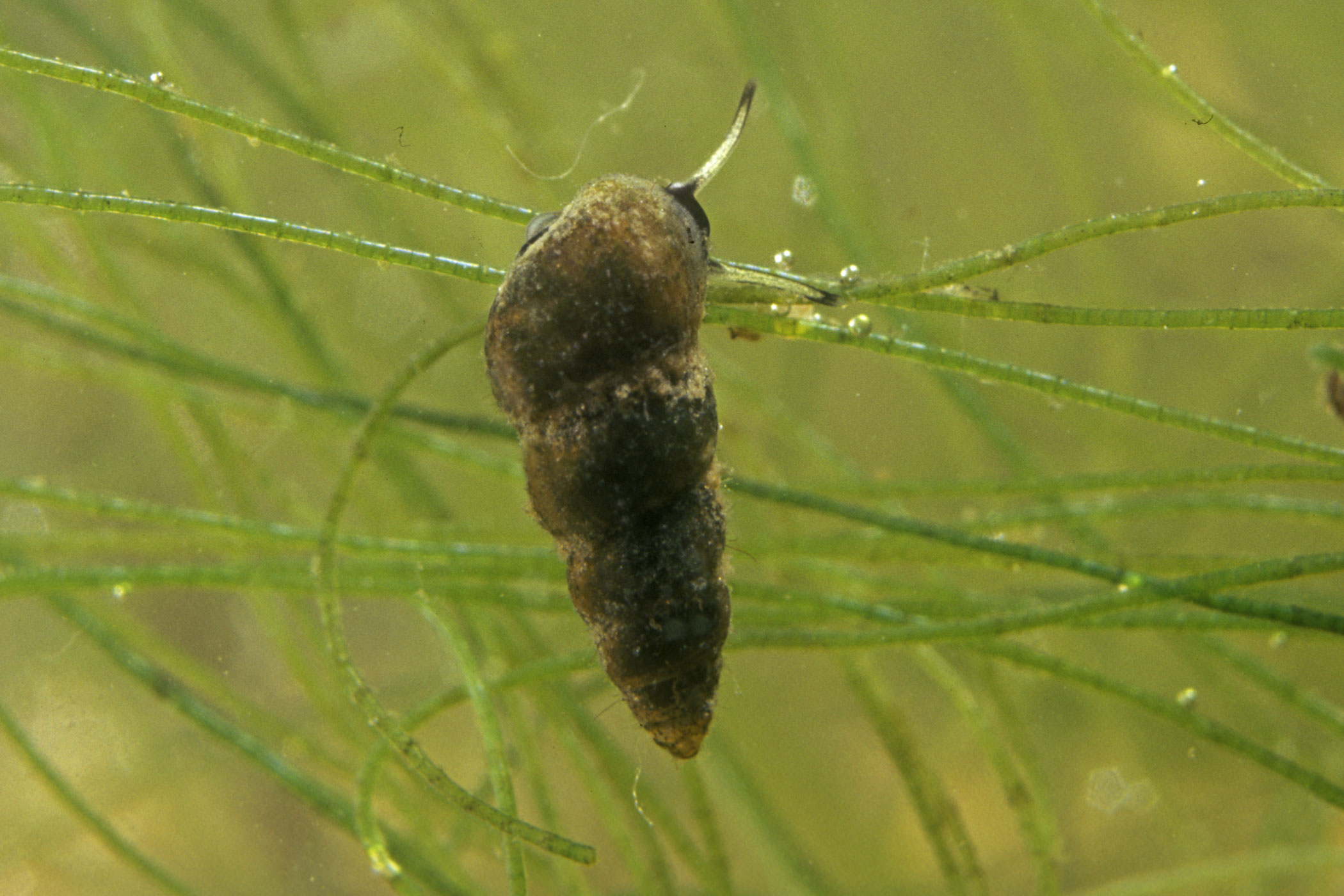 |
| Hydrobia acuta neglecta |
Hydrobia acuta neglecta is a minute mud snail found in brackish water along the coast. Despite their small size, some mud snails are important sources of food for migrating and overwintering birds in sea bays and inlets. The commonest is Peringia ulvae (Pennant) which occurs in vast numbers on the foreshore of Strangford Lough. Hydrobia acuta neglecta, like the very similar Ecrobia ventrosa, is not found in the sea but in coastal brackish lagoons or pools separated from the sea. It is rare in Britain and Ireland.
In brief
- Found at only a few sites in Northern Ireland, mostly in Strangford Lough. Recently only recorded at Ann’s Point on Strangford Lough. Found historically in Larne Lough.
- Historically brackish mud snails, including this species, were known from at least four sites in Northern Ireland.
- Confined to semi-saline lagoons.
- Lagoons are amongst the most endangered habitats in Northern Ireland.
- It has declined and is rare
- The cause of recent decline is probably a combination of reclamation and changes in the salinity of previously occupied habitats..
Species description: Hydrobia acuta neglecta belongs to the family Hydrobiidae. The British Hydrobiidae were formerly all included in the genus Hydrobia but the other species have now been placed in separate genera. Hydrobia acuta is small at about 4-6mm, has a sharp spire, is dark in colour and has a small, horny flap called an operculum which closes the entrance to the shell. The animal’s head behind the eyes is dark in colour, its tentacles are a uniform white with a black ring just behind the tip, and its fore-body (snout) is mid-grey with two large, pale spots. The shell differs from that in related hydrobiids by its relatively flattened whorls and shallow sutures (lines separating the whorls).
Life cycle: Reproduction occurs during a brief breeding season in the spring, typically peaking in May and June. Unlike many other marine snails, this species is ovoviviparous. Females retain fertilized eggs within their bodies, where they develop and hatch into juveniles before being released directly into the sediment. Juvenile snails emerge in early summer (June/July). In winter the juvenile snails enter a dormant phase and hibernate by burrowing deep into the muddy sediment.
Similar species: To identify Hydrobia acuta subsp.neglecta examine live specimens in water using a magnifying glass to check soft-body pigmentation, as shells can overlap in appearance with related mudsnails such as Ventrosia ventrosa.
How to see this species: This species can be found at Ann’s Point Lagoon, Castle Espie and Cadew Point Lagoon in Strangford Lough. It lives in mud and at the roots of plants in shallow water and feeds on algae. Ann’s Point Reserve is managed by the National Trust for wetland birds and the public are discouraged from visiting because of the potential for disturbance. There are no hides or other facilities at the site.
Current status: This species is listed as near threatened in the IUCN Red List of Threatened Species. It is extremely scarce and its habitat is vulnerable. It appears to be readily outcompeted by the marine mud snail Peringia ulvae where the two occur together.The species was feared extinct in Northern Ireland until the rediscovery of the Ann’s Point colony in 2001. “Hydrobia ventrosa” was recorded there about a century ago but at that time Hydrobia acuta was not recognised as a separate species from Ecrobia ventrosa. Old records of “Hydrobia ventrosa” apart from the Ann’s Point record, mainly refer to Ecrobia ventrosa (Ross, 1984). Kerney (1999) indicates a second Northern Ireland site for H. acuta neglecta at Magheramorne, Larne Lough. This has been visited recently but only Potamopyrgus antipodarum is now present in the area and the site is presumed lost.
In southern Ireland two recent sites are known: on Inishmore, Aran Islands, County Galway; on the Mullet, West Mayo.
Why is this species a priority in Northern Ireland?
- Criterion 1: Internationally listed species.
- Criterion 2: Decline based on available data and expert judgement.
- Criterion 3: Rare or restricted range – rare breeding species confined to 5 hectads or less (based on expert judgement).
Threats: It is a highly localized species that depends entirely on specialized coastal lagoon environments. Its habitat is exceptionally rare and vulnerable to seasonal environmental shifts, climate-driven sea-level rise, coastal development, changing salinity and water pollution.
Action: Records of new sites for this species, with details of habitat and population are always valuable. Observations with a photograph can be recorded using iNaturalist, find the MBDP-NI iNaturalist project here.
Alternatively, records can be sent to CEDaR, National Museums Northern Ireland, 153 Bangor Road, Cultra, Holywood, County Down, BT18 0EU. Tel 028 9039 5257, e-mail cedar.records@nationalmuseumsni.org, or via the online portal.
Objectives: The status of Hydrobia acuta neglecta will be surveyed and monitored and appropriate conservation action undertaken if required.
Conservation:
- Strangford Lough is a Marine Protected Area with multiple designations.
Distribution Map from NBN: Hydrobia acuta neglecta at National Biodiversity Network mapping facility, data for UK.
iNaturalist: Hydrobia acuta neglecta at iNaturalist World Species Observations database.
WoRMS: Hydrobia acuta neglecta at World Register of Marine Species. Accepted name: Hydrobia acuta neglecta Muus, 1963. AphiaID: 465551.
Classification: Biota; Animalia; Mollusca; Gastropoda; Caenogastropoda; Littorinimorpha; Truncatelloidea; Hydrobiidae; Hydrobiinae; Hydrobia
| Previous species | Next species |
| Adapted from text by Dr Roy Anderson (2026). Hydrobia acuta neglecta. Muus, 1963. [In] Priority species, Marine Biodiversity Portal NI. https://www2.habitas.org.uk/marbiop-ni/priorityaccounts.php?item=W2700. Accessed on 2026-09-13 |