
Northern Ireland Priority species (NIPS)
| CNIDARIA : Leptothecata : Aglaopheniidae | SEA ANEMONES AND HYDROIDS |
Lytocarpia myriophyllum (Linnaeus, 1758)
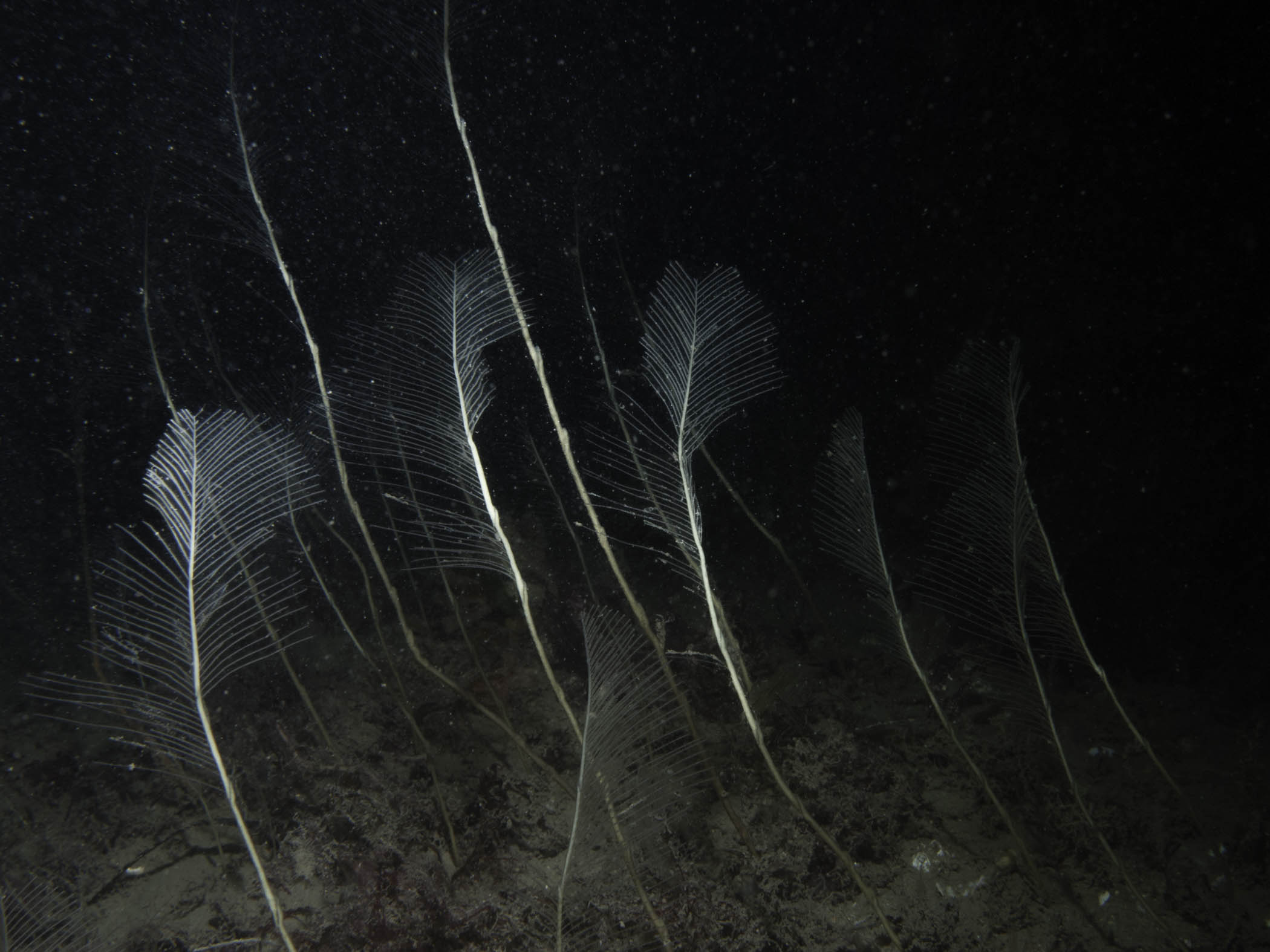 |
| Lytocarpia myriophyllum |
A large hydroid that occurs in a number of areas around Northern Ireland, but whose status may have deteriorated due to habitat loss.
In brief
- Recorded off Rathlin Island, The Maidens and off County Down.
- Found amongst sublittoral sediments, shells and gravels at depths exceeding 25 m.
- A conservation priority because of habitat loss
- Main threats are deployment of mobile fishing gear and the disruption of the seabed.
Species description: A large hydroid, about 300-400 mm in height, with tall feathery colonies of unbranched main stems carrying straight side branches about 20 mm in length. These are arranged in pairs, almost opposite each other so that the cross-section as viewed from above represents an open ‘V’. The polyps (inhabitants of the colony) face the concave surface of the V. The colonies are somewhat colourless or pale grey. A number of colonies tend to occur in clumps, and seemingly share the same base, or at least abut each other at their bases.
Life cycle: Reproductive polyps are born on modified side branches, which produce medusae (jellyfish-like juvenile forms which may be free swimming or remain attached).
Similar species: This is a much larger hydroid than Gymnangium montagui or any of the Aglaophenia species found in the NE Atlantic.
How to see this species: L. myriophyllum is found at numerous sites around Rathlin Island, off the Maidens Rocks, off the outer Ards Peninsula, off Kearney Point, St John’s Point, and various locations off south Down. Further afield in Ireland it occurs in Kilkieran Bay and a number of sites in south-west Ireland. It is recorded from a number of sites amongst the islands in south-west Scotland. It occurs in depths exceeding 25 m, in semi-sheltered locations experiencing moderate tidal streams.
Current status: Rare and declining. The species is known from a number of sites along the Antrim and Down coasts. It has no legal protection.
Why is this species a priority in Northern Ireland?
- Criterion 2: Decline based on available data and expert judgement.
- Criterion 3: Rare or restricted range – rare breeding species confined to 5 hectads or less (based on expert judgement).
Threats:
- Its habitat has been heavily affected by bottom trawling and dredging fisheries, and it is highly likely that this is the reason for its decline in numbers and distribution.
Action: Records of new sites for this species, with details of habitat and population are always valuable. Observations with a photograph can be recorded using iNaturalist, find the MBDP-NI iNaturalist project here.
Alternatively, records can be sent to CEDaR, National Museums Northern Ireland, 153 Bangor Road, Cultra, Holywood, County Down, BT18 0EU. Tel 028 9039 5257, e-mail cedar.records@nationalmuseumsni.org, or via the online portal.
Objectives:
- Increase the number of viable populations of the species.
- Maintain the range of the species.
- Establish appropriate management of known sites.
- Protect sites of conservation importance from damage through contamination and physical disturbance or excessive use (for example, nutrient enrichment, dredging and development).
- Require EIAs for coastal developments to examine potential effects on nearshore areas.
- Monitor any impact of dump sites on inshore sublittoral sediment habitats, communities and wildlife, and take action as appropriate.
- Develop and implement strategies for the conservation and management of the wider marine environment at local, regional and national levels. For example, integrated Coastal Management Plans, water quality objectives, pollution control and avoidance measures. Species recovery and habitat restoration programmes should be included.
Conservation:
- Rathlin Island is a Marine Protected Area with multiple designations.
- There is a relevant Habitat Action Plan for Tide-Swept Channels.
- The Maidens are a Marine Protected Area with multiple designations.
Distribution Map from NBN: Lytocarpia myriophyllum at National Biodiversity Network mapping facility, data for UK.
iNaturalist: Lytocarpia myriophyllum at iNaturalist World Species Observations database.
WoRMS: Lytocarpia myriophyllum at World Register of Marine Species. Accepted name: Lytocarpia myriophyllum (Linnaeus, 1758). AphiaID: 117302.
Classification: Biota; Animalia; Cnidaria; Medusozoa; Hydrozoa; Hydroidolina; Leptothecata; Plumularioidea; Aglaopheniidae; Lytocarpia
| Previous species | Next species |
| Adapted from text by Allen & Mellon Environmental Ltd. (2026). Lytocarpia myriophyllum. (Linnaeus, 1758). [In] Priority species, Marine Biodiversity Portal NI. https://www2.habitas.org.uk/marbiop-ni/priorityaccounts.php?item=D5660. Accessed on 2026-09-13 |