
Northern Ireland Priority species (NIPS)
| CNIDARIA : Malacalcyonacea : Alcyoniidae | SEA ANEMONES AND HYDROIDS |
Alcyonium hibernicum (Renouf, 1931)
 |
| Alcyonium hibernicum |
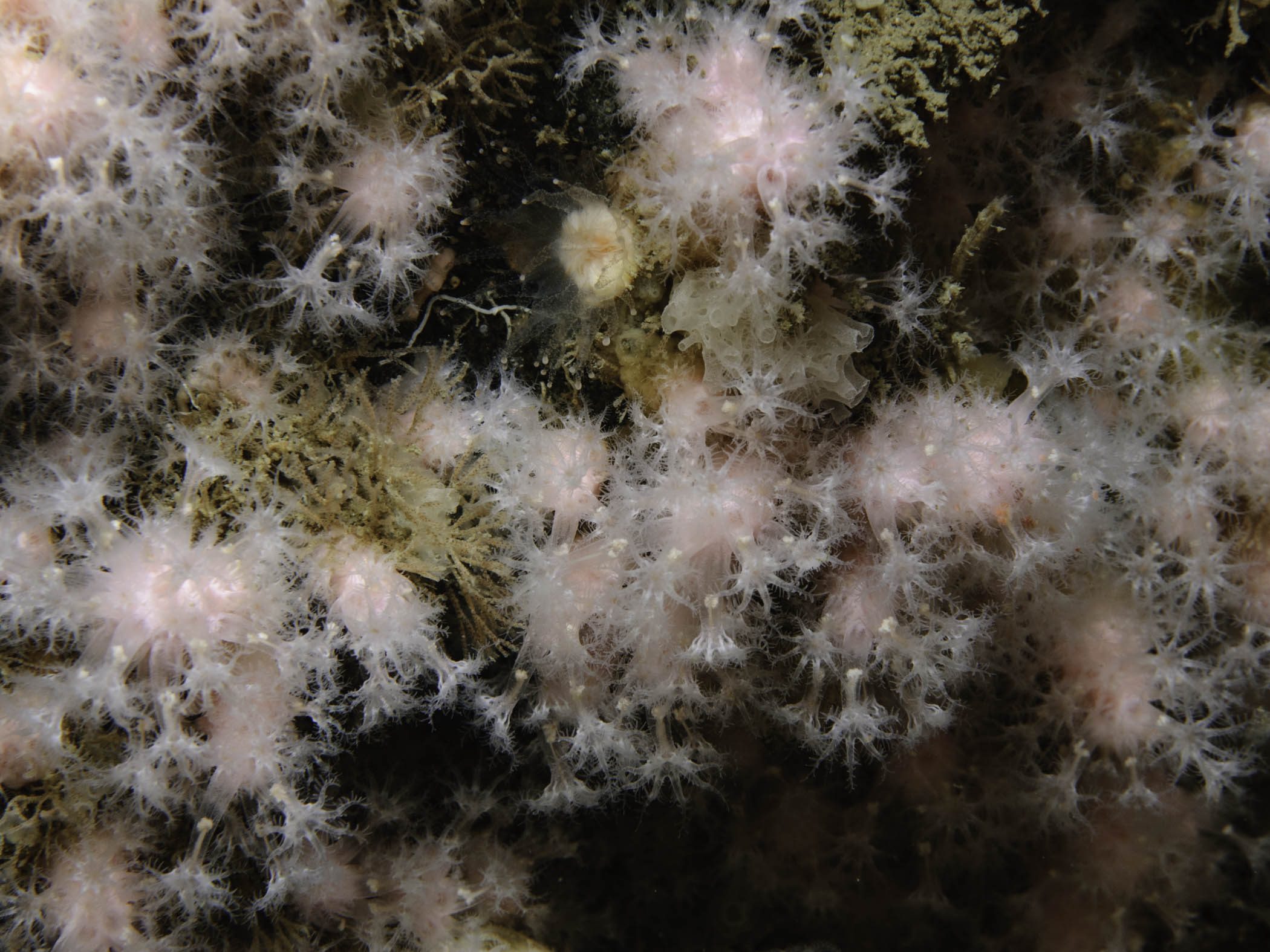
A rare, rather small soft coral that occurs in small colonies in rocky clefts, gullies and wrecks. Only two locations are recorded in Northern Ireland.
In brief
- Only known Northern Ireland site are the west end of Rathlin Island, and Ardglass.
- Habitat — rocky overhangs, caves, gullies and wrecks.
- Can be seen throughout the year.
- This is a species of conservation concern because of its rarity, and localised nature of its colonies.
- Rarity is the main concern, but the very localised nature of its larval dispersal means colonies are unlikely to recover from any disruption.
Species description: Alcyonium hibernicum is a small soft coral occurring in very localised situations. Its ‘fingers’ are up to 40 mm tall, pink with whitish flecks on the tentacles, giving a somewhat spangled appearance. The species has undergone a number of taxonomic reviews and synonyms include Parerythropodium coralloides, Alcyonium coralloides, and Alcyonium pusillum, and readers should investigate these as well when researching historic distribution and other data.
Life cycle: The species only has female colonies, and through July the ova develop parthenogenically, that is, without fertilisation, and are brooded in the gastric cavity. The larvae are released in August and settle on the benthos, very close to the parental colony. As a result distribution is very localised, and colonies within a small area are likely to be genetically very similar, and there is reduced chance of dispersal and colonisation of new areas of sea bed compared with its close relative A. digitatum.
Similar species: Alcyonium digitatum — dead man’s fingers. This is a larger and much more common species, widely occurring in more open subtidal rock and boulder situations dominated by tidal currents. It ranges from white through yellow to orange, and lacks the spangled effect seen in A. hibernicum. There is another soft coral Alcyonium glomeraturm but it is again much larger and has a red colouration.
How to see this species: The species has only been recorded in Northern Ireland at Farganlack Point on the west end of Rathlin Island, Ardglass in Co. Down. In Ireland it is found in south-west of Campbell’s Bed in Mulroy Bay and in Lough Hyne. Elsewhere, it has been recorded off western Scotland, the Calf of Man, the Pembrokeshire and Cornish coasts. Most likely locations are rocky sites down to about 35 m depth, with little algal growth, under overhangs, in caves, gullies and crevices, and on wrecks. It has been recorded in enclosed locations like sea loughs where salinity is slightly reduced.
Current status: Rare. Only two known locations recorded in Northern Ireland. The species has no legal protection. Northern Ireland probably holds 50 per cent of the Irish population. Its method of reproduction and especially the localised nature of its colonies mean that they would be unlikely to recover following any significant damage or disruption.
Why is this species a priority in Northern Ireland?
- Criterion 3: Rare or restricted range – rare breeding species confined to 5 hectads or less (based on expert judgement).
Threats: No immediate threats known. However limited distribution and dispersal ability, as well as only being known from two sites make this species extremely vulnerable.
Action: Records of new sites for this species, with details of habitat and population are always valuable. Observations with a photograph can be recorded using iNaturalist, find the MBDP-NI iNaturalist project here.
Alternatively, records can be sent to CEDaR, National Museums Northern Ireland, 153 Bangor Road, Cultra, Holywood, County Down, BT18 0EU. Tel 028 9039 5257, e-mail cedar.records@nationalmuseumsni.org, or via the online portal.
Objectives:
- Maintain the Rathlin and Ardglass populations in a viable condition.
- Maintain the range of the species.
- Establish appropriate management of its only known Northern Ireland sites.
- Encourage further surveys to identify any new sites.
- Protect sites of conservation importance from damage through contamination and physical disturbance (eg turbidity and towed fishing gears).
- Require EIAs for coastal developments to examine potential effects on intertidal and nearshore areas.
- Monitor any impact of dump sites on inshore sublittoral rock habitats, communities and wildlife, and take action as appropriate.
- Implement strategies for managing the coastal zone at local, regional and national levels.
Conservation:
- Rathlin Island is a Marine Protected Area with multiple designations.
- There is no Species Action Plan for Alcyonium hibernicum, but the Habitat Action Plan for Subtidal chalk has the objective of maintaining the extent, variety and quality of marine subtidal chalk communities based on best available information.
Distribution Map from NBN: Alcyonium hibernicum at National Biodiversity Network mapping facility, data for UK.
iNaturalist: Alcyonium hibernicum at iNaturalist World Species Observations database.
WoRMS: Alcyonium hibernicum at World Register of Marine Species. Accepted name: Alcyonium hibernicum (Renouf, 1931). AphiaID: 178914.
Classification: Biota; Animalia; Cnidaria; Anthozoa; Octocorallia; Malacalcyonacea; Alcyoniidae; Alcyonium
| Previous species | Next species |
| Adapted from text by Allen & Mellon Environmental Ltd. (2026). Alcyonium hibernicum. (Renouf, 1931). [In] Priority species, Marine Biodiversity Portal NI. https://www2.habitas.org.uk/marbiop-ni/priorityaccounts.php?item=D10300. Accessed on 2026-09-13 |