
Northern Ireland Priority species (NIPS)
| CNIDARIA : Stauromedusae : Kishinouyeidae | SEA ANEMONES AND HYDROIDS |
Calvadosia campanulata (Lamouroux, 1815)
Stalked jellyfish
 |
| Calvadosia campanulata |
Small, stalked jellyfish with a seasonal lifespan.
In brief
- Small, stalked jellyfish up to 35 mm in size.
- Could be easily confused with some other species of stalked jellyfish, but in field identification is possible, as is identification with good quality photos.
- No specific threats, but at risk from habitat degradation, climate change and water quality issues.
- Scattered distribution but possibly under-recorded.
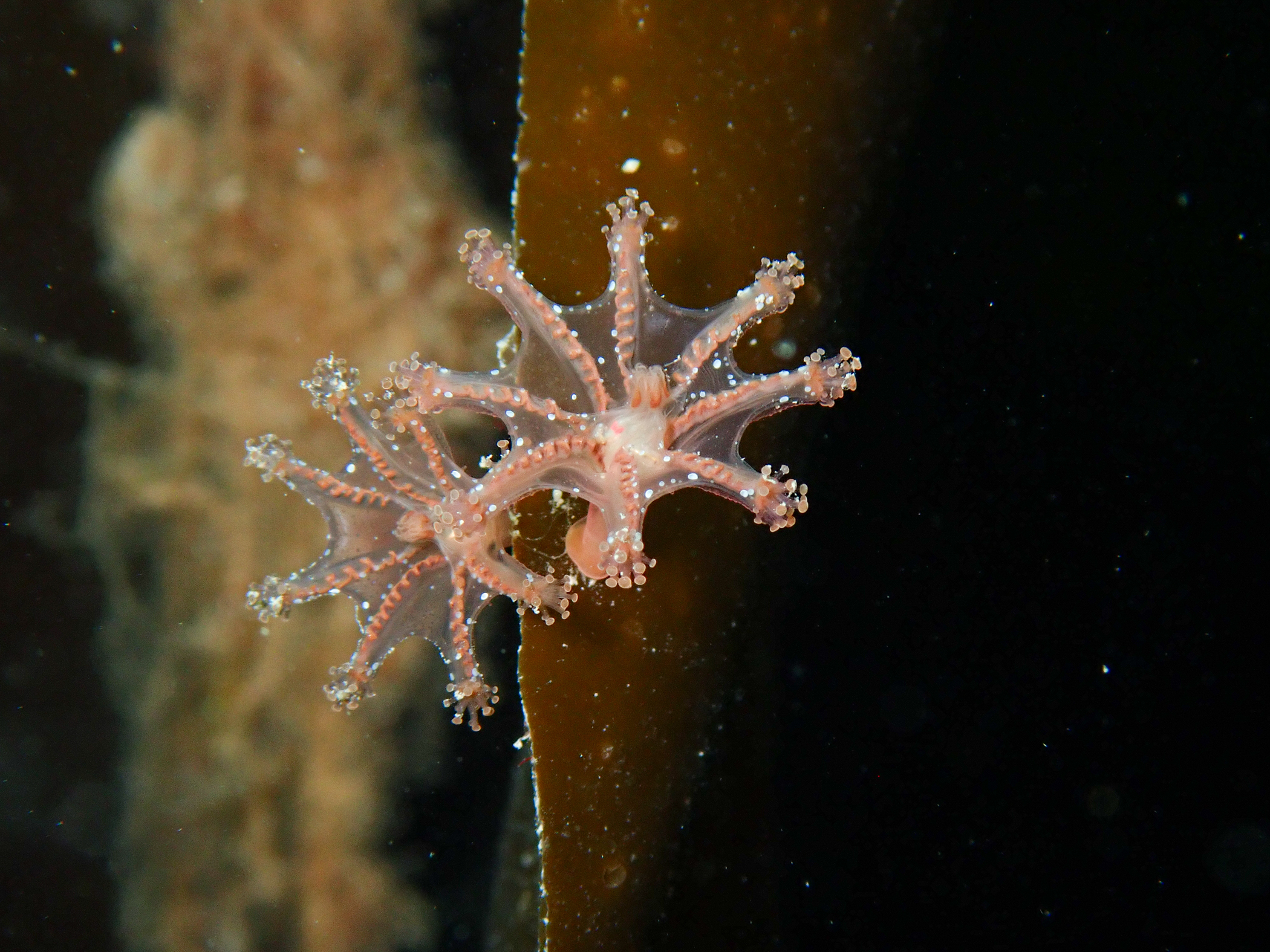
Species description: This small, stalked jellyfish has a body shaped like a funnel or bell up to 35 mm in diameter which is attached with a stalk that ends in an adhesive disc. It is usually pale pink to red in colour but can also be a pale olive green. It typically has 8 equally sized arms, ending in knobbed tentacles (secondary tentacles). The arms, bell and stalk are usually all similar in colour and the outer surface of the bell is granular in texture. This species does not have primary tentacles/anchors between the arms. There are nematocysts (stinging cells) visible as white spots on the bell between and around the arms.
Life cycle: Unknown.
Similar species: There are several species of stalked jellyfish found in Britain and Ireland, but careful examination of key features often allows for in situ identification. If in doubt several good quality photographs showing the bell, stalk, arms and tentacles should be sufficient for ID. This species doesn't possess primary tentacles/anchors but does possess nematocysts which are clearly visible inside the bell.
How to see this species: Typically found attached to seaweed or the seagrass Zostera marina; less commonly on rocks. Found from lower shore to around 10 m depth.
Current status: Declining. There are scattered records around the coasts of Britain and Ireland. Few records from east coast of Scotland/England. Possibly under-recorded due to seasonality and small size.
Why is this species a priority in Northern Ireland?
- Criterion 1: Internationally listed species.
- Criterion 2: Decline based on available data and expert judgement.
- Criterion 3: Rare or restricted range – rare breeding species confined to 5 hectads or less (based on expert judgement).
Threats: No threats specific to this species are known, however climate change, water quality issues and habitat degradation are likely to play a factor.
Action: Records of new sites for this species, with details of habitat and population are always valuable. Observations with a photograph can be recorded using iNaturalist, find the MBDP-NI iNaturalist project here.
Alternatively, records can be sent to CEDaR, National Museums Northern Ireland, 153 Bangor Road, Cultra, Holywood, County Down, BT18 0EU. Tel 028 9039 5257, e-mail cedar.records@nationalmuseumsni.org, or via the online portal.
Objectives:
- Maintain the number of viable populations of the species and safeguard their habitat.
- Establish range limits and maintain the range of the species.
- Establish appropriate management of known sites where possible.
Conservation:
- There is a Habitat Action Plan for Seagrass Beds with the relevant objective of maintaining the extent, quality and distribution of seagrass beds in Northern Ireland.
Distribution Map from NBN: Calvadosia campanulata at National Biodiversity Network mapping facility, data for UK.
iNaturalist: Calvadosia campanulata at iNaturalist World Species Observations database.
WoRMS: Calvadosia campanulata at World Register of Marine Species. Accepted name: Calvadosia campanulata (Lamouroux, 1815). AphiaID: 886183.
Classification: Biota; Animalia; Cnidaria; Medusozoa; Staurozoa; Stauromedusae; Amyostaurida; Kishinouyeidae; Calvadosia
| Previous species | Next species |
| Picton, B.E., Keatley, L. & Morrow, C.C. (2026). Calvadosia campanulata. (Lamouroux, 1815). [In] Priority species, Marine Biodiversity Portal NI. https://www2.habitas.org.uk/marbiop-ni/priorityaccounts.php?item=D290. Accessed on 2026-09-13 |