
Northern Ireland Priority species (NIPS)
| CNIDARIA : Leptothecata : Sertulariidae | SEA ANEMONES AND HYDROIDS |
Diphasia alata (Hincks, 1855)
 |
| Diphasia alata |
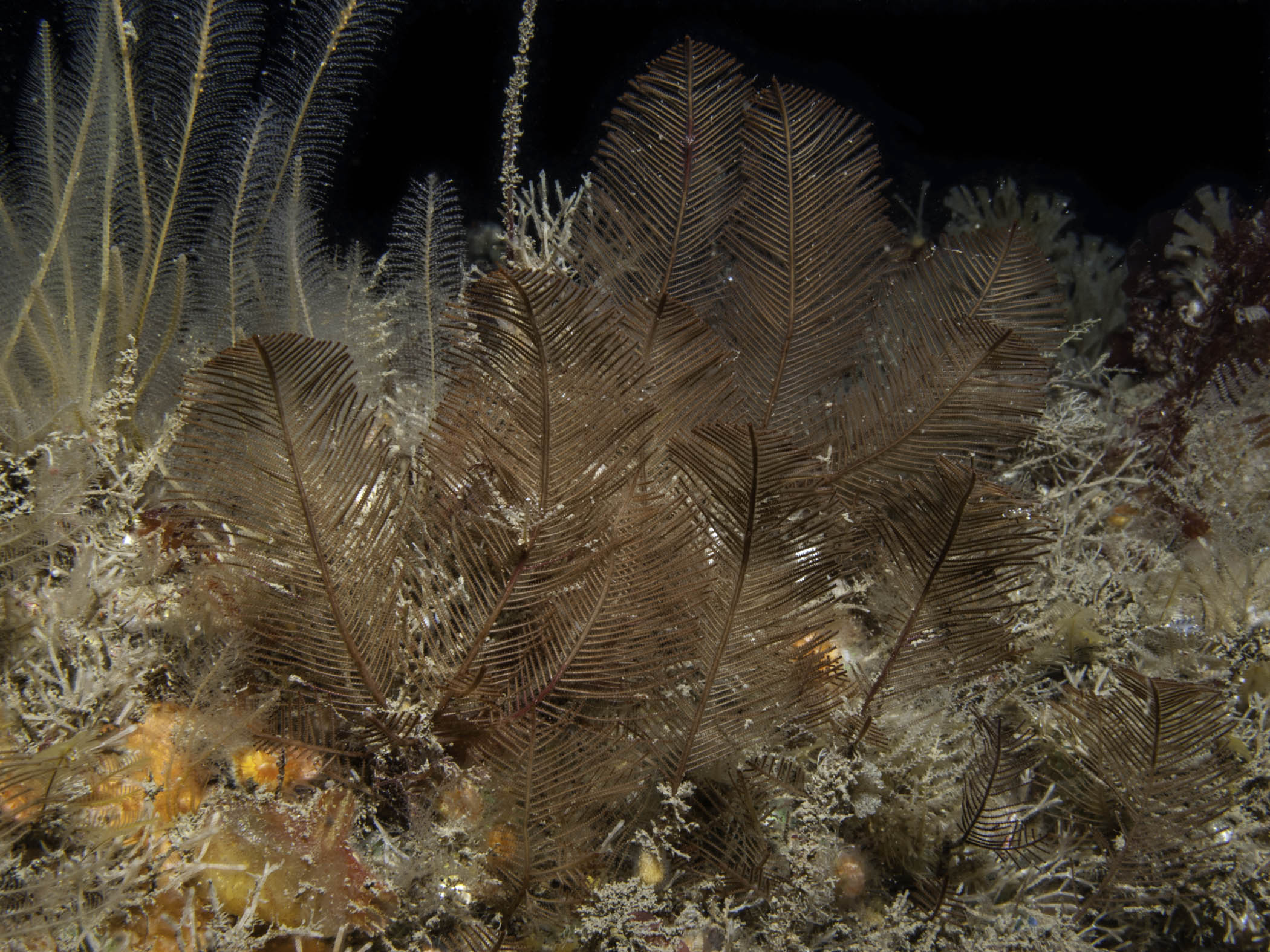
Hydroids are a group of animals which are related to sea anemones, corals and jellyfish. Most of them consist of plant-like branching colonies of small zooids, each of which has a ring of tentacles with stinging cells, surrounding a mouth. In some species the branching is very irregular and the zooids are free at the tips of the branches, whilst in other groups the branching is very regular and rather like a feather or a branch of a fir tree, with the zooids enclosed in a protein container. This species is of the latter type, with large numbers of small zooids arranged on branching, two-dimensional fir-like fronds.
In brief
- Populations of this species occur on the east coast of Rathlin Island and at the Maidens near Larne, on the Antrim coast.
- In Northern Ireland this species is most abundant on low-lying rock reefs or boulders adjacent to gravel which may contain scallops.
- Lives in the sea at depths of 25-580 m or more on open coasts with strong tidal streams.
- Scarce in Northern Ireland and almost unknown elsewhere in Britain and Ireland.
- Life cycle unknown, new branches probably arise yearly from a perennial base.
- Threatened primarily by bottom fishing with trawls or dredges which roll or remove the boulders.
Species description: Colony pinnate with the main stem straight and thick and the side branches alternate. The side branches increase in length towards the colonies base, giving a triangular outline to the apex of the colony. The hydrothecae are arranged in opposite pairs and are attached to the side branches for about two-thirds of their length. The outer rim of the hydrotheca is smooth and flared and there is a single, rounded opercular flap. Both the male and female gonothecae are small, quadrangular in shape and taper towards the base. Each corner of the capsule forms a projection which curves inwards towards the centre of the theca. The colour of the colony in life is a distinctive chocolate brown. Colony typically 100-130 mm in height by 60 mm in width.
Life cycle: Colonies produce gonothecae in early summer and presumably release planktonic larvae. No other details known.
Similar species: Several other smaller Diphasia species exist in almost the same habitat. Diphasia pinaster has a main stem hardly differentiated from the side branches and Diphasia alata is dark brown in life.
How to see this species: This is a deep water species most likely to be seen by divers visiting the seabed on the east coast of Rathlin Island or the Maidens, both in the North Channel.
Current status: Rare and undergoing rapid decline. Populations of this species occur on the east coast of Rathlin Island and at the Maidens near Larne, on the Antrim coast. The main stronghold for this species in Northern Ireland was the east coast of Rathlin Island where it was quite common in 30-50 m depth attached to boulders on a stable gravel seabed. This area has changed considerably since 1986 and when visited in 2005 by divers and a Remote Operated Vehicle (ROV) it was found that the boulders have mostly been removed, presumably by scallop dredging activities. The hydroid is still quite frequent on bedrock reefs in the area. Northern Ireland is thought to be the Irish and UK stronghold.
Why is this species a priority in Northern Ireland?
- Criterion 2: Decline based on available data and expert judgement.
- Criterion 3: Rare or restricted range – rare breeding species confined to 5 hectads or less (based on expert judgement).
- Criterion 4: NI stronghold or endemic – both stronghold range/population and designation as ‘endemic’ subject to expert judgement.
Threats: The main threat to this species is scallop dredging and other forms of bottom fishing.
Action: Records of new sites for this species, with details of habitat and population are always valuable. Observations with a photograph can be recorded using iNaturalist, find the MBDP-NI iNaturalist project here.
Alternatively, records can be sent to CEDaR, National Museums Northern Ireland, 153 Bangor Road, Cultra, Holywood, County Down, BT18 0EU. Tel 028 9039 5257, e-mail cedar.records@nationalmuseumsni.org, or via the online portal.
Objectives:
- Maintain the number of viable populations of the species.
- Establish appropriate management on suitable historical sites.
- Check and monitor populations in the North Channel.
Conservation:
- Rathlin Island is a Marine Protected Area with multiple designations.
- Sites on Rathlin Island with previous records were surveyed in 2005 by the Ulster Museum during the Sponge Biodiversity of Rathlin Island project.
- There is a Habitat Action Plan for Tide-swept Channels.
- The Maidens are a Marine Protected Area with multiple designations.
Distribution Map from NBN: Diphasia alata at National Biodiversity Network mapping facility, data for UK.
iNaturalist: Diphasia alata at iNaturalist World Species Observations database.
WoRMS: Diphasia alata at World Register of Marine Species. Accepted name: Diphasia alata (Hincks, 1855). AphiaID: 117876.
Classification: Biota; Animalia; Cnidaria; Medusozoa; Hydrozoa; Hydroidolina; Leptothecata; Sertularioidea; Sertulariidae; Diphasia
| Previous species | Next species |
| Picton, B.E., Keatley, L. & Morrow, C.C. (2026). Diphasia alata. (Hincks, 1855). [In] Priority species, Marine Biodiversity Portal NI. https://www2.habitas.org.uk/marbiop-ni/priorityaccounts.php?item=D6370. Accessed on 2026-09-13 |