
Northern Ireland Priority species (NIPS)
| CNIDARIA : Actiniaria : Edwardsiidae | SEA ANEMONES AND HYDROIDS |
Edwardsia timida de Quatrefages, 1842
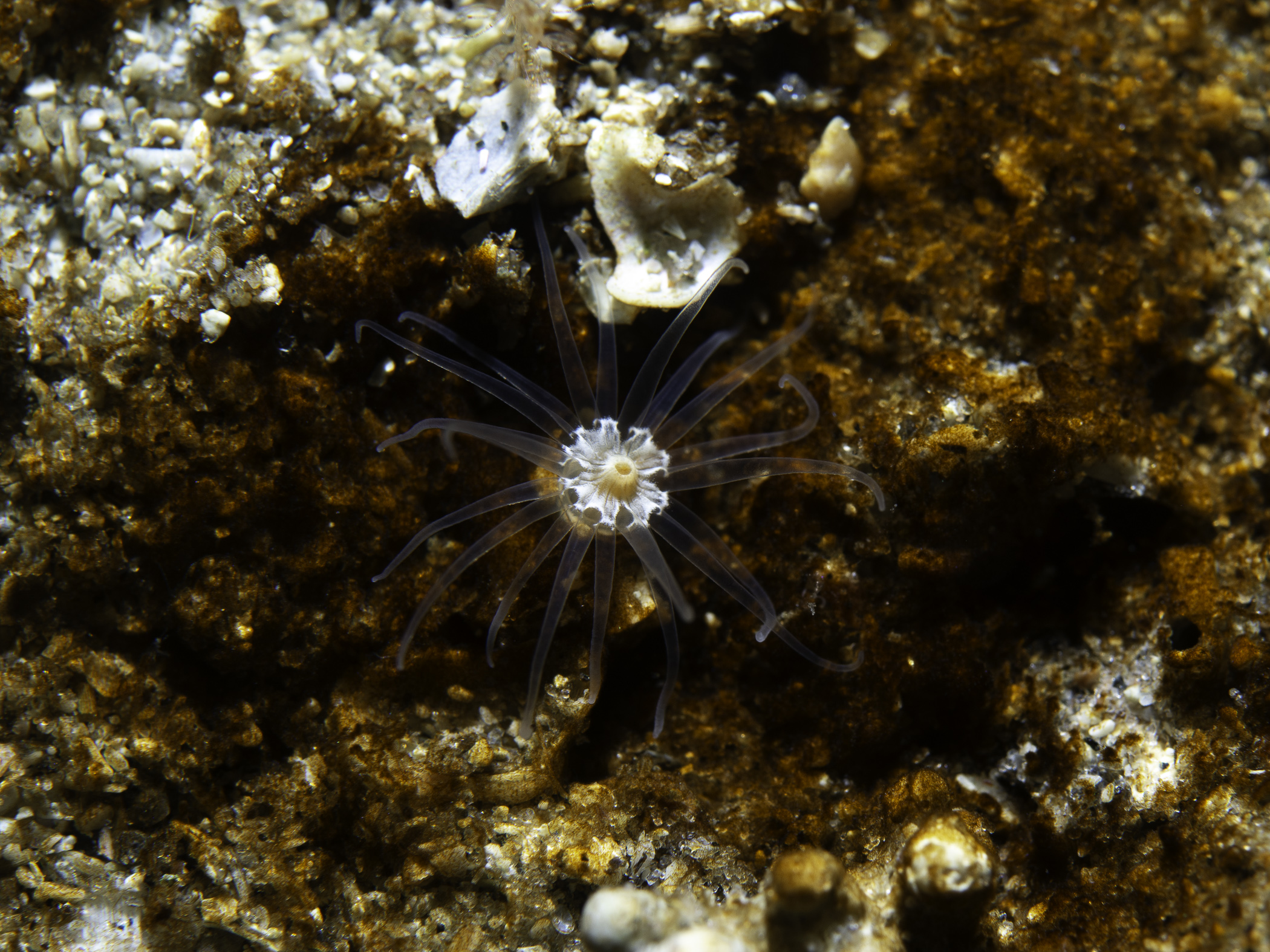 |
| Edwardsia timida |
This sea anemone is long and thin and lives with its body completely buried in muddy gravel.
In brief
- In Northern Ireland this species is found only in Strangford Lough, with one potential record from Rathlin Island.
- Lives on the lower shore in sheltered inlets of the sea, buried in muddy gravel.
- Individuals can be numerous in suitable habitats, but these habitats seem to be rare.
- Sea anemone known to have very limited populations in Britain and Ireland.
- Threatened primarily by disturbance of the small part of the shore where it is found.
Species description: This burrowing sea anemone has an elongated and worm-like column which is divided into a scapus and scapulus. The scapus has a soft, adherent cuticle and a naked rounded base. There are 16-32 tentacles, arranged in three cycles with four in the primary cycle. The colour of the disc, tentacles and scapulus is translucent pale orange, usually patterned with opaque white or cream, tentacles plain or with white tips. The column is up to 70 mm long and 5 mm diameter, span of tentacles to 40 mm.
Life cycle: Oviparous with the eggs hatching into planula larvae which develop into small anemones in two months.
Similar species: There are several other small burrowing anemones but all the others have fewer than 20 tentacles apart from Edwardsiella carnea, but this species lives in rock crevices or borings in limestone and is not buried free in gravel.
How to see this species: The population has been known for many years at Ballyhenry Island, Strangford Lough. The shore of the Lough is designated as an ASSI and it is not recommended that anyone should search for this animal without getting advice and permission in advance. There is a record from Rathlin Island but there is no photograph or specimen, and has not been seen there since, so this requires further investigation.
Current status: Rare and declining. In Northern Ireland this species is found only in Strangford Lough, and possibly around Rathlin Island. The other well-known population in the Irish Sea is in the Menai Strait, where it also occurs in the sublittoral. The only other Irish locality at Malahide has been severely altered and the species has not been found there for many years. Northern Ireland is a stronghold for this species.
Why is this species a priority in Northern Ireland?
- Criterion 2: Decline based on available data and expert judgement.
- Criterion 3: Rare or restricted range – rare breeding species confined to 5 hectads or less (based on expert judgement).
- Criterion 4: NI stronghold or endemic – both stronghold range/population and designation as ‘endemic’ subject to expert judgement.
Threats:
- Population is vulnerable to disturbance by shore collectors, especially student field courses.
- Vulnerable to habitat degradation and poor water quality.
Action: Records of new sites for this species, with details of habitat and population are always valuable. Observations with a photograph can be recorded using iNaturalist, find the MBDP-NI iNaturalist project here.
Alternatively, records can be sent to CEDaR, National Museums Northern Ireland, 153 Bangor Road, Cultra, Holywood, County Down, BT18 0EU. Tel 028 9039 5257, e-mail cedar.records@nationalmuseumsni.org, or via the online portal.
Objectives:
- Maintain the number of viable populations of the species.
- Establish appropriate management on suitable historical sites.
- Investigate biology of species and survey shallow sublittoral in the area for sublittoral extension to the habitat and population.
Conservation:
- Strangford Lough is Marine Protected Area with multiple designations.
- Implementation of the Northern Ireland Habitat Action Plan for Subtidal Sands and Gravel.
- Rathlin Island is a Marine Protected Area with multiple designations.
Distribution Map from NBN: Edwardsia timida at National Biodiversity Network mapping facility, data for UK.
iNaturalist: Edwardsia timida at iNaturalist World Species Observations database.
WoRMS: Edwardsia timida at World Register of Marine Species. Accepted name: Edwardsia timida Quatrefages, 1842. AphiaID: 100892.
Classification: Biota; Animalia; Cnidaria; Anthozoa; Hexacorallia; Actiniaria; Anenthemonae; Edwardsioidea; Edwardsiidae; Edwardsia
| Previous species | Next species |
| Picton, B.E., Keatley, L. & Morrow, C.C. (2026). Edwardsia timida. de Quatrefages, 1842. [In] Priority species, Marine Biodiversity Portal NI. https://www2.habitas.org.uk/marbiop-ni/priorityaccounts.php?item=D13440. Accessed on 2026-09-13 |