
Northern Ireland Priority species (NIPS)
| CNIDARIA : Actiniaria : Haloclavidae | SEA ANEMONES AND HYDROIDS |
Anemonactis mazeli (Jourdan, 1880)
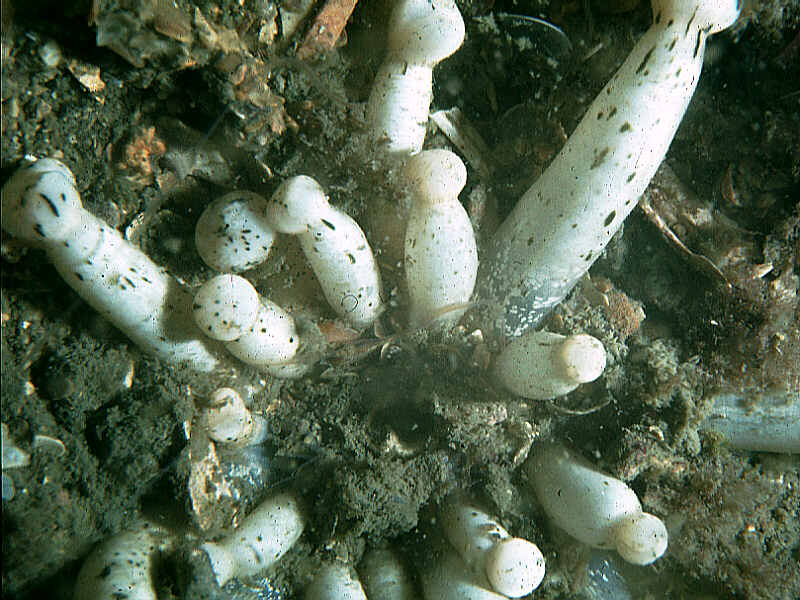 |
| Anemonactis mazeli |
This is a large, pale, burrowing anemone with stout blunt tentacles so far the only confirmed Northern Ireland record from a single location in Strangford Lough. It has been suggested that the species found in Strangford Lough may be different from those recorded under this name from Plymouth and other suitable areas to the south of this.
In brief
- A rare anemone; in Northern Ireland, found only in Strangford Lough and the north coast.
- Inhabits sands and muds to depths down to 1,000 m.
- Can be found throughout the year.
- A priority on account of its rarity, and threats to its known sites.
- Likely to be vulnerable to seabed disruption.
Species description: The main body of the anemone is a pale elongate column about 120 mm in length, buried in mud or sand and often encrusted with sediment particles. It has 20 stout tentacles, each a cylindrical shaft with a knob at the end. The diameter across the tentacle crown is about 60mm, and at the centre of this, the disc has dark radial lines against (variously) a cream to orange background. The animal’s general colour varies from translucent to various shades of white, cream and orange.
Life cycle: The life cycle is not known; however, the conservation status of the species is likely to be dependent, in part, on the ability to produce mobile larvae, and the extent of their dispersal.
Similar species: None.
How to see this species: This anemone may be found subtidally at depths variously reported from the shallow sublittoral to 1,000 m, burrowed quite deeply in sands and muds. It can be seen throughout the year. In Northern Ireland it has been confirmed from one site in Strangford Lough (Bird Island Passage). There are anecdotal accounts off the Portrush Skerries, and Portstewart Point however these are uncomformed. Further afield, it occurs on all the main coasts of Ireland.
Current status: Rare. Difficult to spot as it is usually buried. The species has no legal protection status.
Why is this species a priority in Northern Ireland?
- Criterion 3: Rare or restricted range – rare breeding species confined to 5 hectads or less (based on expert judgement).
Threats: Trends of populations and distribution of the species are not known. However its sand and mud habitats are vulnerable to disruption by use of bottom fishing gear, and both Strangford Lough and the north coast have been subject to this.
Action: Records of new sites for this species, with details of habitat and population are always valuable. Observations with a photograph can be recorded using iNaturalist, find the MBDP-NI iNaturalist project here.
Alternatively, records can be sent to CEDaR, National Museums Northern Ireland, 153 Bangor Road, Cultra, Holywood, County Down, BT18 0EU. Tel 028 9039 5257, e-mail cedar.records@nationalmuseumsni.org, or via the online portal.
Objectives:
- Maintain the number of viable populations of the species and safeguard their habitat.
- Maintain the range of the species.
- Establish appropriate management of known sites.
Conservation:
- Strangford Lough is Marine Protected Area with multiple designations.
- There is no Species Action Plan for Anemonactis mazeli; however, the Habitat Action Plan for Subtidal Sands and Gravel has the following relevant objectives: protect the extent and quality of a representative range of subtidal sand and gravel habitats and communities.
Distribution Map from NBN: Anemonactis mazeli at National Biodiversity Network mapping facility, data for UK.
iNaturalist: Anemonactis mazeli at iNaturalist World Species Observations database.
WoRMS: Anemonactis mazeli at World Register of Marine Species. Accepted name: Anemonactis mazeli (Jourdan, 1880). AphiaID: 100924.
Classification: Biota; Animalia; Cnidaria; Anthozoa; Hexacorallia; Actiniaria; Enthemonae; Actinioidea; Haloclavidae; Anemonactis
| Previous species | Next species |
| Adapted from text by Allen & Mellon Environmental Ltd. (2026). Anemonactis mazeli. (Jourdan, 1880). [In] Priority species, Marine Biodiversity Portal NI. https://www2.habitas.org.uk/marbiop-ni/priorityaccounts.php?item=D13090. Accessed on 2026-09-13 |