
Northern Ireland Priority species (NIPS)
| CNIDARIA : Actiniaria : Capneidae | SEA ANEMONES AND HYDROIDS |
Capnea sanguinea Forbes, 1841
Imperial anemone
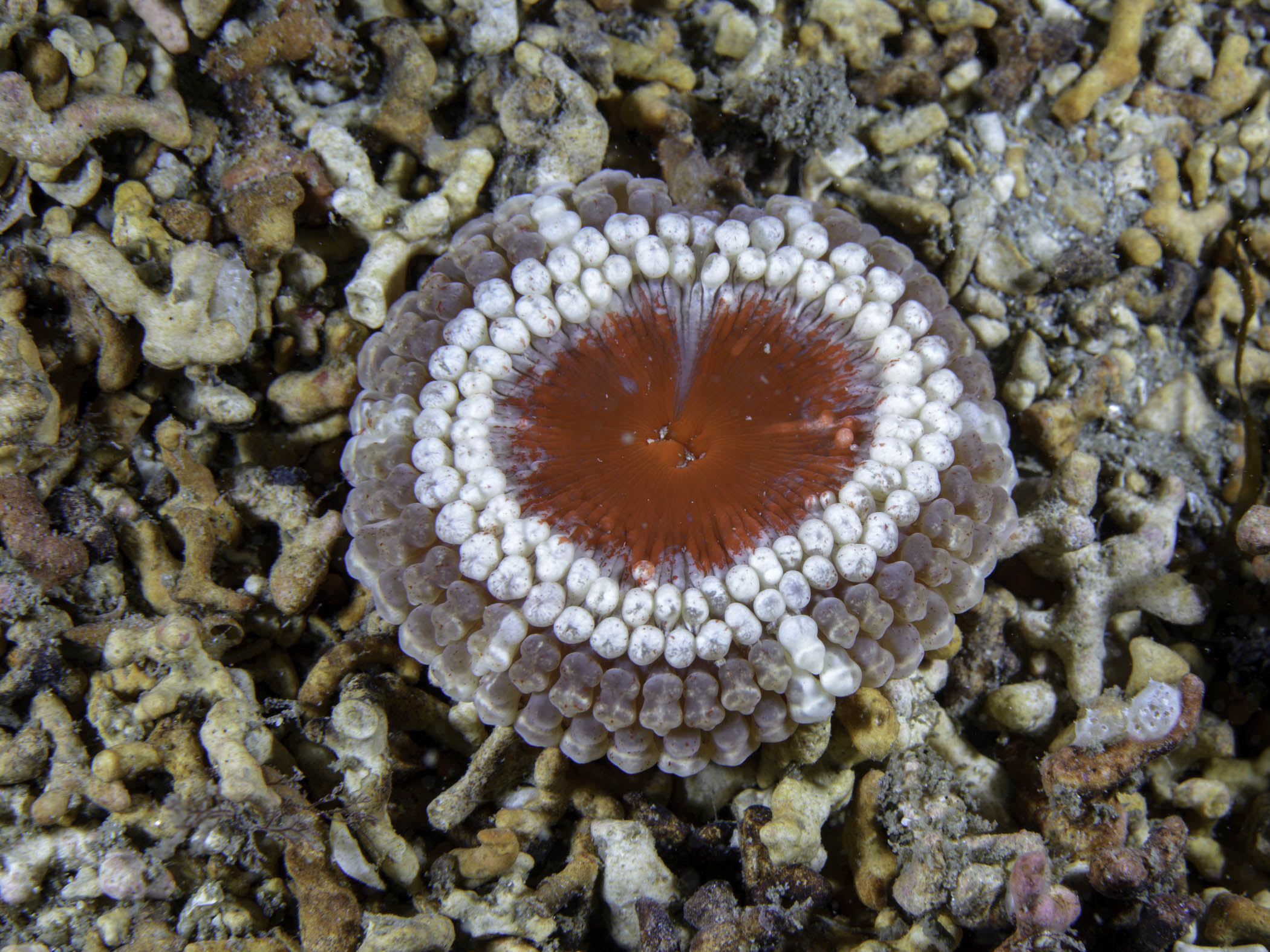 |
| Capnea sanguinea |
A very distinctive anemone occurring at a number of sites in County Antrim and in Strangford Lough, comprising the majority of recorded sites in Ireland. Its habitat of sands, gravels and maerl is vulnerable to disturbance from fisheries and aggregate extraction.
In brief
- Found off Rathlin Island, mainland County Antrim, and off reefs in the inner parts of Strangford Lough.
- Occurring in sands, gravels and maerl.
- Can be seen year round.
- Northern Ireland holds the majority of the recorded sites in Ireland.
- Main threats come from use of mobile fishing gear; aggregate extraction could become a problem in future.
Species description: This is a large and very distinctive sea anemone, with a base some 70-90 mm in diameter, and broader than the relatively short column, thus giving the animal a bell-like shape. The column has an upper collar, and within that, some 150 very short tentacles arranged in four concentric rings, each terminating in a knob. Colour varies from bright red (most common), yellow or purplish, whilst the central disc and tentacles are sometimes grey, white or brownish, and can be quite blotchy in appearance. When disturbed by nearby movements or disruption of sediments, the animal can rapidly retract its disc and tentacles. The tentacles have relatively few stinging or adhesive cells (nematocysts), and food particles are taken in by everting the throat.
Life cycle: There is currently no information on the life cycle of this species in Northern Ireland or adjacent waters.
Similar species: No other species has the characteristic array of very short tentacles.
How to see this species: Capnea sanguinea can be found embedded in sands, gravels and maerl, most generally subtidally to depths of 600 m, and occasionally in lower shores holding this type of substrate. In Northern Ireland it occurs at a number of sites; Church Bay Rathlin, Red Bay, off the Maidens, Gobbins, and in Strangford Lough at Bird Island Passage, off Pawle Island, Colin Rock, Limestone Rock. Only two other locations are recorded in Ireland, namely St John’s Point, Donegal and Kilkieran Bay, Galway. In Britain it is found off western Scotland and Hebrides, Calf of Man, Pembrokeshire, southern England; further afield its range includes European coasts of the Atlantic and Mediterranean.
Current status: Scarce and declining. In Northern Ireland this species is known from only four locations on the Antrim coast, and four within Strangford Lough, and these represent the majority of the Irish records. It has no legal protection. Northern Ireland holds over 50 per cent of the Irish population, and possibly as much as 20 per cent of the UK population.
Why is this species a priority in Northern Ireland?
- Criterion 3: Rare or restricted range – rare breeding species confined to 5 hectads or less (based on expert judgement).
Threats: Because of its predominantly southern distribution relative to Northern Ireland, there may be some possibility that the species may extend its range northwards if sea temperatures continue to increase. However, the present population is threatened by the vulnerability of its habitat. Sands, gravels and maerl beds can be heavily impacted by mobile bottom fishing gear, resulting in loss of longer-lived species with slower rates of reproduction. Extraction of aggregates for the building industry would pose a similar threat.
Action: Records of new sites for this species, with details of habitat and population are always valuable. Observations with a photograph can be recorded using iNaturalist, find the MBDP-NI iNaturalist project here.
Alternatively, records can be sent to CEDaR, National Museums Northern Ireland, 153 Bangor Road, Cultra, Holywood, County Down, BT18 0EU. Tel 028 9039 5257, e-mail cedar.records@nationalmuseumsni.org, or via the online portal.
Objectives:
- Maintain the number of viable populations of the species in Northern Ireland.
- Maintain the range of the species in a Northern Ireland and all-Ireland context.
- Establish appropriate management of known sites.
Conservation:
- Strangford Lough is a Marine Protected Area with multiple designations.
- Rathlin Island is a Marine Protected Area with multiple designations.
- There are Habitat Action Plans for Maerl Beds, with the relevant objective - maintain extent, variety and quality of maerl beds and associated plant and animal communities in Northern Ireland, subject to best available information, and Subtidal Sands and Gravels with the relevant objective - protect the extent and quality of a representative range of subtidal sand and gravel habitats and communities.
Distribution Map from NBN: Capnea sanguinea at National Biodiversity Network mapping facility, data for UK.
iNaturalist: Capnea sanguinea at iNaturalist World Species Observations database.
WoRMS: Capnea sanguinea at World Register of Marine Species. Accepted name: Capnea sanguinea Forbes, 1841. AphiaID: 410805.
Classification: Biota; Animalia; Cnidaria; Anthozoa; Hexacorallia; Actiniaria; Enthemonae; Actinostoloidea; Capneidae; Capnea
| Previous species | Next species |
| Adapted from text by Allen & Mellon Environmental Ltd. (2026). Capnea sanguinea. Forbes, 1841. [In] Priority species, Marine Biodiversity Portal NI. https://www2.habitas.org.uk/marbiop-ni/priorityaccounts.php?item=D11860. Accessed on 2026-09-13 |