
Northern Ireland Priority species (NIPS)
| CNIDARIA : Zoantharia : Parazoanthidae | SEA ANEMONES AND HYDROIDS |
Parazoanthus axinellae (Schmidt, 1862)
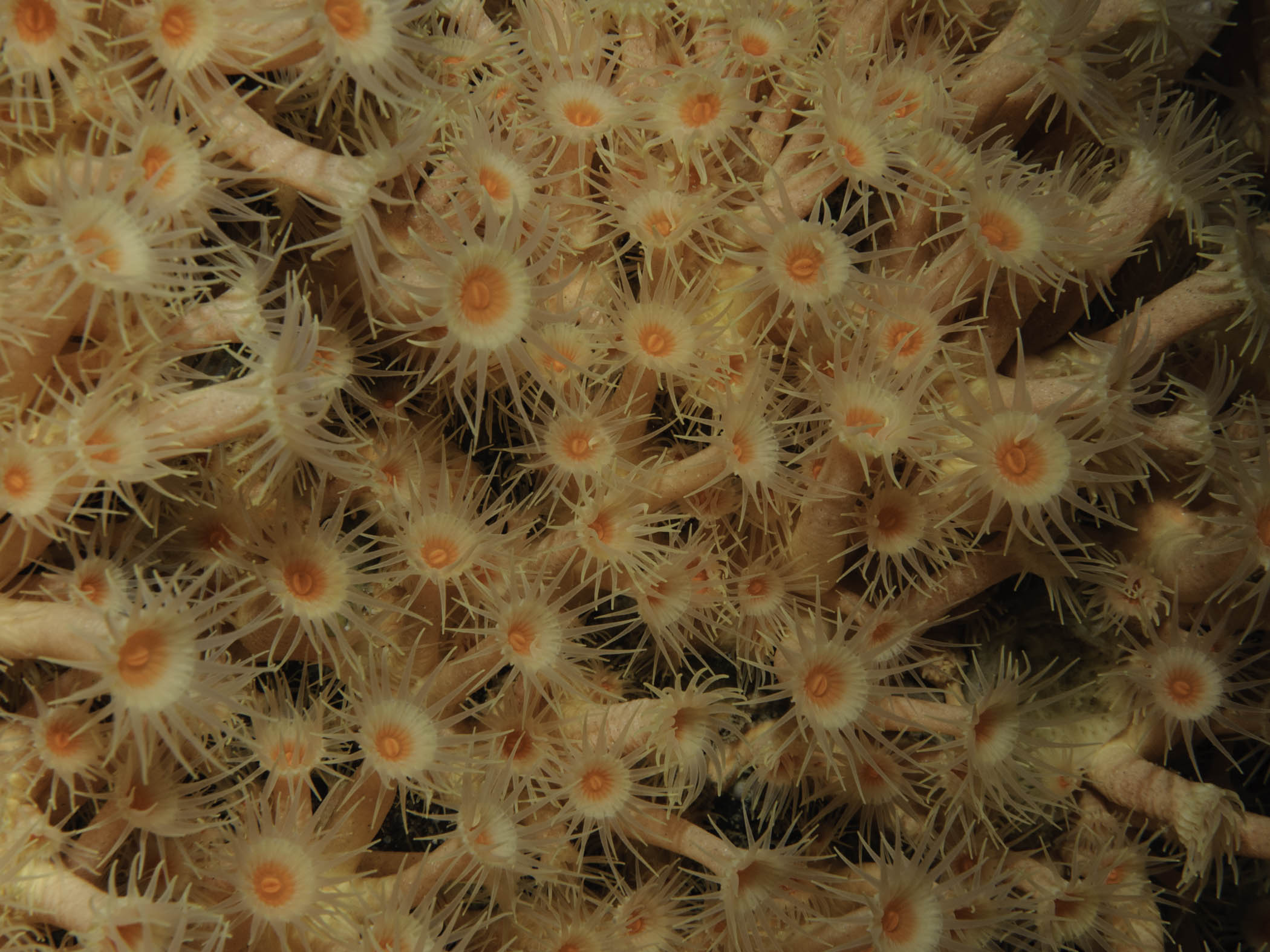 |
| Parazoanthus axinellae |
A yellow colonial sea anemone, in Northern Ireland known only from Rathlin Island. It may be vulnerable to disruption of its habitat by fishing in some locations.
In brief
- Found at western end of the north coast of Rathlin Island.
- Grows on sponges and rocks.
- Can be found throughout the year.
- Listed as a priority because of its rarity in Northern Ireland.
- There are few major threats to the species, but disruption of its habitat by fisheries is a possibility in some locations.
Species description: Parazoanthus axinellae is a colonial anemone forming encrustations in discreet clumps of variable thickness and shape. Individual polyps are up to 20 mm in height and 5 mm in diameter and are coloured a bright yellow, with orange around the mouth. The column is often encrusted with sand particles or sponge spicules (sponge skeletal structures) and its top is serrated. Between 26 and 34 pointed tentacles are arranged in two circles, the outer of these being more horizontal.
Life cycle: The sexes are separate; spawning takes place during the summer, and it is likely that planktonic larvae are produced. However, colonies are also expanded by fission, that is, partition of individuals into replicas of themselves; some workers consider this asexual method to be more important to reproduction that the sexual one.
Similar species: Parazoanthus anguicomis, has more tentacles, is generally white, and colonies tend to form more extensive sheets. P. axinellae is also larger than Isozoanthus sulcatus and Epizoanthus couchii.
How to see this species: The species is found on open coasts, at depths ranging from 6 to 100 m, on rocky habitats, often attached to rocks and sponges, and often on vertical faces or beneath rocky overhangs. Four sites on Rathlin Island have been recorded, at the western end of its north coast, and elsewhere in Ireland it has been recorded in Donegal Bay, off Achill Island, Loop Head and Old Head of Kinsale, and in Britain, in Pembrokeshire and Cornwall.
Current status: Rare and declining. In Northern Ireland, known only from Rathlin Island, four sites. The species has no legal protection. Scarce throughout Britain and Ireland.
Why is this species a priority in Northern Ireland?
- Criterion 2: Decline based on available data and expert judgement.
- Criterion 3: Rare or restricted range – rare breeding species confined to 5 hectads or less (based on expert judgement).
Threats: No particular threats are identified, but where the species occurs in more level areas of seabed, it may be vulnerable to mobile fishing gear.
Action: Records of new sites for this species, with details of habitat and population are always valuable. Observations with a photograph can be recorded using iNaturalist, find the MBDP-NI iNaturalist project here.
Alternatively, records can be sent to CEDaR, National Museums Northern Ireland, 153 Bangor Road, Cultra, Holywood, County Down, BT18 0EU. Tel 028 9039 5257, e-mail cedar.records@nationalmuseumsni.org, or via the online portal.
Objectives:
- Maintain the number of viable populations of the species.
- Maintain the range of the species.
- Establish appropriate management of the Rathlin Island known sites, and any others that are discovered.
- Monitor population (or sample of) at known sites.
- Protect sites of conservation importance from damage through contamination and physical disturbance (for example, turbidity and towed fishing gear).
- Require EIAs for coastal developments to examine potential effects on intertidal and nearshore areas.
- Monitor any impact of dump sites on inshore sublittoral rock habitats, communities and wildlife, and taking action as appropriate.
- Implement strategies for managing the coastal zone at local, regional and national levels.
Conservation:
- Rathlin Island is a Marine Protected Area with multiple designations.
- There is a Habitat Action Plan for Fragile Sponge and Anthozoan Communities on Rocky Habitats.
Distribution Map from NBN: Parazoanthus axinellae at National Biodiversity Network mapping facility, data for UK.
iNaturalist: Parazoanthus axinellae at iNaturalist World Species Observations database.
WoRMS: Parazoanthus axinellae at World Register of Marine Species. Accepted name: Parazoanthus axinellae (Schmidt, 1862). AphiaID: 101055.
Classification: Biota; Animalia; Cnidaria; Anthozoa; Hexacorallia; Zoantharia; Macrocnemina; Parazoanthidae; Parazoanthus
| Previous species | Next species |
| Adapted from text by Allen & Mellon Environmental Ltd. (2026). Parazoanthus axinellae. (Schmidt, 1862). [In] Priority species, Marine Biodiversity Portal NI. https://www2.habitas.org.uk/marbiop-ni/priorityaccounts.php?item=D11150. Accessed on 2026-09-13 |