
Northern Ireland Priority species (NIPS)
| PORIFERA : Tetractinellida : Ancorinidae | SPONGES |
Stelletta grubii Schmidt, 1862
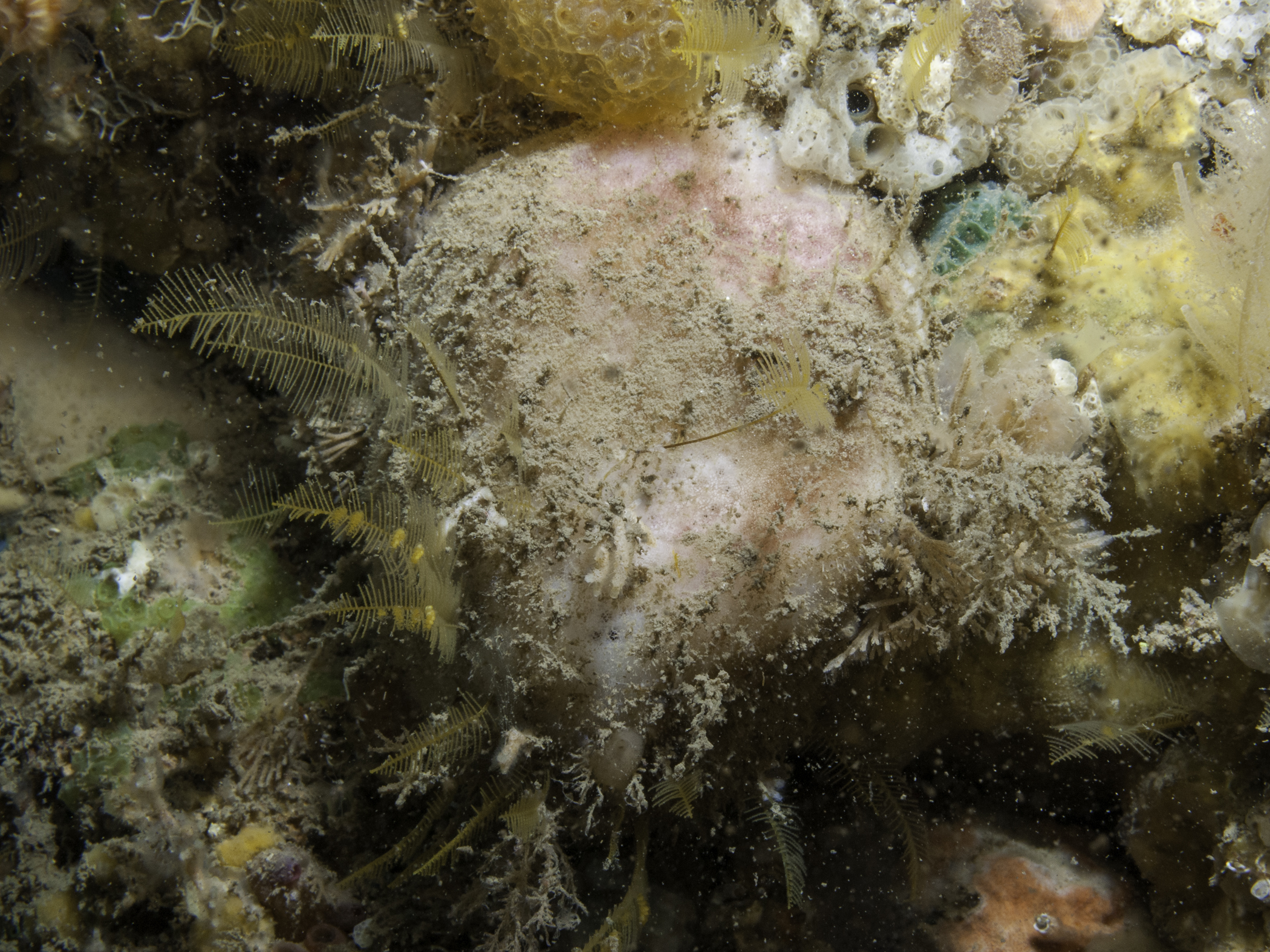 |
| Stelletta grubii |
A large round but inconspicuous sponge living both on current swept rocky overhangs and caves and in more sheltered silty areas. It is known from only three sites in Northern Ireland.
In brief
- Found on the north coast of Rathlin Island and off Ballintoy.
- Found in rock or boulder overhangs and caves in areas of tidal currents, but also in more enclosed silty areas.
- Can be found throughout the year.
- Listed as NIPS on account of its rarity.
- Main threats are shearing by lobster pot lines, this species is especially vulnerable due to its dependency on a very small number of sites where lobster potting is intensive.
Species description: A large round sponge, up to 30 cm in diameter, but despite its size often difficult to find because it is obscured by silt, or overgrown by sponges or other encrusting organisms. The thick surface layer is rough, sandpaper-like to the touch, and this is caused by dense quantities of skeletal structures or spicules in the surface layer. However, the interior of the sponge, where it has been broken open, is much softer.
Life cycle: Stelletta grubii is an oviparous sponge, it reproduces sexually by expelling unfertilized eggs (oocytes) or zygotes directly into the water column. Fertilization and the development of swimming larvae take place outside the body of the sponge.
Similar species: Stryphnus ponderosus is similar, but has a thinner surface layer and tends to be flatter or more encrusting in shape.
How to see this species: This sponge can be found on rock and boulders in overhangs and caves, particular where there is little light. Whilst it is often present in open areas with strong tidal currents, it also occurs in silty habitats within sea loughs. In Northern Ireland it is known only from three sites — two on Rathlin Island’s north coast, and one off Ballintoy. Elsewhere in Ireland it is found at several locations in Mulroy Bay, north Donegal Bay, Clare Island and Inishark. Further afield it is found from Shetland to the Mediterranean and in Britain off Anglesey, Pembrokeshire, and a few sites from Cornwall to the Isle of Wight.
Current status: Nationally scarce. Known from only three locations in Northern Ireland. Other records are from Wales. The species has no legal protection. Northern Ireland is considered a stronghold for this species.
Why is this species a priority in Northern Ireland?
- Criterion 3: Rare or restricted range – rare breeding species confined to 5 hectads or less (based on expert judgement).
- Criterion 4: NI stronghold or endemic – both stronghold range/population and designation as ‘endemic’ subject to expert judgement.
Threats:
- At risk of shearing due to lobster pot lines.
- It is especially vulnerable to any threats due to a dependency on a very limited number of sites.
Action: Records of new sites for this species, with details of habitat and population are always valuable. Observations with a photograph can be recorded using iNaturalist, find the MBDP-NI iNaturalist project here.
Alternatively, records can be sent to CEDaR, National Museums Northern Ireland, 153 Bangor Road, Cultra, Holywood, County Down, BT18 0EU. Tel 028 9039 5257, e-mail cedar.records@nationalmuseumsni.org, or via the online portal.
Objectives:
- Maintain viable populations of this species.
- Maintain the range of this species.
- Monitor the population (or a sample) at key locations.
Conservation:
- Rathlin Island is a Marine Protected Area with multiple designations, and has a ban on bottom fishing.
Distribution Map from NBN: Stelletta grubii at National Biodiversity Network mapping facility, data for UK.
iNaturalist: Stelletta grubii at iNaturalist World Species Observations database.
WoRMS: Stelletta grubii at World Register of Marine Species. Accepted name: Stelletta grubii Schmidt, 1862. AphiaID: 133974.
Literature:
Picton, B.E. and Morrow, C.C. (2007). [In] Encyclopedia of Marine Life of Britain and Ireland. http://www.habitas.org.uk/marinelife/species.asp?item=C1500.
Classification: Biota; Animalia; Porifera; Demospongiae; Heteroscleromorpha; Tetractinellida; Astrophorina; Ancorinidae; Stelletta
| Previous species | Next species |
| Picton, B.E., Keatley, L. & Morrow, C.C. (2026). Stelletta grubii. Schmidt, 1862. [In] Priority species, Marine Biodiversity Portal NI. https://www2.habitas.org.uk/marbiop-ni/priorityaccounts.php?item=C1500. Accessed on 2026-09-13 |