
| PORIFERA : Poecilosclerida : Hymedesmiidae | SPONGES |
Phorbas fictitius (Bowerbank, 1866)
 |
| Phorbas fictitius |
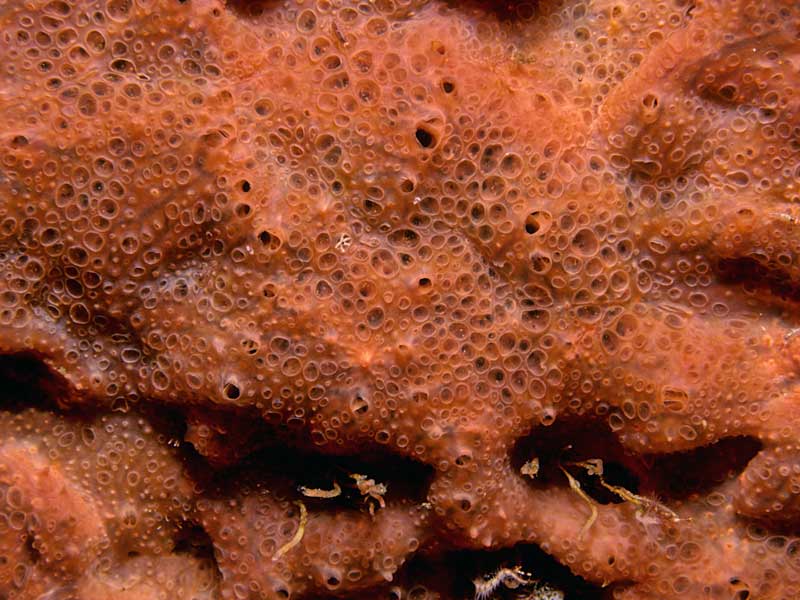
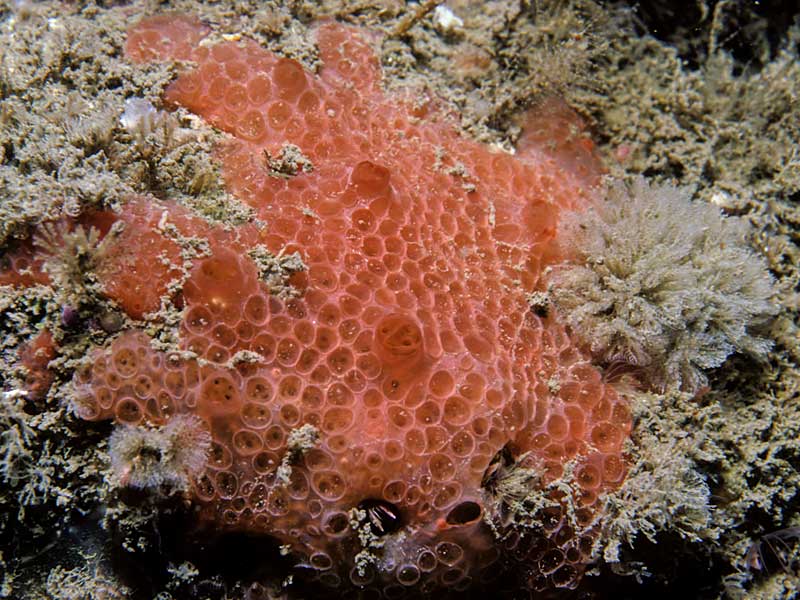
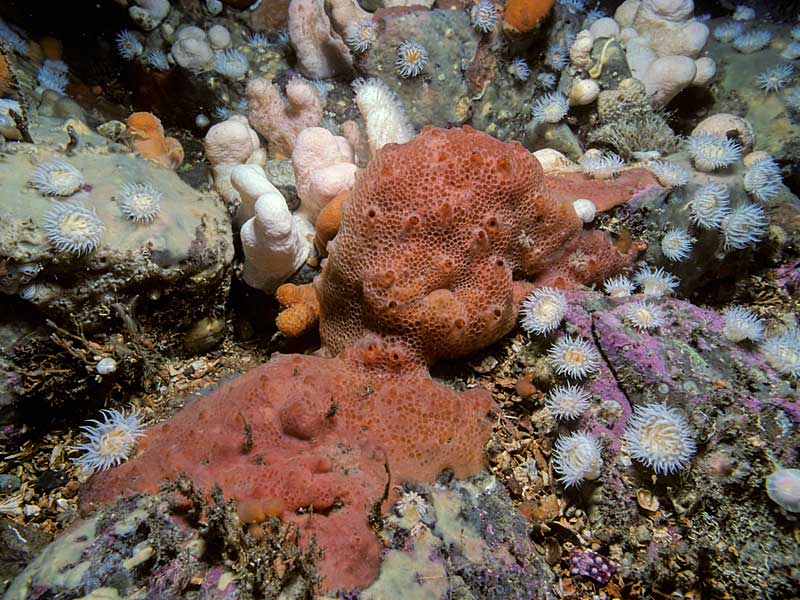
Form: Thin sheets to cushions, up to 14mm thick when contracted. Forms patches up to 30cm across.
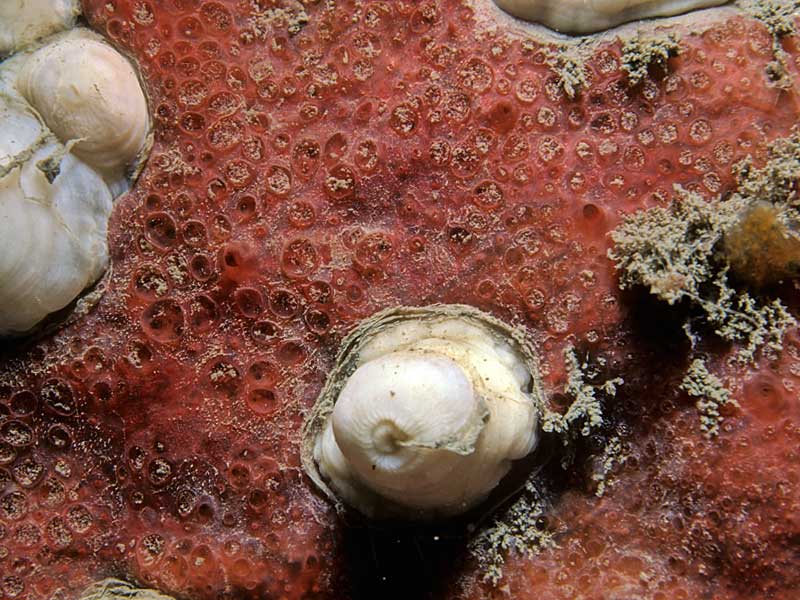
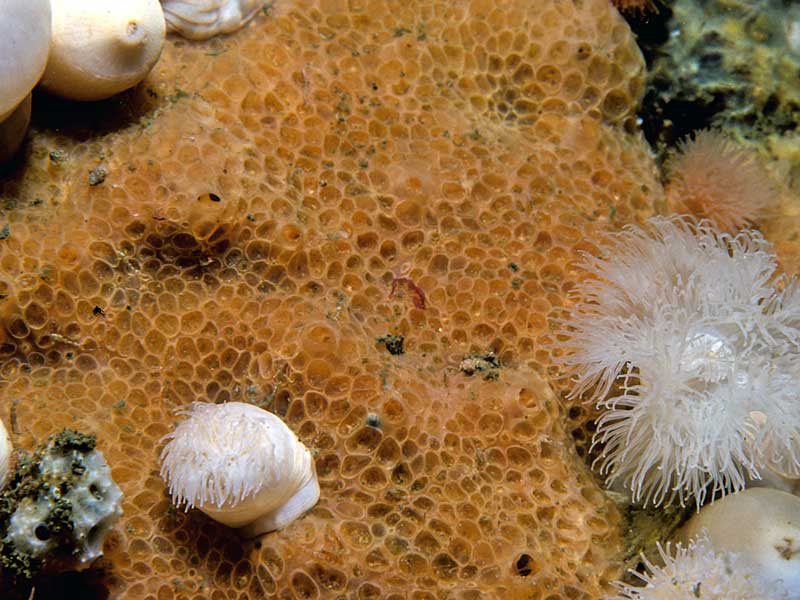
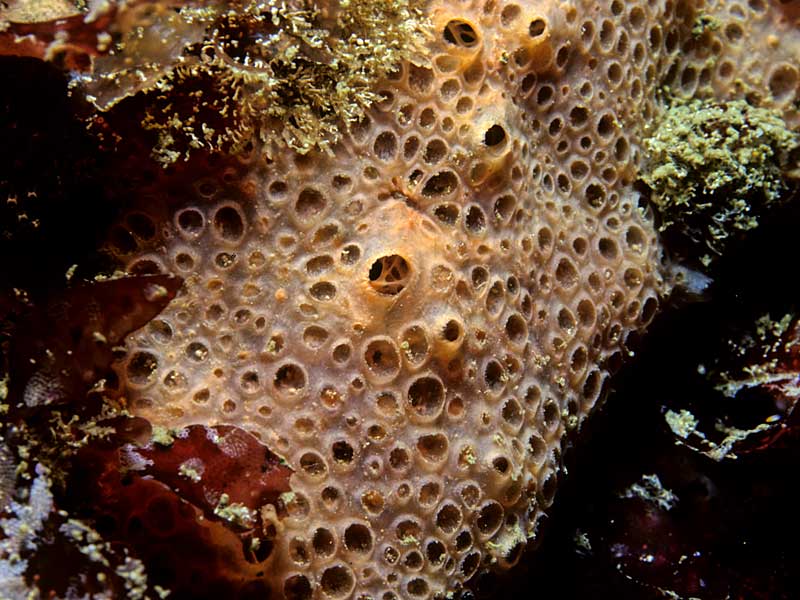
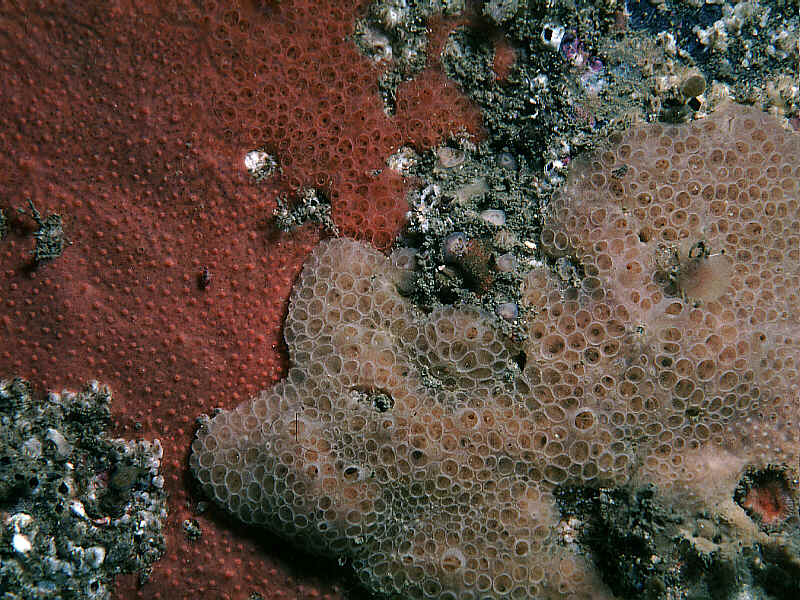
Colour: Variable. Grey, pale orange pink, to deep red. This is a species where the amount of pigment present generally reflects prevailing water clarity and illumination levels. On the west coast of Ireland it is normally bright red, while in turbid water in Stra
Smell: Present, but not strong.
Consistency: Firm, "compressible".
Surface: Smooth to slippery, with circular depressions containing inhalent pore sieves similar to those in Hemimycale columella, but the rims are the same colour as the rest of the sponge. Unlike Hemimycale the inhalent depressions contract in disturbed and collected specimens. The depressions are smaller at ca. 1mm (max 2mm) than in Hemimycale when out of the water, and are more uniform in diameter in any given specimen.
Apertures:
- Oscules are distinct, with raised translucent rims; raised oscular channels may be visible whilst in situ but disappear on preservation. Regularly distributed.
Contraction:
- Distinct: 25 - 50%.
 |
 |
 |
 |
 |
 |
| [ More images ] |
Synonyms: Anchinoe fictitius (Bowerbank, 1866:124) Stephens, 1921:45, Plumohalichondria fictitia (Bowerbank, 1866:124) Hanitsch, 1894:195, Microciona fictitia Bowerbank, 1866:124.
Internal characters
 |
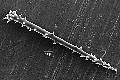
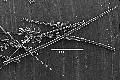
Skeleton: Plumose. Main skeleton of ascending multispicular fibres of tornotes echinated and almost concealed by acanthostyles. Tornotes also form the ectosomal skeleton. Chelae are present, abundant in the ectosomal region. Spongin does not encase the spicules in the ascending fibres as much as in the Crellinae (q.v.)
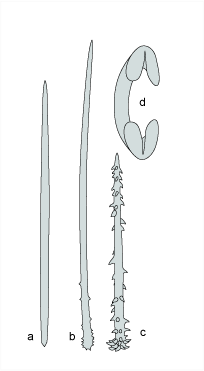
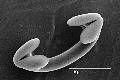
Spicules: Megascleres are tornotes with dissimilar, oxeote, ends (a), 310-(330)-350 μm. Acanthostyles are of two sizes, the larger (b) are basally spined, 330-(430)-490 μm and the smaller (c) entirely spined, 130-(155)-195 μm. Microscleres are arcuate isochelae (d), 18-25 μm.
 |  |  |
Habitat: In exposed or tide swept areas on rock. Most often recorded in the infralittoral zone, on gully walls. "Can be locally abundant, in the littoral and to 19m; on hydroids, oyster shells and under stones."
Distribution: "British Isles; France; Spain, Mediterranean." Known recently from Strangford Lough; Tiree; Western Ireland; Saltee Is., Co. Wexford; Isle of Man; Lleyn peninsula. A fairly common species.
Identity: This species has been confused in situ with Hemimycale but its raised oscular rims, conspicuous oscules and the lack of white rims to the uniformly-sized depressions make it quite easy to distinguish from Hemimycale. A number of Phorbasinid and Hymedesmid species could be confused superficially with this species, so the spiculation and skeleton must be checked for positive identification. Both spiculation and colour are similar to Hymedesmia jecusculum (q.v.), but this species is permanently a thin sheet. Phorbas is distinguished from Crellid spp. by having echinating spicules on the ascending fibres, and ectosomal spicules of tornotes rather than acanthostyles.
Distribution Map from NBN: Phorbas fictitius at National Biodiversity Network mapping facility, data for UK.
iNaturalist: Phorbas fictitius at iNaturalist World Species Observations database.
WoRMS: Phorbas fictitius at World Register of Marine Species. Accepted name: Phorbas fictitius (Bowerbank, 1866). AphiaID: 133679.
Classification: Biota; Animalia; Porifera; Demospongiae; Heteroscleromorpha; Poecilosclerida; Hymedesmiidae; Phorbas
Voucher: BELUM : Mc468. Tiree, Hebrides.
Editors: R. Earll, D. Moss, B.E. Picton.
| Previous species | Next species |
| Picton, B.E. & Morrow, C.C. (2023). Phorbas fictitius. (Bowerbank, 1866). [In] Sponges of Britain and Ireland. https://www2.habitas.org.uk/marbiop-ni/sponges.php?item=C7590. Accessed on 2026-10-15 |