
| PORIFERA : Poecilosclerida : Hymedesmiidae | SPONGES |
Spanioplon armaturum (Bowerbank, 1866)
 |
| Spanioplon armaturum |
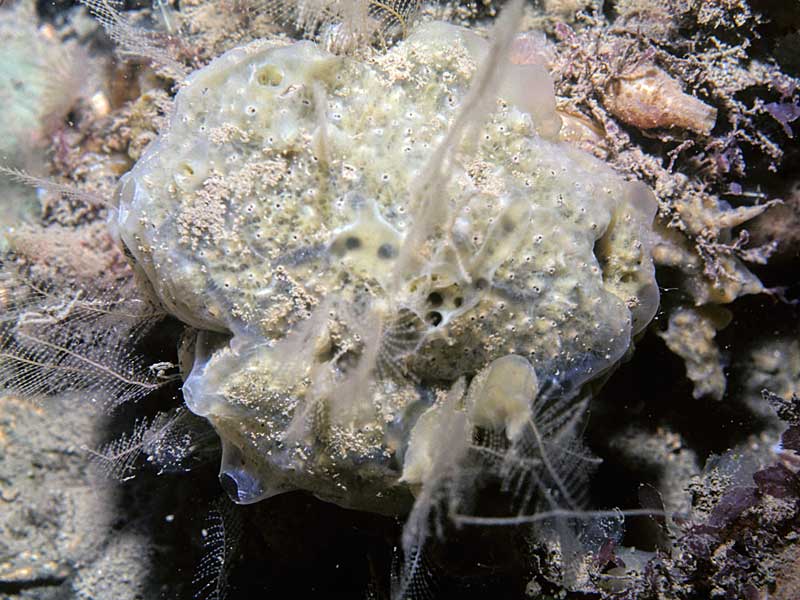
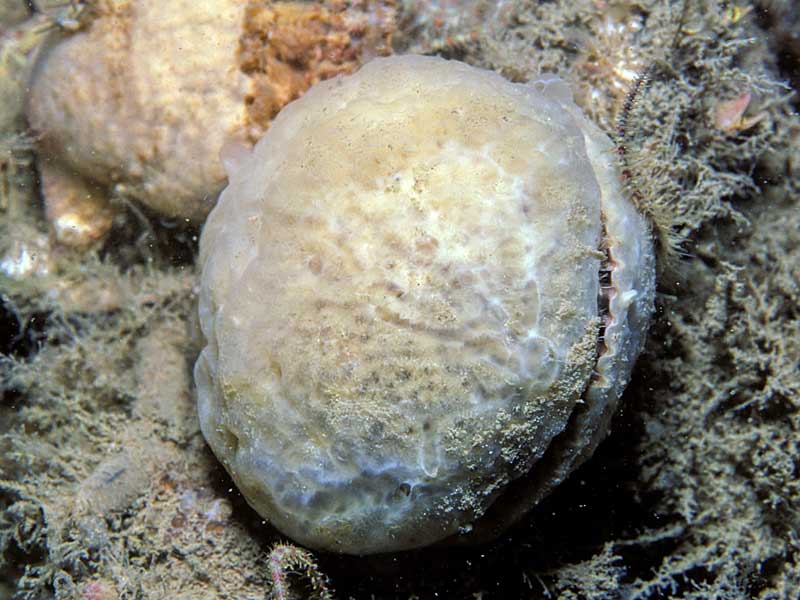
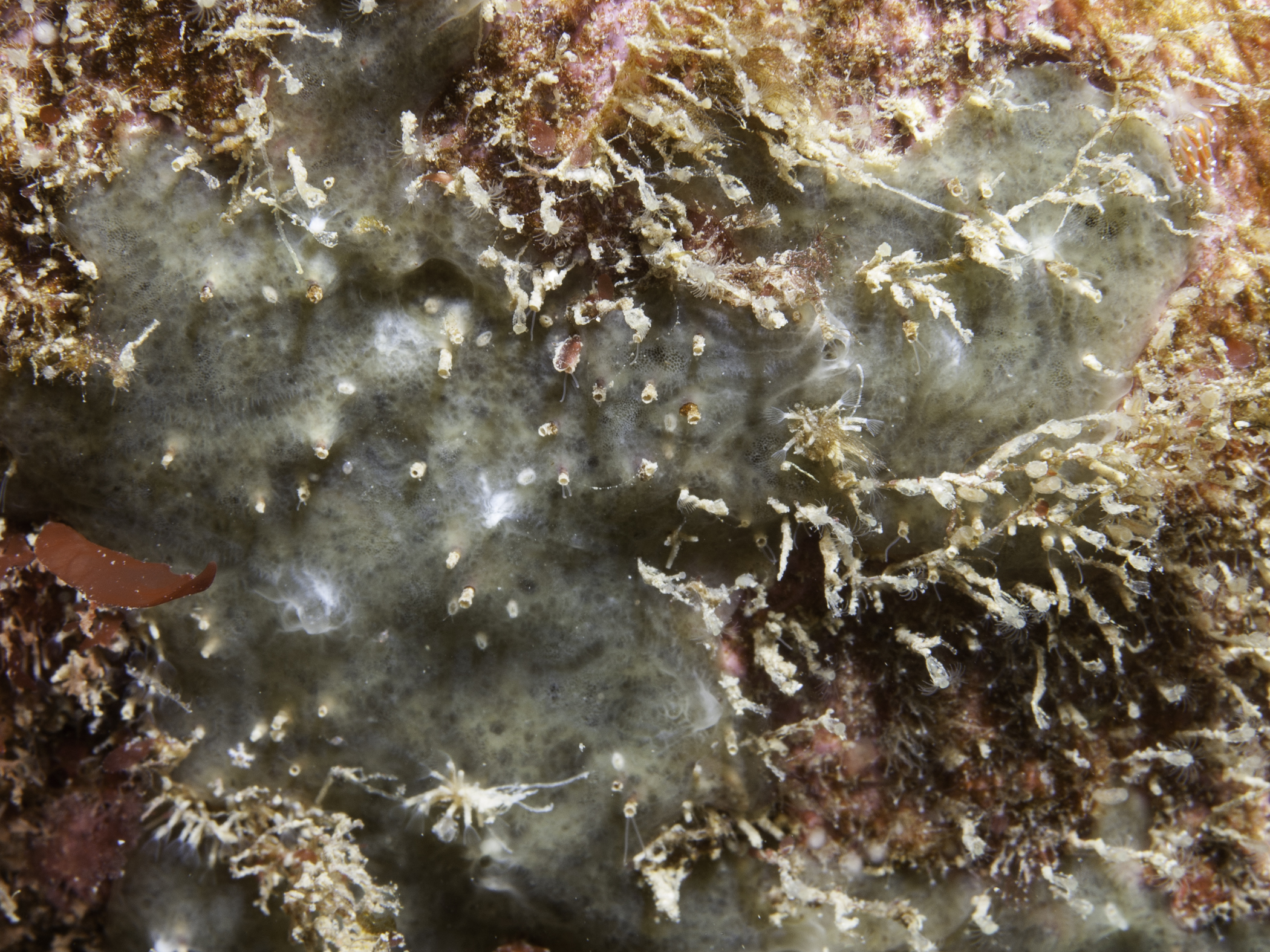
Form: Moderately thin sheets, up to 7cm across, to cushions 1cm thick.
Colour: Grey (dark red brown when dried).
Smell: None. Slime : "Slimy".
Consistency: Soft.
Surface: Smooth, with obvious exhalent canals which become deep grooves on removal from the water. "Uneven, hispid, in places slightly conulose".
Apertures:
- Oscules few in number, sometimes scattered, or at the edge of specimens growing on shells. Ostia not apparent.
Contraction:
- Considerable contraction and collapse of the oscular channels occurs on removal from water.
 |
 |
 |
| [ More images ] |
Synonyms: Hymeniacidon armatura Bowerbank, 1866: 183, Hymedesmia stephensi Burton, 1930: 494.
Internal characters
 |
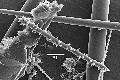
Skeleton: The ectosome consists of tangentially arranged strongyles, sometimes collected into bundles. In the choanosome there are styles loosely arranged into tracts, together with many scattered small acanthostyles.
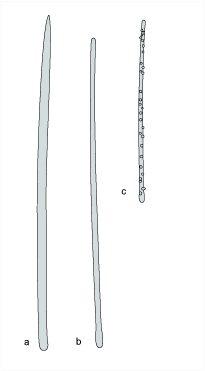
Spicules: There are three types of megascleres. The styles (a) measure 235-(250)-260 μm "220-250 μm" by 2-8 μm, and are slightly curved. The heads of some show tylote and/or mucronate tendencies, and very sparse spines may occur towards the head end. Strongyles (b) measure 195-(200)-205 μm by 1-8 μm, and sometimes possess variably and unequally dilated ends. The acanthostyles (c) are 55-(72)-90 μm "40-65 μm" by 1-5 μm, and they are characteristically small and thin, with only slightly swollen heads, and very short points. They are weakly, but entirely, spined. Microscleres are absent.
 |  |  |
Habitat: On stones, bivalve shells, and under boulder/bedrock overhangs. Found both in very sheltered conditions in sites like Strangford Lough, in Modiolus communities, and on very exposed bedrock, eg. at St. Kilda. In the Mediterranean, reported on bryozoans, other sponges, and plant debris. Shore to 50m.
Distribution: N. Atlantic, Mediterranean. Known recently from Lough Hyne, Strangford Lough, several localities in the Channel, St. Kilda.
Identity: The size and shape of the acanthostyles, and the variability of the other two megascleres, are characteristic on microscopic examination. This sponge typically covers shells of Chlamys varia and develops into thick cushions completely covering the shell, with a single oscule at the outer edge. It is frequently perforated by many tubes of polychaete worms.
Distribution Map from NBN: Spanioplon armaturum at National Biodiversity Network mapping facility, data for UK.
iNaturalist: Spanioplon armaturum at iNaturalist World Species Observations database.
WoRMS: Spanioplon armaturum at World Register of Marine Species. Accepted name: Spanioplon armaturum (Bowerbank, 1866). AphiaID: 133701.
Classification: Biota; Animalia; Porifera; Demospongiae; Heteroscleromorpha; Poecilosclerida; Hymedesmiidae; Spanioplon
Voucher: BELUM : Mc211. Strangford Lough, Down.
Editors: D. Moss, B.E. Picton.
| Previous species | Next species |
| Picton, B.E. & Morrow, C.C. (2023). Spanioplon armaturum. (Bowerbank, 1866). [In] Sponges of Britain and Ireland. https://www2.habitas.org.uk/marbiop-ni/sponges.php?item=C7530. Accessed on 2026-10-15 |