
| PORIFERA : Poecilosclerida : Hymedesmiidae | SPONGES |
Hymedesmia paupertas (Bowerbank, 1866)
 |
| Hymedesmia paupertas |
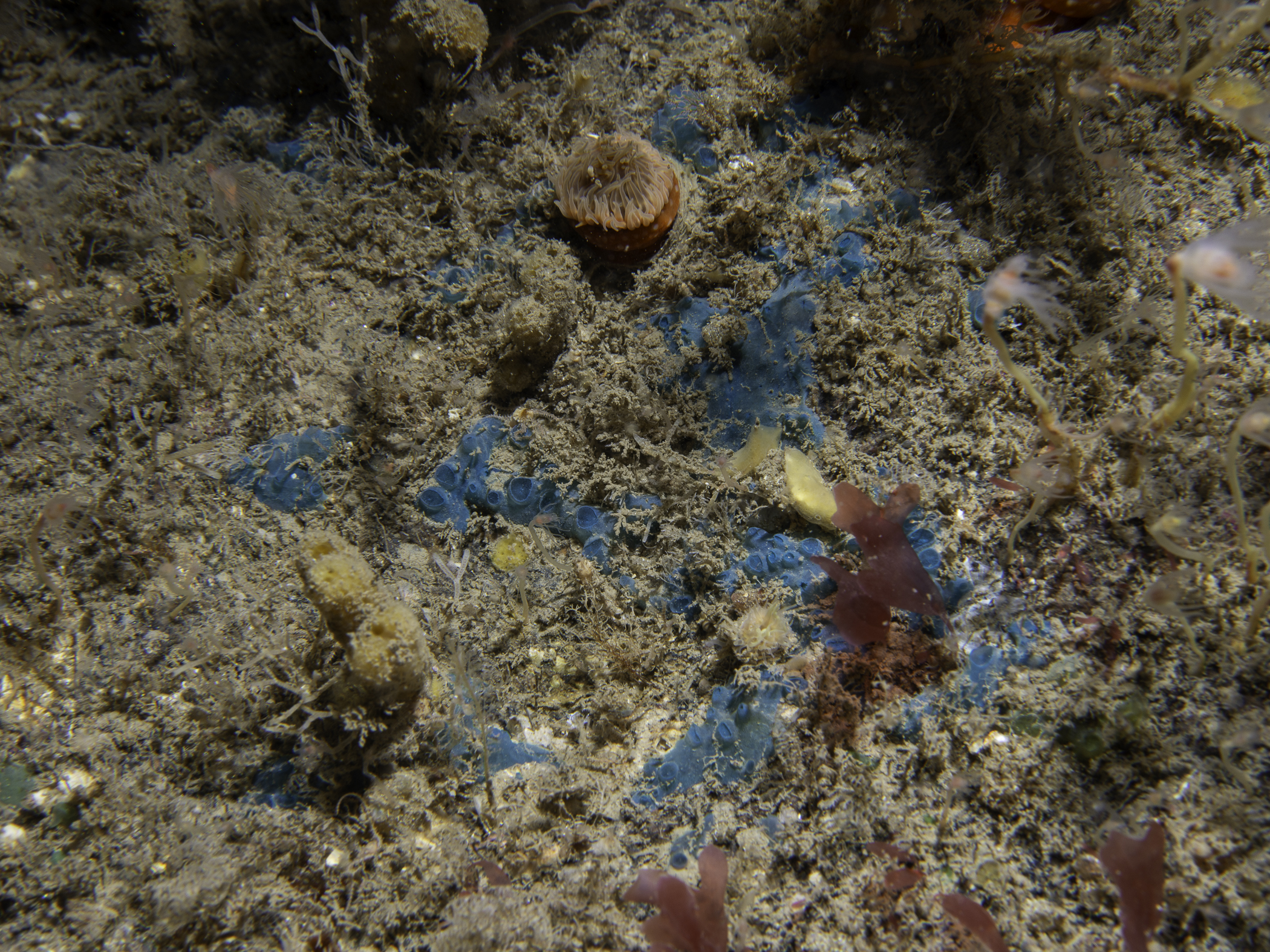
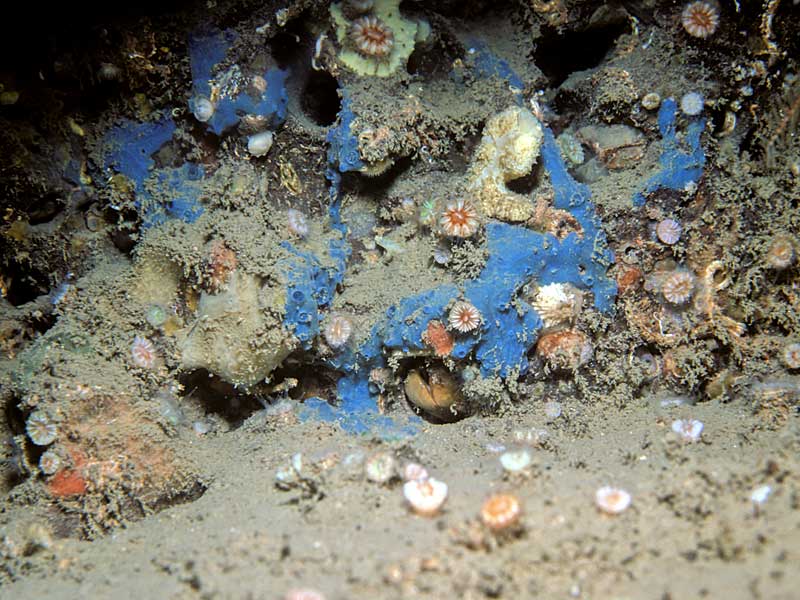
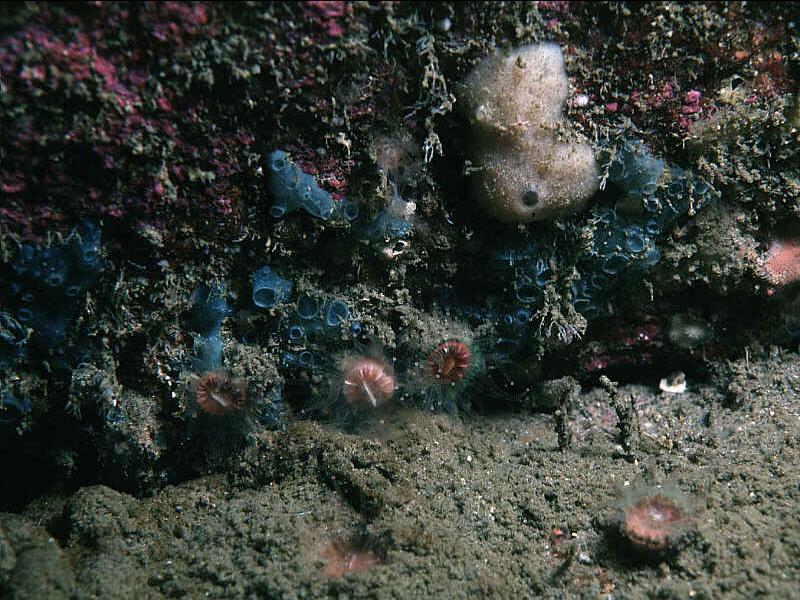
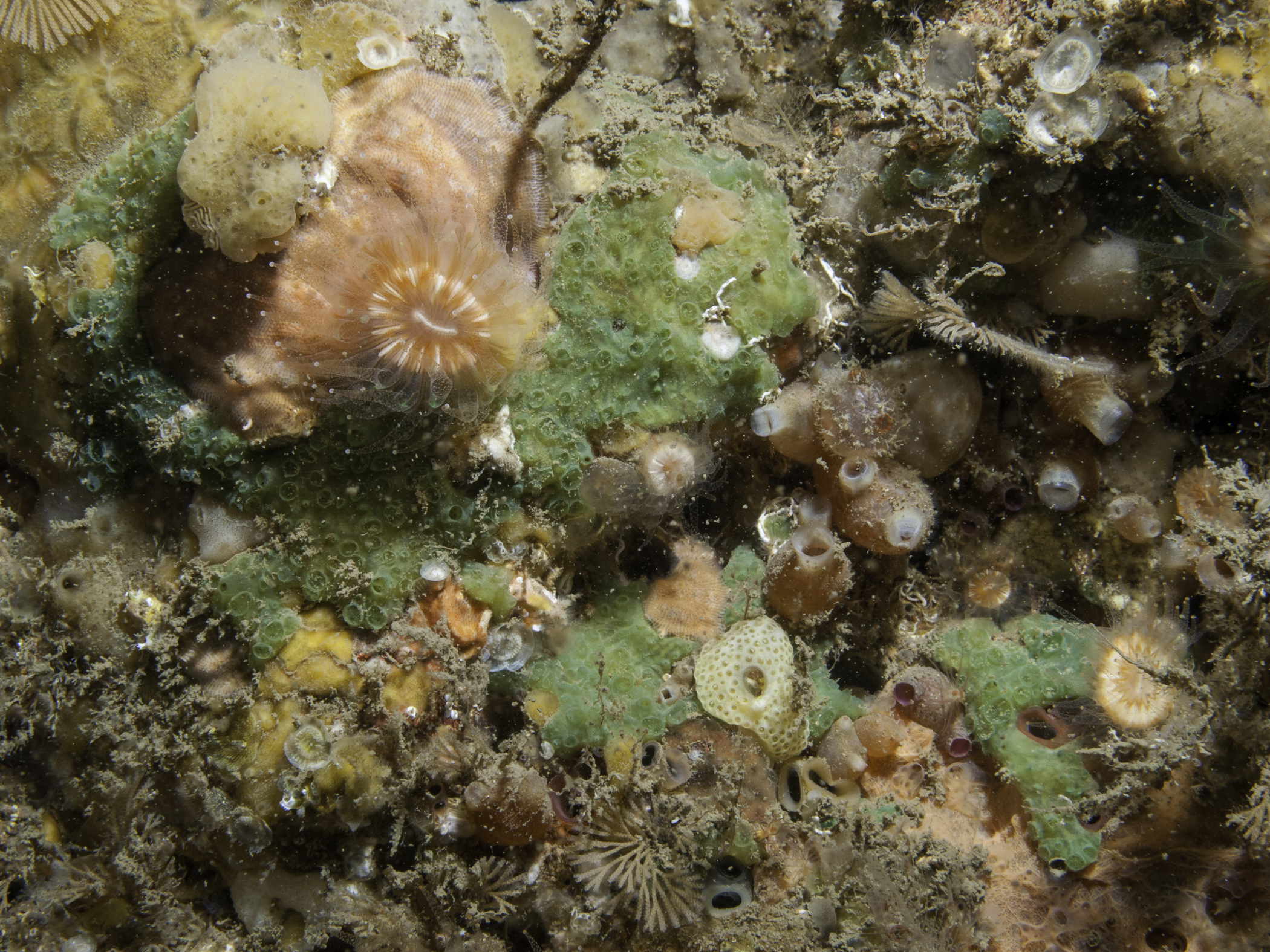
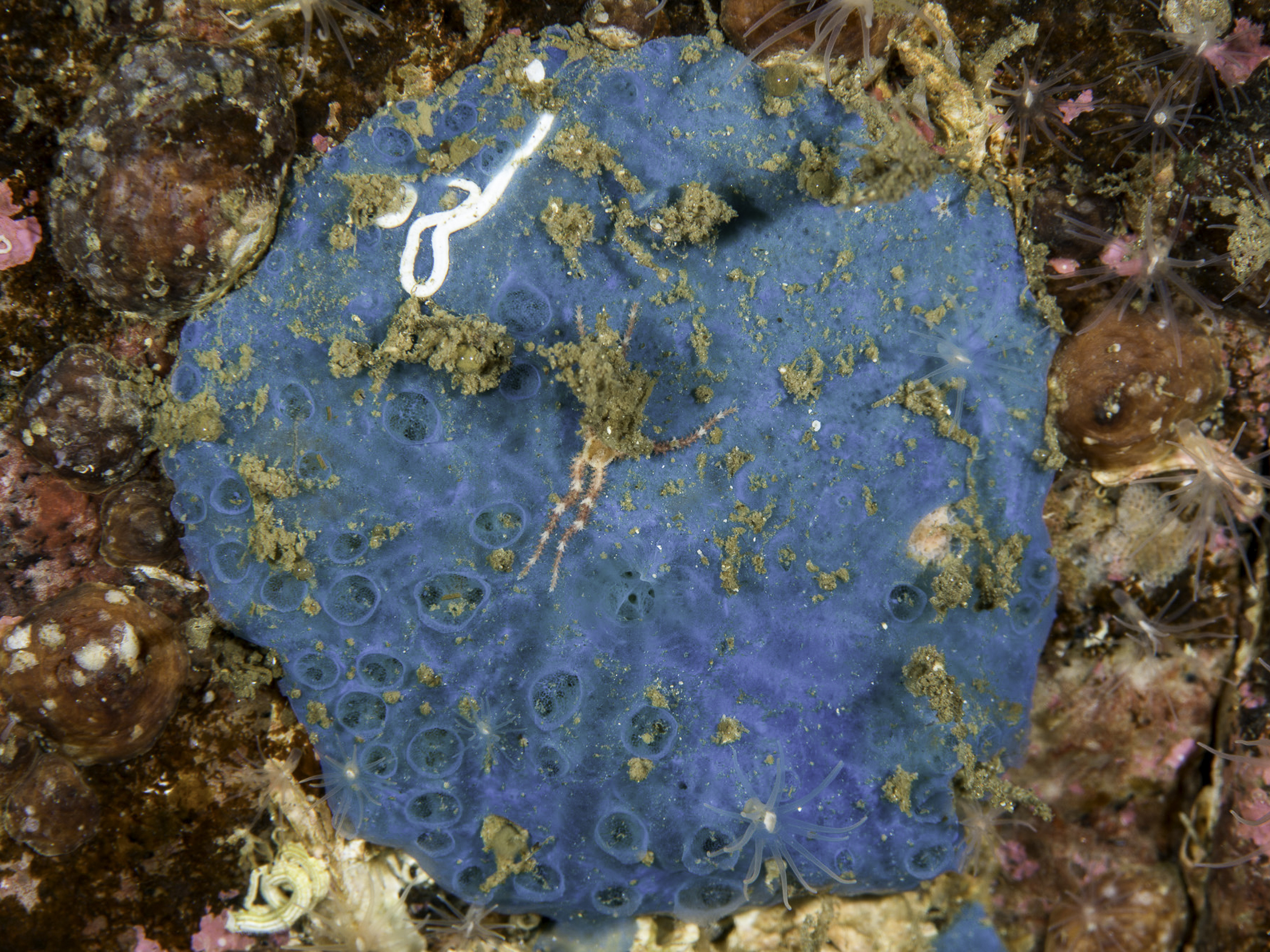
Form: Small thin sheets usually covering areas only 1 or 2cm in diameter, very irregular in outline, giving the appearance of several separate patches.
Colour: Bright blue or green - distinctly unusual.
Smell: None
Consistency: Difficult to determine.
Surface: With small pore sieves, similar to Hemimycale columella. This appears to be characteristic of a group of Hymedesmia spp. which may all be related more closely to Phorbas and Hemimycale than to other Hymedesmia species.
Apertures:
- Oscules with converging excurrent channels and transparent, slightly raised rims, few in number and towards the centre of patches.
Contraction:
- Difficult to determine.
 |
 |
 |
 |
 |
[ More images ] |
Synonyms: Anchinoe paupertas sensu Stephens, 1921:35.NB. the species known as Anchinoe paupertas in the Mediterranean is a species of Anchinoe (Phorbas) and is not this species.
Internal characters
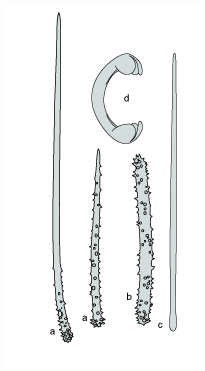 |
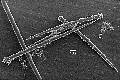
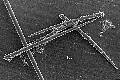
Skeleton: A basal layer of acanthostyles of two sizes with their heads on the substrate. The longer ones have smooth shafts, the shorter are entirely spined. Fibres of parallel tornotes, with slightly different ends, run up through the body to the surface. The surface layer of chelae is especially packed in the pore areas.
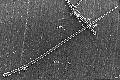
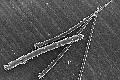
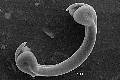
Spicules: Acanthostyles (a) of two types are present: long ones with more or less smooth shafts, 360-(400)-420 μm long; and short entirely spined ones, 130-(150)-155 μm long. There are also tornotes (c), length 225-(263)-275 μm, and arcuate isochelae (d), 25-32 μm, with particularly broad shafts when viewed face-on, and very arcuate from the side. Occasional aberrant spicules (b) apparently derived from the larger acanthostyles, may be present.
 |  |  |  |
 |
Habitat: So far recorded from deep rocky areas, sheltered or with moderate exposure. A circalittoral species, found on cliffs in W. Scotland, and on limestone ridges in western Ireland.
Distribution: Known recently from Bill's Rocks, Achill Is., Co. Mayo; Rathlin O'Birne Is., Co. Donegal; St. John's Pt., Co. Donegal; west coast of Scotland.
Identity: The combination of pore sieves and bright blue or green colour seems to be characteristic of this species, as is the shape of the chelae and tornotes. Many Hymedesmia species exist, whose live appearance is currently unknown. Terpios fugax (q.v.) is a blue sponge found in the littoral zone.
Distribution Map from NBN: Hymedesmia paupertas at National Biodiversity Network mapping facility, data for UK.
iNaturalist: Hymedesmia paupertas at iNaturalist World Species Observations database.
WoRMS: Hymedesmia paupertas at World Register of Marine Species. Accepted name: Hymedesmia (Hymedesmia) paupertas (Bowerbank, 1866). AphiaID: 133621.
Classification: Biota; Animalia; Porifera; Demospongiae; Heteroscleromorpha; Poecilosclerida; Hymedesmiidae; Hymedesmia
Voucher: BELUM : Mc513. Lunga, Firth of Lorne, Hebrides.
Editors: D. Moss, B.E. Picton.
| Previous species | Next species |
| Picton, B.E. & Morrow, C.C. (2023). Hymedesmia paupertas. (Bowerbank, 1866). [In] Sponges of Britain and Ireland. https://www2.habitas.org.uk/marbiop-ni/sponges.php?item=C7250. Accessed on 2026-10-15 |