
| PORIFERA : Poecilosclerida : Hymedesmiidae | SPONGES |
Hymedesmia pansa Bowerbank, 1882
 |
| Hymedesmia pansa |
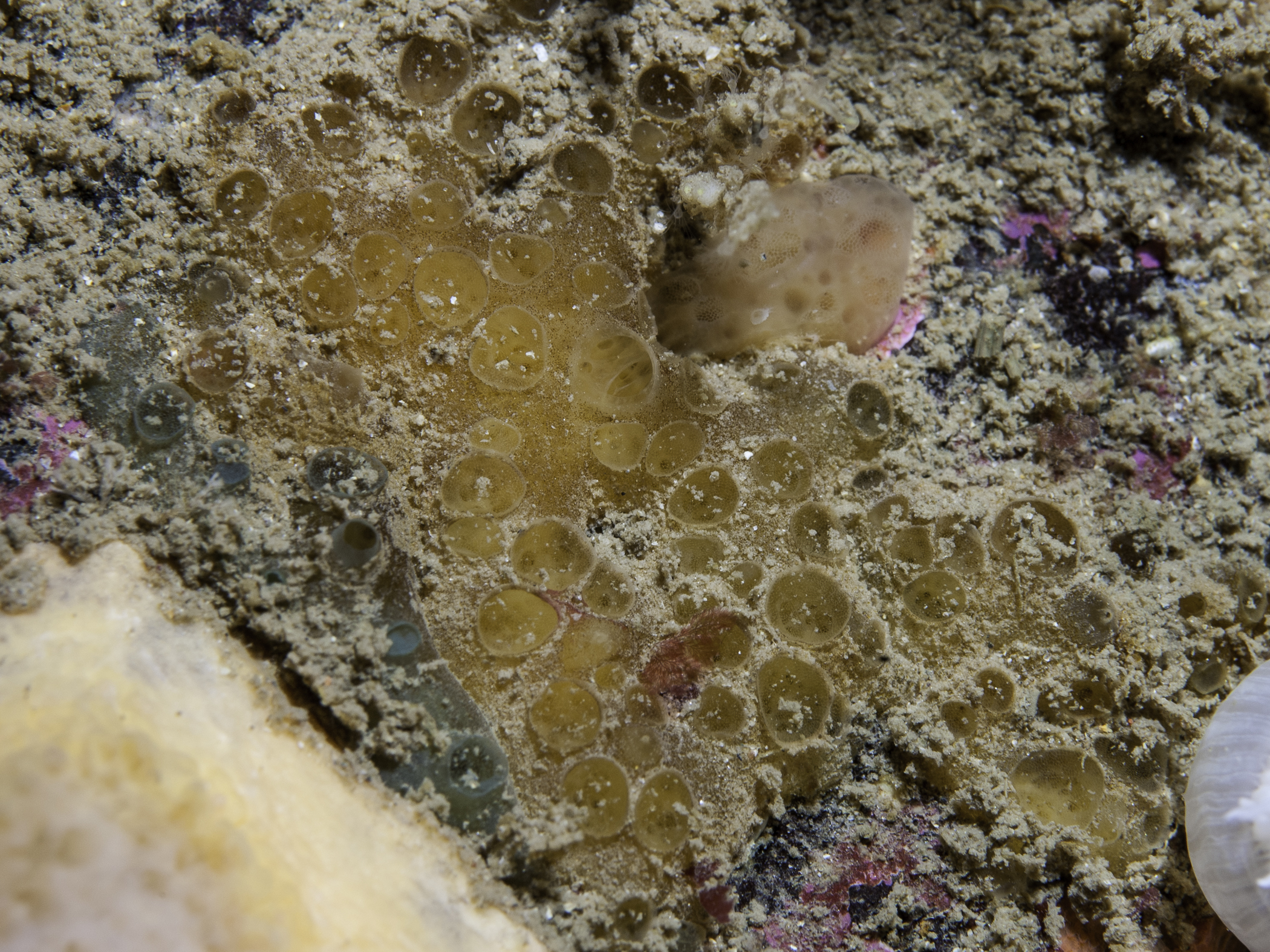
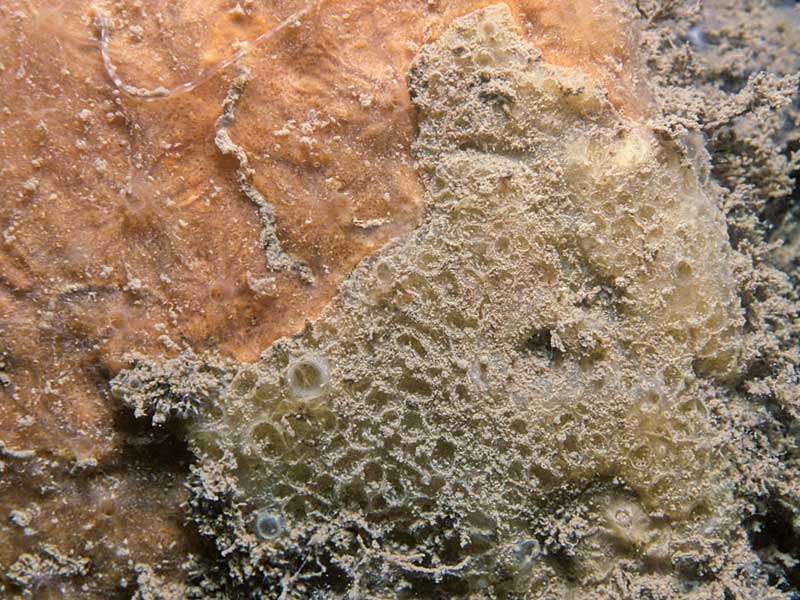
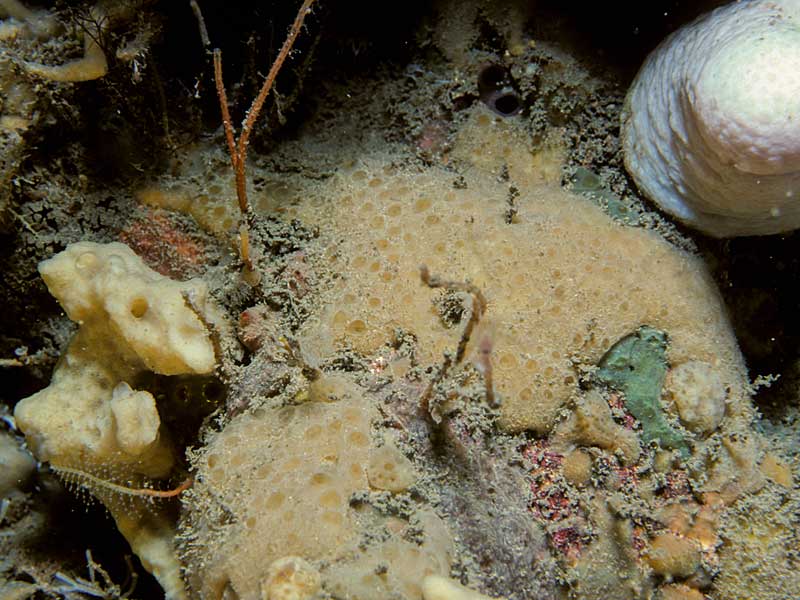
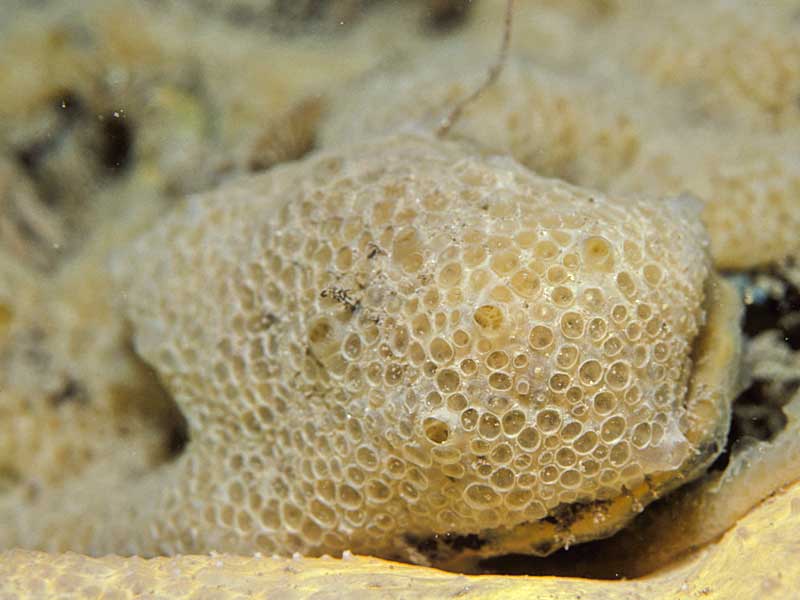
Form: Thin sheets, up to 3cms across, but smaller typically.
Colour: Consistently pale yellow. "Yellow, or yellowish orange" (in the Mediterranean). "Deep orange, rarely red". (Amber yellow when dry, pale pink in spirit).
Smell: None.
Consistency: Soft.
Surface: Smooth, with subsurface exhalent canals visible. Densely covered with oval pore areas.
Apertures:
- Oscules may not be apparent. Pores in oval pore areas with smooth tissue between. "Oscules dispersed, simple".
Contraction:
- Hard to determine because of thinness of sheets.
 |
 |
 |
| [ More images ] |
Internal characters
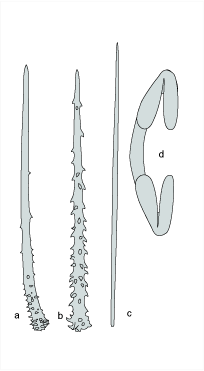 |
Skeleton: Hymedesmoid, with large primary acanthostyles and also smaller acanthostyles echinating the substrate. The rest of the skeleton consists of flexuous columns or fibres of many parallel (subtylo)tornotes, which fan out to run parallel with the surface. Arcuate isochelae reinforce the ectosome.
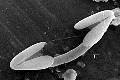
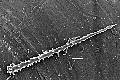
Spicules: Primary acanthostyles (a) measure 220-(235)-250 μm "155-300 μm" in length by ca. 5-10 μm in width (ca. 110-170 x 3-10 μm in the Azores, according to Boury-Esnault & Lopes). They have a slightly curved shaft and the head is thickly set with spines, whilst small, rather scattered, spines extend along the shaft but are much less frequent in the distal half. The smaller acanthostyles (b) measure 95-(103)-110 μm "60-120 μm" in length by 4-7 μm in width. They are straight or very slightly curved, and conspicuously spined along the whole length. The spines on the head are fairly long, those on the shaft recurved. The tornotes (c) are very slender, straight, measuring 215-(237)-260 μm "180-260 μm" in length, by 2-3 μm in width. They are strongylote to subtylote, one end being rounded and sometimes very slightly swollen, the other tapering to a fine point, slightly fusiform; indeed they could equally be described as styles. Microscleres are arcuate isochelae (d), ca. 16-19 μm in length (11-22 μm in specimens from the Azores) with a less strongly curved shaft than in most Hymedesmia species.
 |  |
Habitat: On rock, stones and bivalve shells, to 300m. Reported on algae and sponges in the Mediterranean. On horizontal rock in clear water.
Distribution: Channel (Roscoff), west coast of England, Mediterranean, Azores.
Identity: External appearance is not particularly helpful, but the pore sieves and thin sheet may suggest a hymedesmid sponge. The spicule complement and sizes are distinct from the other two Hymedesmia in this Guide, but there are many other Hymedesmia species and the complex is currently ill-understood.
Distribution Map from NBN: Hymedesmia pansa at National Biodiversity Network mapping facility, data for UK.
iNaturalist: Hymedesmia pansa at iNaturalist World Species Observations database.
WoRMS: Hymedesmia pansa at World Register of Marine Species. Accepted name: Hymedesmia (Hymedesmia) pansa Bowerbank, 1882. AphiaID: 133620.
Classification: Biota; Animalia; Porifera; Demospongiae; Heteroscleromorpha; Poecilosclerida; Hymedesmiidae; Hymedesmia
Voucher: BELUM : Mc1576. Rathlin Island, Antrim.
Editors: D. Moss, B.E. Picton.
| Previous species | Next species |
| Picton, B.E. & Morrow, C.C. (2023). Hymedesmia pansa. Bowerbank, 1882. [In] Sponges of Britain and Ireland. https://www2.habitas.org.uk/marbiop-ni/sponges.php?item=C7240. Accessed on 2026-10-14 |