
| PORIFERA : Poecilosclerida : Acarnidae | SPONGES |
Iophon hyndmani (Bowerbank, 1858)
 |
| Iophon hyndmani |
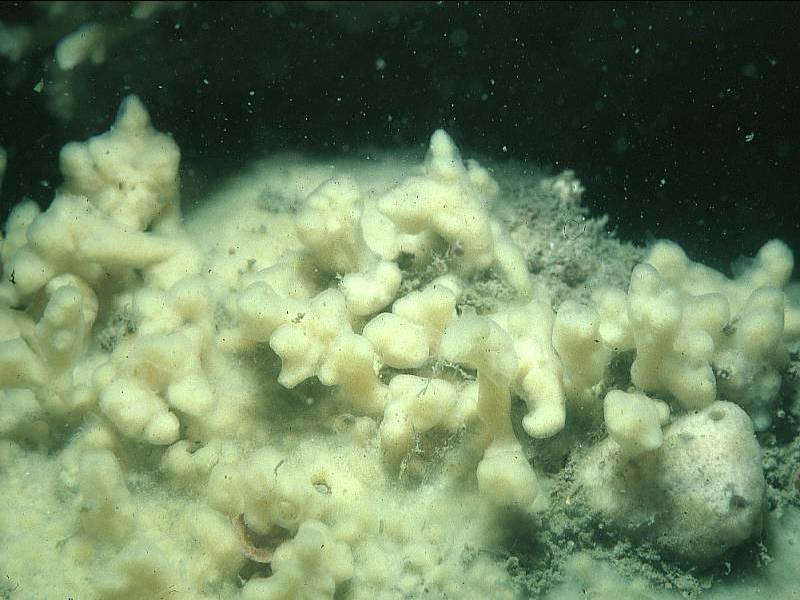
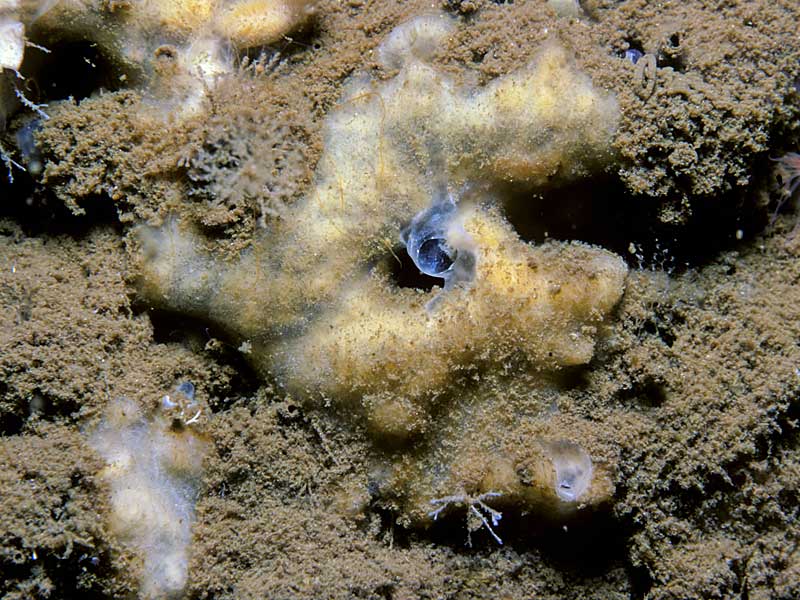
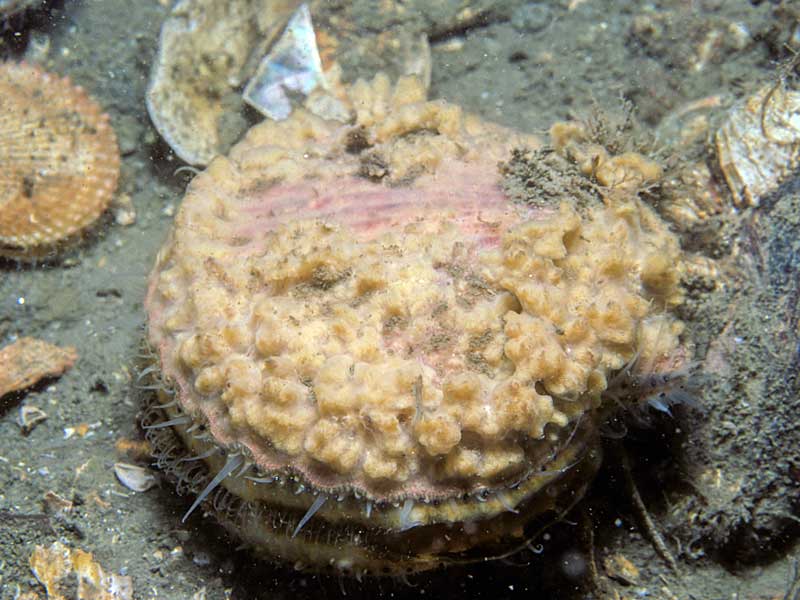
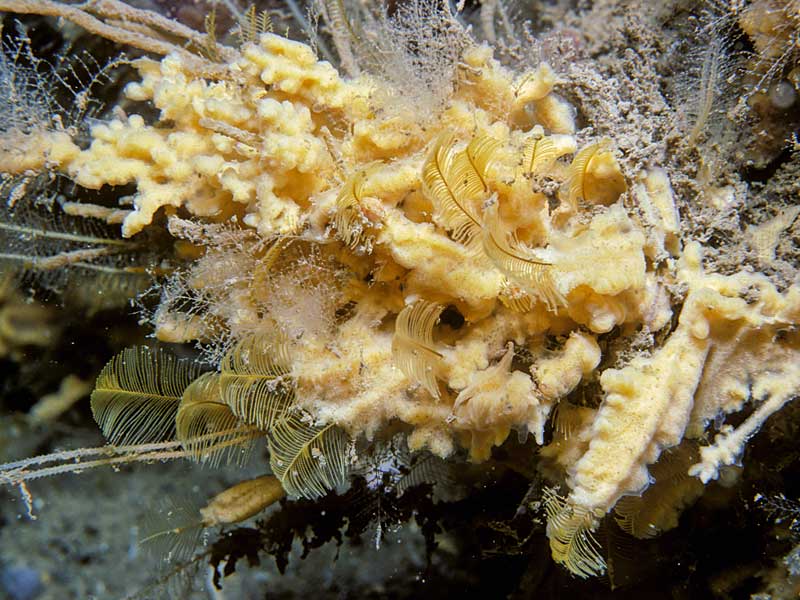
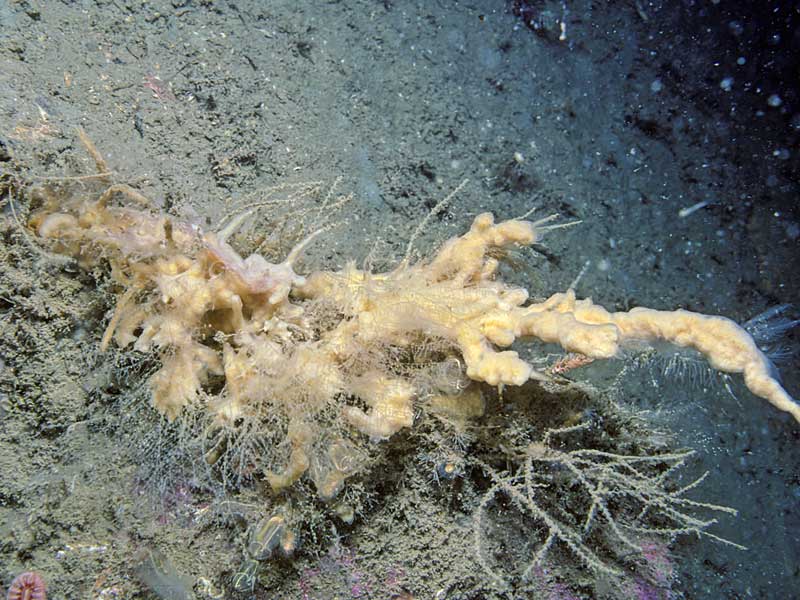
Form: Thin sheet or cushion, developing into branching-repent form with anastomosing branches, 3 - 4mm diameter.
Colour: Pale yellow, purple only when preserved. The colour change on preservation in alcohol to brown is distinctive, paper labels are stained brown.
Smell: ? None, not strong?
Consistency: Moderately soft, branches have no axial skeletal structure and apparently only develop fully in fairly sheltered conditions. Friable and not easy to section.
Surface: "Wrinkled or thrown into prominent folds." Initially smooth sheets, developing into fistular outgrowths, and eventually anastomosing branches.
Apertures:
- Oscules "small, scattered", not obvious.
Contraction:
- None.
 |
 |
 |
 |
 |
[ More images ] |
Synonyms: In recent literature it is treated as a synonym of Iophon ingalli (Bwk, 1866:258). As it belongs to a taxonomically difficult group, it may be best, at the moment, for us to treat it as I. hyndmani. Also cited as Pocillon hyndmani (Bwk,1858:302) Topsent 1894:8.
Internal characters
 |
Skeleton: A plumo-reticulation of loose, multispicular fibres, with echinating spicules. There is a surface layer of strongyles (lying tangentially or in vertical brushes). Spongin is scarce.
Spicules: Megascleres of the main skeleton are acanthostyles (a), which are smooth in the distal (i.e. further from the base) half, 200-(225)-250 μm. The echinating acanthostyles are entirely spined and are 130-(155)-175 μm "110 μm" long. The ectosomal spicules are very thin tornotes (b), with strongylote ends which bear crowns of a few spines, ca. 135-(170)-195 μm. Microscleres are palmate anisochelae (c), 13-20 μm long, and bipocilles with saucer shaped ends (d), 9-15 μm long.
 |  |  |  |
 |
Habitat: On shells such as Modiolus modiolus, Chlamys varia, and Aequipecten opercularis; on rocks, in localities sheltered from wave action, with no or slight tidal action. "On hydroids, other sponges, coralline algae, nullipores, fucoids, etc."
Distribution: "Norway; British Isles; France; Mediterranean." Recent voucher specimens from Strangford Lough (the original type specimen was collected from Strangford Lough by Hyndman). Also Mulroy Bay; Lough Hyne; Rathlin Is.; Kilkieran Bay; Skomer; Loch Sunart, Loch Fyne. Common.
Identity: Difficult to identify with confidence when encrusting, but when well developed the characteristic branching combined with the colour are fairly distinctive. It belongs to a very difficult group taxonomically, so all identifications must be treated as provisional - see also Iophon ingalli, Iophon pattersoni (Bwk., 1866:255), etc. This description is based partly on voucher material collected from the type locality, Strangford Lough, in 1980.
Distribution Map from NBN: Iophon hyndmani at National Biodiversity Network mapping facility, data for UK.
iNaturalist: Iophon hyndmani at iNaturalist World Species Observations database.
WoRMS: Iophon hyndmani at World Register of Marine Species. Accepted name: Iophon hyndmani (Bowerbank, 1858). AphiaID: 132970.
Classification: Biota; Animalia; Porifera; Demospongiae; Heteroscleromorpha; Poecilosclerida; Acarnidae; Iophon
Voucher: BELUM : Mc138. Strangford Lough, Down.
Editors: R. Earll, D. Moss, B.E. Picton.
| Previous species | Next species |
| Picton, B.E. & Morrow, C.C. (2023). Iophon hyndmani. (Bowerbank, 1858). [In] Sponges of Britain and Ireland. https://www2.habitas.org.uk/marbiop-ni/sponges.php?item=C6840. Accessed on 2026-10-15 |