
| PORIFERA : Poecilosclerida : Myxillidae | SPONGES |
Myxilla fimbriata (Bowerbank, 1864)
 |
| Myxilla fimbriata |
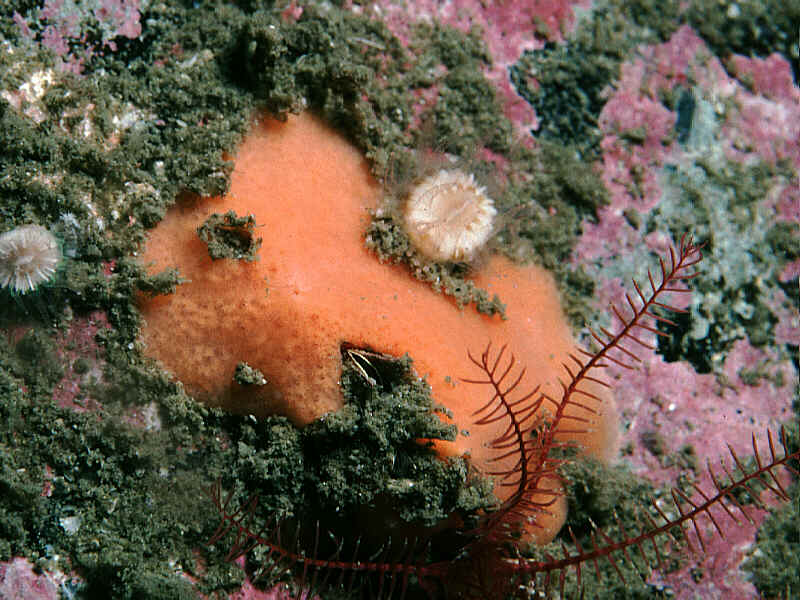
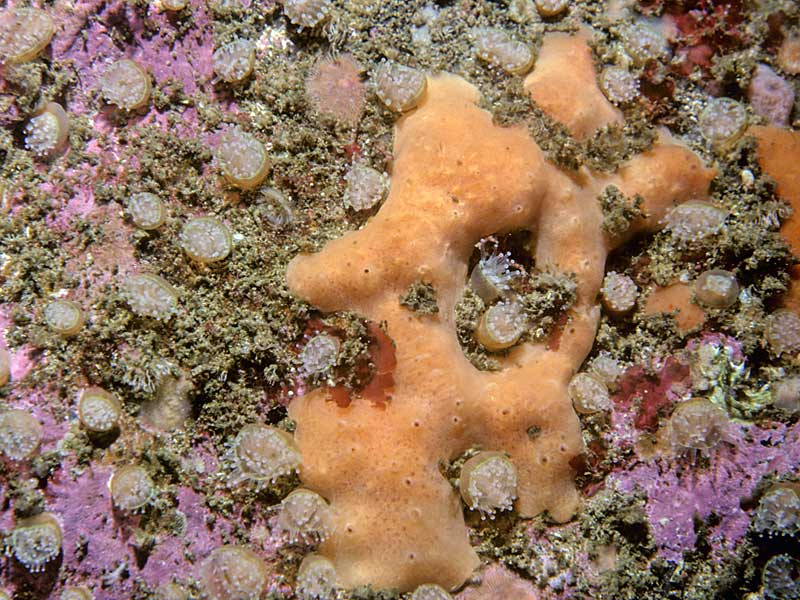
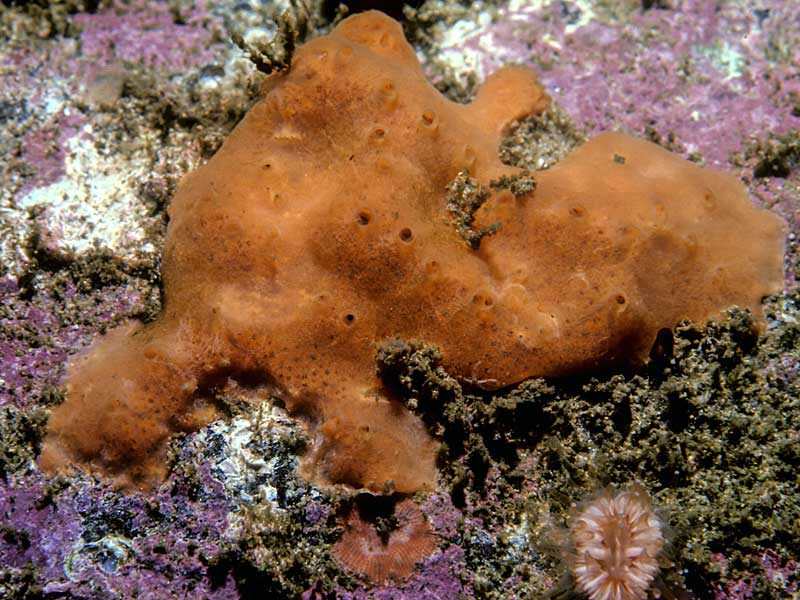
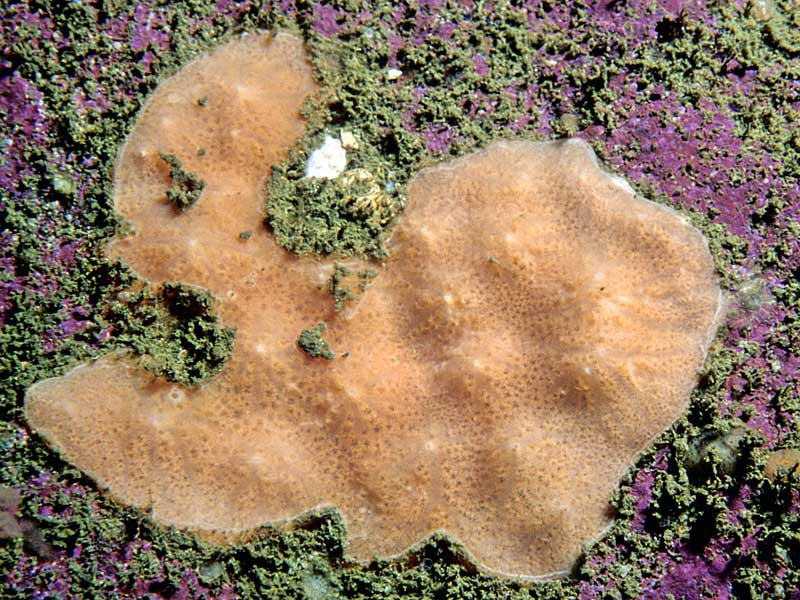
Form: Cushion usually 6-7mm thick; can be 30mm thick. Found as distinct specimens 2-5cm across, with an irregular outline. The specimens are rounded in cross section with steep sides.
Colour: Bright orange in surface layers, yellow in deeper layers. Specimens from less clear water conditions may be beige in colour. The sponge goes black or brown in alcohol, staining the label, but may fade to a dirty, pale brown.
Smell: Slight.
Consistency: Quite firm, tears easily. "Resilient."
Surface: Not 'open' as in M. incrustans though underlying porous areas are clearly visible through transparent 'skin'. "Slightly hispid", smooth to touch.
Apertures:
- The oscules are small, with slightly raised transparent rims. They are placed towards the central, thickest parts of the sponge, or raised on ridges. There are no oscular channels.
Contraction:
- Slight.
 |
 |
 |
| [ More images ] |
Synonyms: Isodictya fimbriata Bwk. 1864:251, Isodictya lurida Bwk. 1866:336.
Internal characters
 |
Skeleton: The reticulation of multispicular fibres is less regular and isodictyal than in other Myxilla spp. There are no echinating spicules associated with these fibres. Special ectosomal spicules (tornotes) are present. Spongin is scarce.
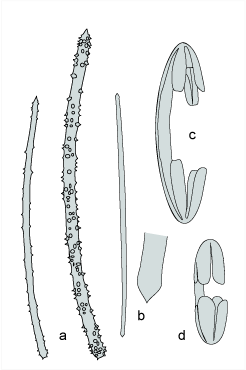
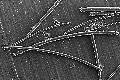
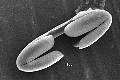
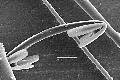
Spicules: The megascleres of the main skeleton are long, sparsely-spined acanthostyles (a) 265-(300)-350 μm in length. The surface tornotes (b) measure 202-(290)-325 μm in length and have abruptly terminating ends, ending in a short point, often mucronate. The ends are sometimes slightly unequal lying in vertical brushes. Different development stages of tornote ends can be present in any one specimen, making recognition difficult. However the broad pattern should conform to the diagram given here. Microscleres are spatuliferous anchorate chelae, of two sizes (c) 60 μm and (d) 27 μm. Sigmata are infrequent or absent, thin, and easily overlooked.
 |  |  |
Habitat: On rock in lower infralittoral and upper circalittoral.
Distribution: "Arctic; Faroes; Norway; Sweden; British Isles!" Known recently from various sites on the W and SE of Ireland, where this sponge is a characteristic circalittoral species in sites exposed to the Atlantic. Also Rathlin Is., Co. Antrim; St. Abbs; Coll; Lewis.
Identity: Superficially there might be confusion with Amphilectus fucorum but there are distinct spicule differences. The blackening of the sponge in alcohol is rapid and striking, and this combined with a lack of slime in what is otherwise a typical Myxillid skeleton makes this species distinctive from other Myxillid species such as M. rosacea and M. incrustans. If there are echinating spicules and the chelae are arcuate, the specimen belongs to a different genus, e.g. Ectyodoryx. Note from BEP: "There is definitely another form/species of this sponge with distinct oscular channels, which goes dark brown in alcohol, doesn't slime and has a similar spiculation. However the acanthostyles in this form are much thicker."
Distribution Map from NBN: Myxilla fimbriata at National Biodiversity Network mapping facility, data for UK.
iNaturalist: Myxilla fimbriata at iNaturalist World Species Observations database.
WoRMS: Myxilla fimbriata at World Register of Marine Species. Accepted name: Myxilla (Myxilla) fimbriata (Bowerbank, 1866). AphiaID: 169461.
Classification: Biota; Animalia; Porifera; Demospongiae; Heteroscleromorpha; Poecilosclerida; Myxillidae; Myxilla
Voucher: BELUM : Mc575. Skird Rocks, Galway.
Editors: R. Earll, D. Moss, B.E. Picton.
| Previous species | Next species |
| Picton, B.E. & Morrow, C.C. (2023). Myxilla fimbriata. (Bowerbank, 1864). [In] Sponges of Britain and Ireland. https://www2.habitas.org.uk/marbiop-ni/sponges.php?item=C6430. Accessed on 2026-10-16 |