
| PORIFERA : Axinellida : Stelligeridae | SPONGES |
Paratimea loennbergi (Alander, 1942)
 |
| Paratimea loennbergi |
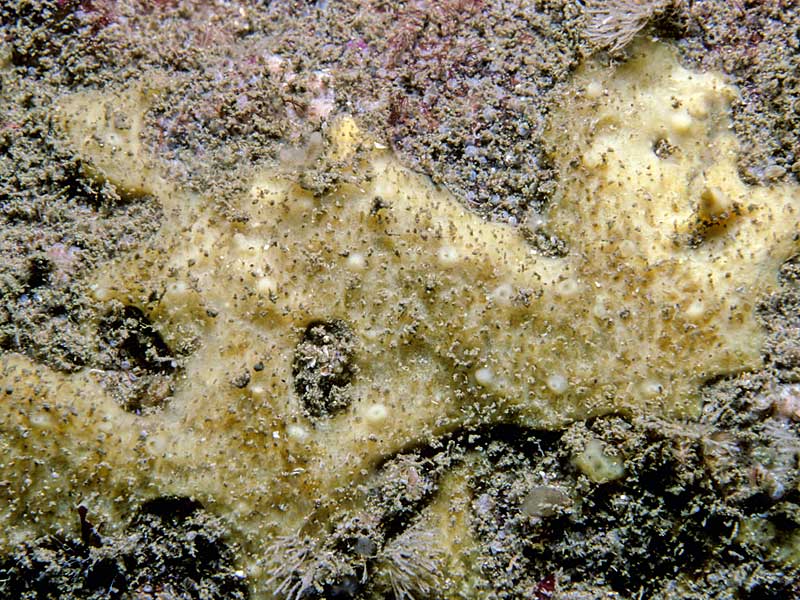
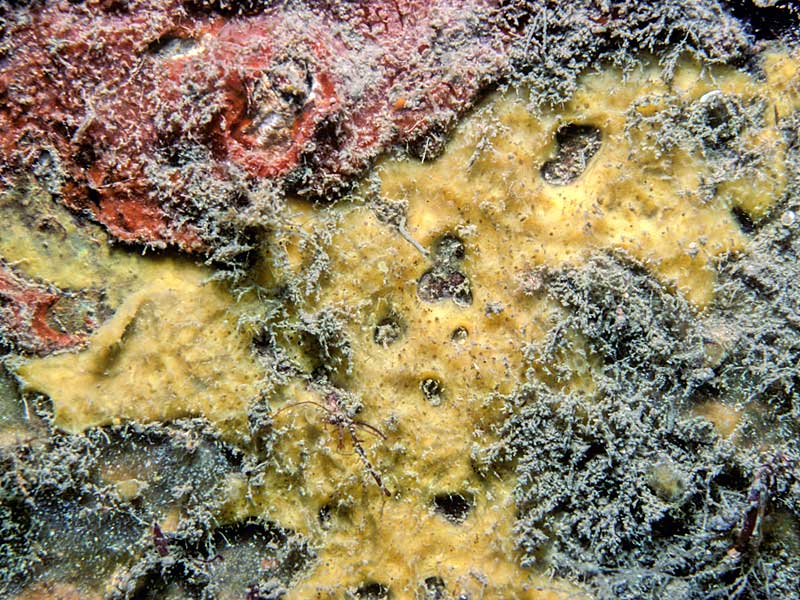
Form: Encrusting in thin irregular patches.
Colour: Pale yellow. Often there is adhering detritus due to the long projecting spicule brushes.
Smell: None. Slime : None.
Consistency: Thinly encrusting but fairly tough, not inclined to crumble when scraped off.
Surface: Strongly villose (very 'bristly') with long projecting spicules (to 2mm), which often trap quantities of silt.
Apertures:
- The oscules are small and inconspicuous, but there are excurrent channels which are just visible on close inspection of living colonies in situ.
Contraction:
- None apparent.
 |
[ More images ] |
Synonyms: Bubaris constellata, Halicnemia constellata.
Internal characters
 |
Skeleton: Irregular. Long tylostyles stand perpendicular to the substratum, with their heads embedded in a basal spongin layer, and their shafts protruding from the surface. Smaller tylostyles lie jumbled sparsely in the interior. Slender megascleres form divergent brushes around the projecting spicules at the surface. The microscleres (euasters) form a conspicuous layer at the surface.
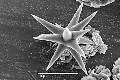
Spicules: The largest megascleres are tylostyles (a) 1500-2700 μm long. The surface brushes consist of slender oxea or anisoxea (b) 440-1140 μm, often with a slight central swelling or tyle. The microscleres are euasters (c) 21-45 μm diameter. Compared with Stelligera spp. these asters have fewer rays, and are more irregular in shape.
 |
Habitat: Usually in deep water, (25m+) both in sheltered locations and in exposed sites. Found in Lough Hyne on vertical rockfaces with heavy siltation.
Distribution: Recorded from the channel coast of France, the Mediterranean and the Azores. Recent records from Lough Hyne, Cork, where it is quite common on vertical rockfaces, and from vertical rock on the Dingle peninsula, Co. Kerry, and St. John's Point, Co. Donegal. Probably more common than records suggest.
Identity: The external appearance, of an irregular thin yellow encrustation, is not very distinctive. The spiculation, including surface brushes and euasters, is very distinctive. Timea species also have euasters, but no surface brushes of oxea.
Distribution Map from NBN: Paratimea loennbergi at National Biodiversity Network mapping facility, data for UK.
iNaturalist: Paratimea loennbergi at iNaturalist World Species Observations database.
WoRMS: Paratimea loennbergi at World Register of Marine Species. Accepted name: Paratimea loennbergi (Alander, 1942). AphiaID: 134168.
Classification: Biota; Animalia; Porifera; Demospongiae; Heteroscleromorpha; Axinellida; Stelligeridae; Paratimea
Voucher: BELUM : Mc1707. Lough Hyne, Cork.
Editors: B.E. Picton.
| Previous species | Next species |
| Picton, B.E. & Morrow, C.C. (2023). Paratimea loennbergi. (Alander, 1942). [In] Sponges of Britain and Ireland. https://www2.habitas.org.uk/marbiop-ni/sponges.php?item=C4180. Accessed on 2026-10-15 |