
| PORIFERA : Axinellida : Stelligeridae | SPONGES |
Stelligera montagui Van Soest & Hooper, 2020
 |
| Stelligera montagui |
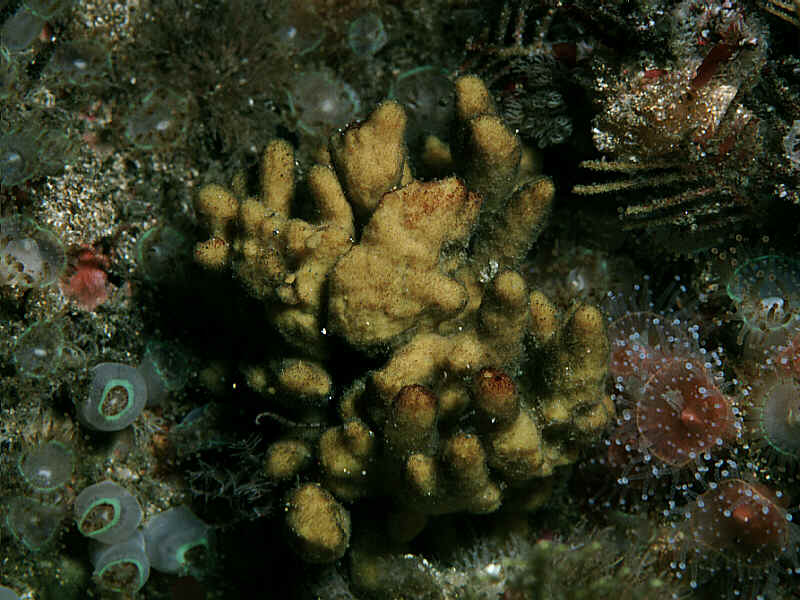
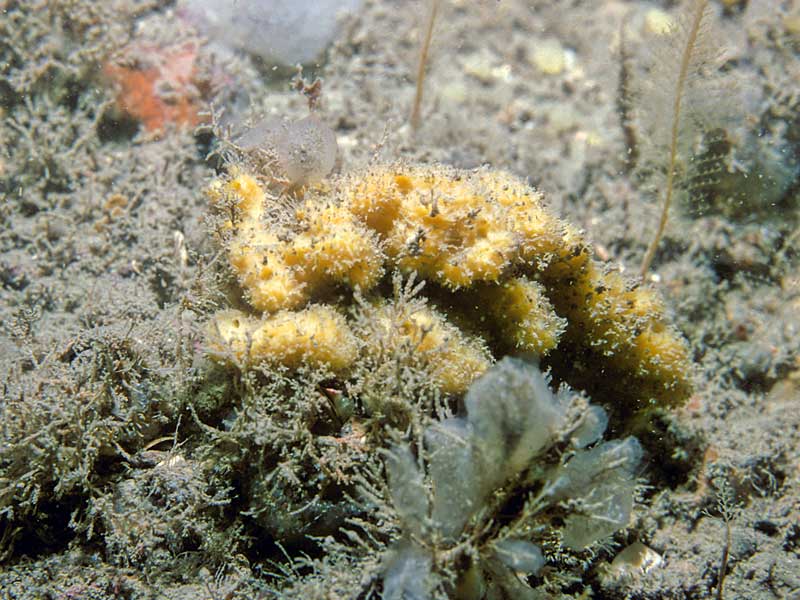
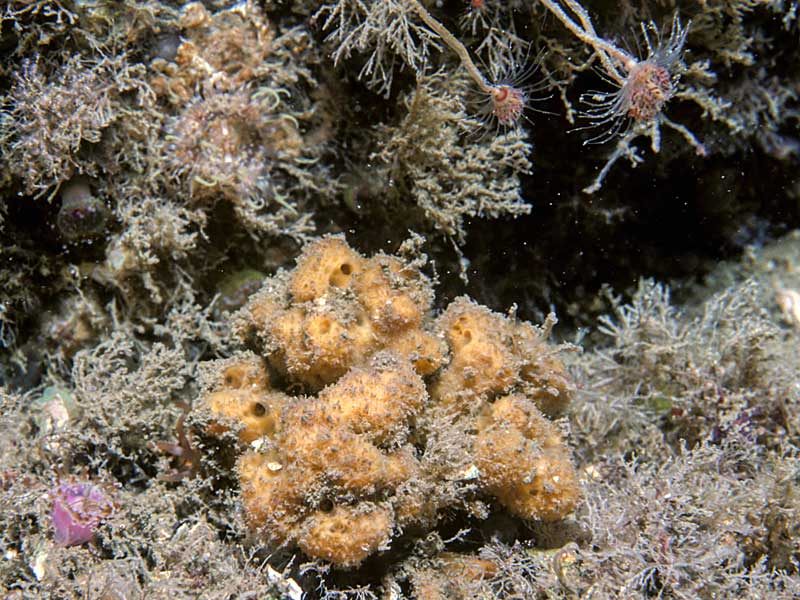
Form: Branching erect to sub-lamellate ('palm-like') with the branches webbed together along their length. Up to 5cm high. The terminal branches are typically 5mm in diameter, tending to be bulbous at their extremities in smaller specimens. The stalk is relatively short and thick.
Colour: Pale yellow to "orange". Usually there is adhering detritus which has to be brushed aside to see the features.
Smell: None. Slime : Some.
Consistency: Firm. The strong axial skeleton gives a firm axial consistency. The peripheral tissue is soft and easily rubbed off but less so than Stelligera stuposa (q.v.).
Surface: Strongly villose (very 'bristly') with long projecting spicules (to 2mm), which often trap quantities of silt.
Apertures:
- The oscules are small and inconspicuous, on the tops of branches. In situ they are apparent as 'clear' areas in the layer of silt. The oscules are not apparent when the sponge is preserved.
Contraction:
- None.
 |
 |
 |
| [ More images ] |
Synonyms: Vibulinus rigidus (Montagu, 1818:87) Topsent, 1890:202.
Internal characters
 |
Skeleton: Plumose. An axial skeleton of longitudinally orientated megascleres forms a stiff core along the centre of each branch. There is a softer, extra-axial skeleton of often single, long megascleres which radiate out at right angles from the core and project through the surface. Slender megascleres scattered in the choanosomal skeleton also form divergent brushes around the projecting spicules at the surface. The microscleres (euasters) form a layer at the surface. There is a minimal amount of spongin.
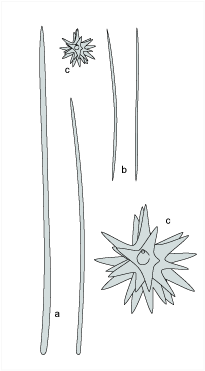
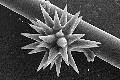
Spicules: The megascleres of the axial core are styles (a) "to 3mm", 500-(530)-550 μm & 890-(1550)-2150 μm long and, occasionally, strongyles 775-(880)-1075 μm. In the extra-axial skeleton long styles are found, with slender oxea (b) to about 460-(600)-780 μm in the divergent brushes. The microscleres are euasters (c) (ca. 22 μm diameter). Compared with Stelligera stuposa (q.v.) these asters have fewer rays, which are more robust and conical in shape.
 |
Habitat: Usually in somewhat sheltered locations with some current. Found in Strangford Lough on sides of boulders with a 2 knot current.
Distribution: "British Isles; Channel coast of France." Known recently from Strangford Lough; Burtonport, Donegal; Anglesey; Skomer; Lundy; Sussex; west coast of Scotland. A fairly common species.
Identity: More robust than Stelligera stuposa with larger spicule categories. Some authorities consider these species to be synonymous. The form may be similar to that of Axinella damicornis (q.v.), but the colour, robust bristles and sliminess are characteristic.
Distribution Map from NBN: Stelligera montagui at National Biodiversity Network mapping facility, data for UK.
iNaturalist: Stelligera montagui at iNaturalist World Species Observations database.
WoRMS: Stelligera montagui at World Register of Marine Species. Accepted name: Stelligera montagui Van Soest & Hooper, 2020. AphiaID: 1424275.
Classification: Biota; Animalia; Porifera; Demospongiae; Heteroscleromorpha; Axinellida; Stelligeridae; Stelligera
Voucher: BELUM : Mc975. Carlingford Lough, Down.
Editors: D. Moss, B.E. Picton.
| Previous species | Next species |
| Picton, B.E. & Morrow, C.C. (2023). Stelligera montagui. Van Soest & Hooper, 2020. [In] Sponges of Britain and Ireland. https://www2.habitas.org.uk/marbiop-ni/sponges.php?item=C4070. Accessed on 2026-10-15 |