
| PORIFERA : Tethyida : Hemiasterellidae | SPONGES |
Adreus fascicularis (Bowerbank, 1866)
 |
| Adreus fascicularis |
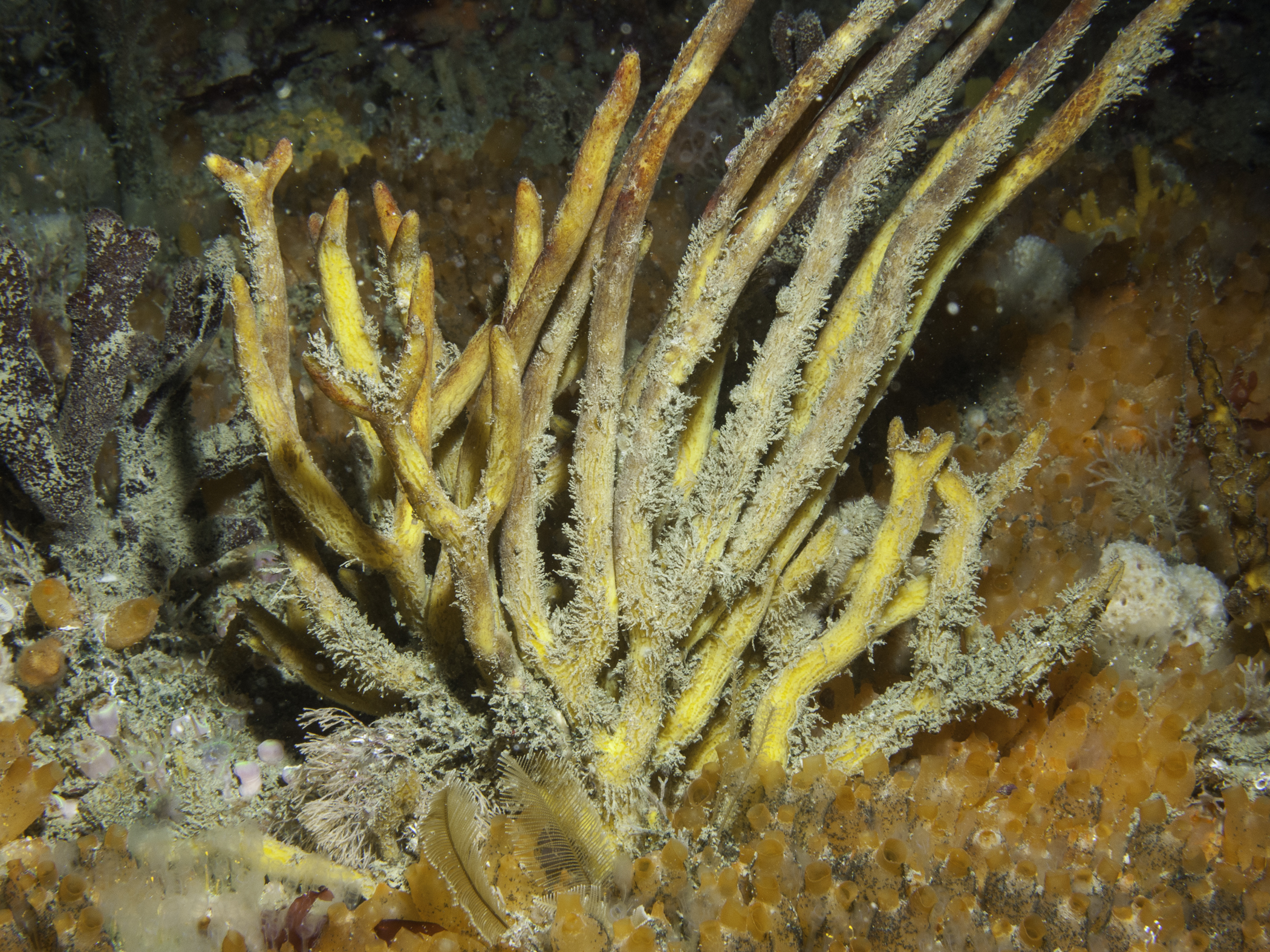
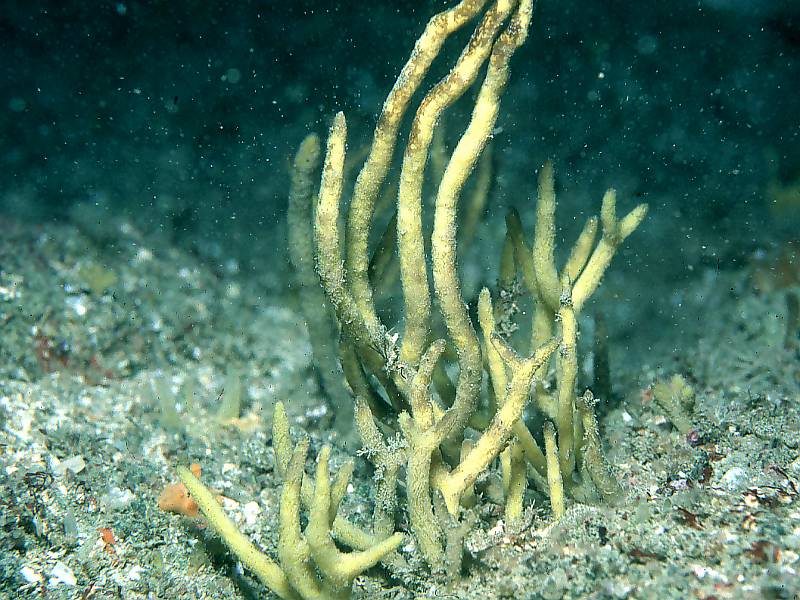
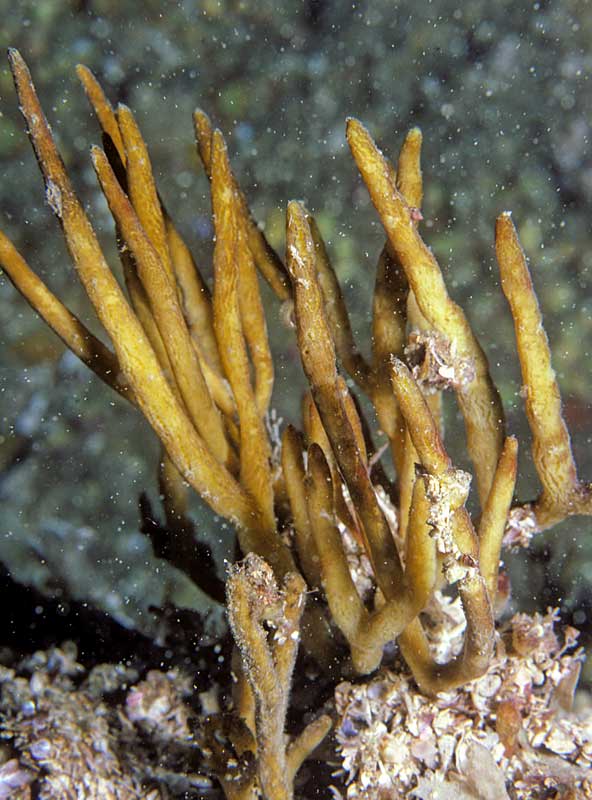
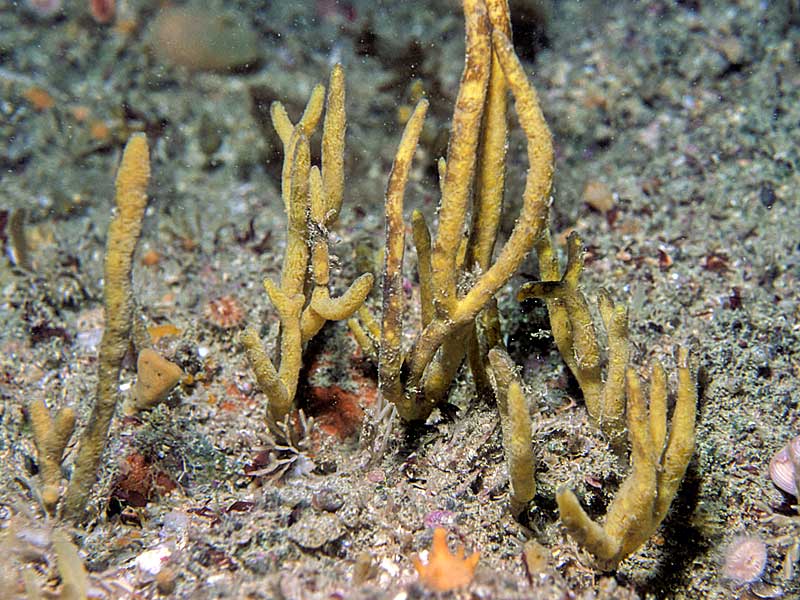
Form: Branching-erect, stalked. Branches are slender, circular in cross section, tapering to a point, and coalesce where they touch. The branching tends to be dichotomous, in one plane, and can produce an antler-like appearance. Several 'individuals' can arise from one flat, spreading base, which may be buried in the substrate - reports on this phenomenon are welcome. Grows up to 15 cm (?) high.
Colour: Strong yellow/brown/ochre/greenish/orange to brownish-yellow.
Smell: None. Slime : A light covering of silt may be found adhering to a little mucus - there are no protruding spicules to trap it.
Consistency: Firm, rigid, wiry - ruptures through to the axial skeleton when bent through 90 degrees, but does not 'snap'.
Surface: Even, slippery, smooth. There are irregularly positioned, faint, longitudinal striations just below the surface, visible after preservation, which are characteristic.
Apertures:
- Oscules are not apparent.
Contraction:
- None.
 |
 |
 |
| [ More images ] |
Synonyms: Dictyocylindrus fascicularis Bwk, 1866:110
Internal characters
Skeleton: Plumose. An axial skeleton of longitudinally orientated megascleres forms a stiff core along the centre of the branches, which is surrounded by fibres radiating at right angles out to the surface, but not piercing it. Minimal amounts of spongin are present (?).
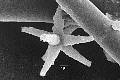
Spicules: Megascleres are styles (a) 270-(440)-560 x 4-5 μm; microscleres are euasters (b) (small oxyasters), ca. 8 μm diameter.
 |
Habitat: Half buried in sediment overlaying horizontal bedrock, also on vertical rock faces; tolerant of silt. Found in sites with strong tidal streams and mobile shelly gravel, usually deeper than about 12m (but in Jersey low growing specimens are common in the lower infralittoral, in direct competition with foliaceous algae).
Distribution: "English Channel; Spain." Recently known from Lundy (occasional); S. Devon; Dorset; Channel Isles. A southern species in the British Isles.
Identity: The manner of branching and the longitudinal striations are quite characteristic, enabling this rather rare species to be recognised on first sight.
Distribution Map from NBN: Adreus fascicularis at National Biodiversity Network mapping facility, data for UK.
iNaturalist: Adreus fascicularis at iNaturalist World Species Observations database.
WoRMS: Adreus fascicularis at World Register of Marine Species. Accepted name: Adreus fascicularis (Bowerbank, 1866). AphiaID: 134155.
Classification: Biota; Animalia; Porifera; Demospongiae; Heteroscleromorpha; Tethyida; Hemiasterellidae; Adreus
Voucher: BELUM : Mc659. Lundy Is., Bristol Channel.
Editors: D. Moss, B.E. Picton.
| Previous species | Next species |
| Picton, B.E. & Morrow, C.C. (2023). Adreus fascicularis. (Bowerbank, 1866). [In] Sponges of Britain and Ireland. https://www2.habitas.org.uk/marbiop-ni/sponges.php?item=C4130. Accessed on 2026-10-15 |