
| PORIFERA : Tethyida : Tethyidae | SPONGES |
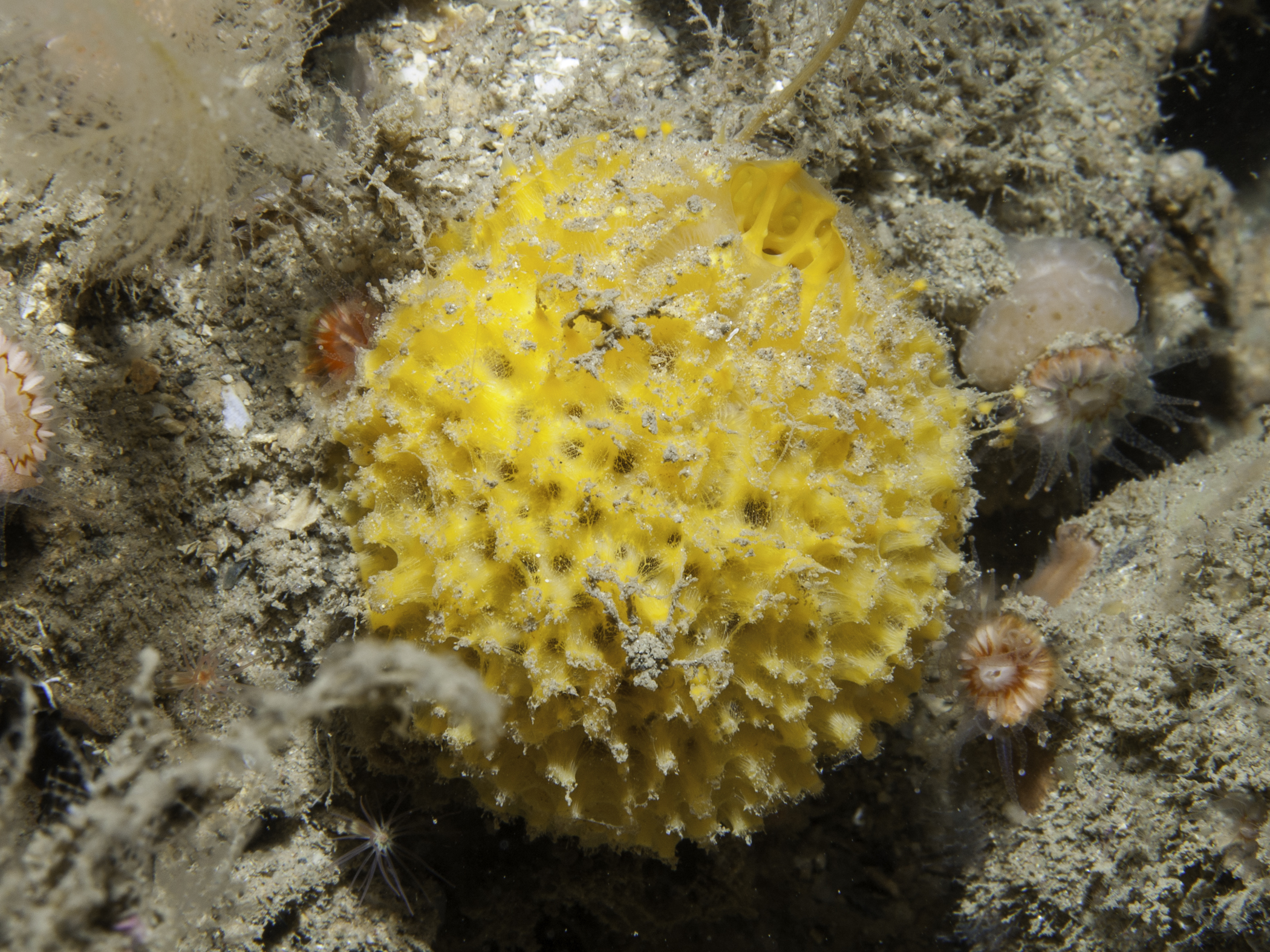
Tethya citrina Sarà & Melone, 1965
 |
| Tethya citrina |
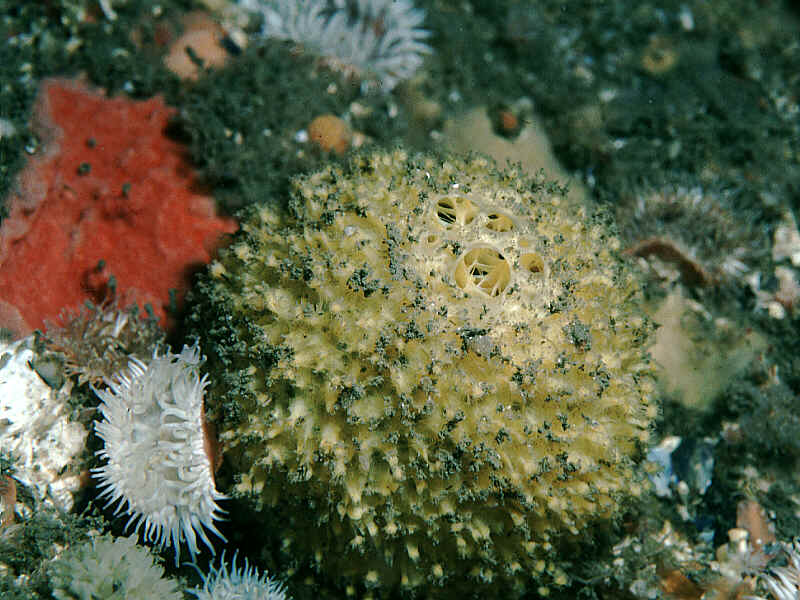
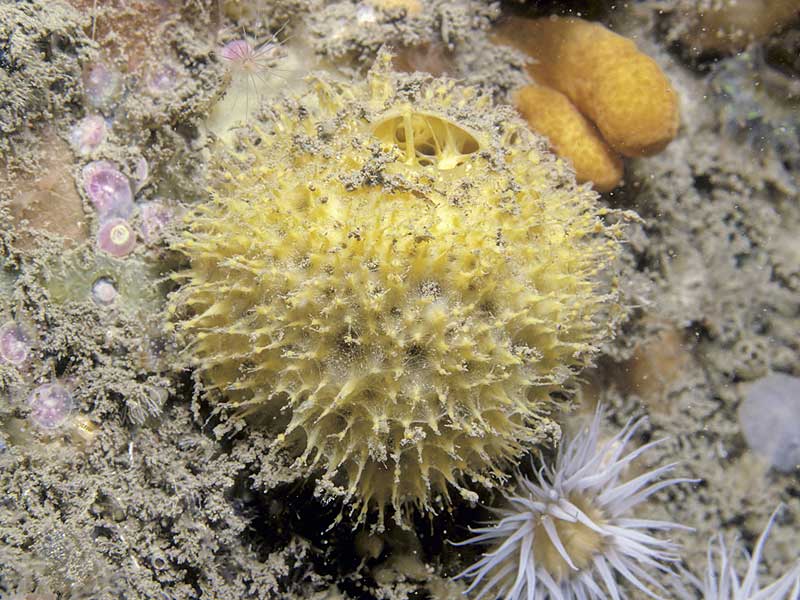
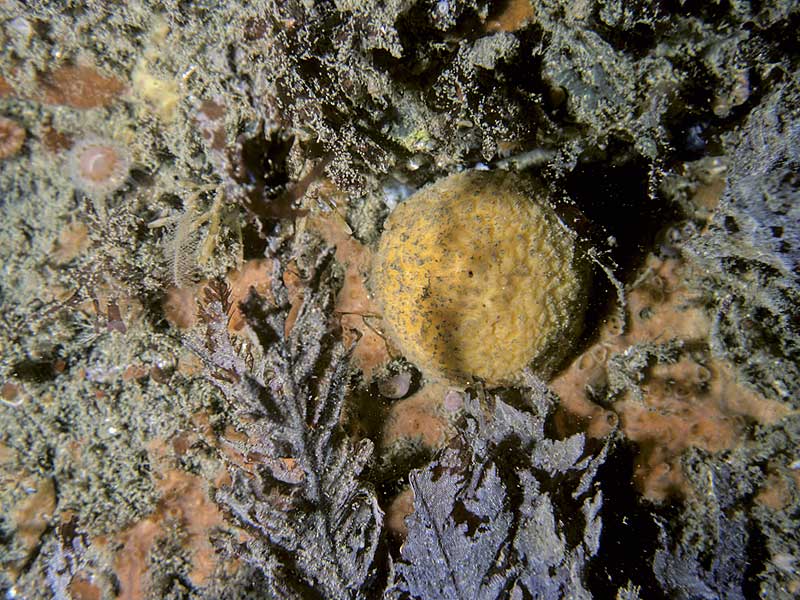
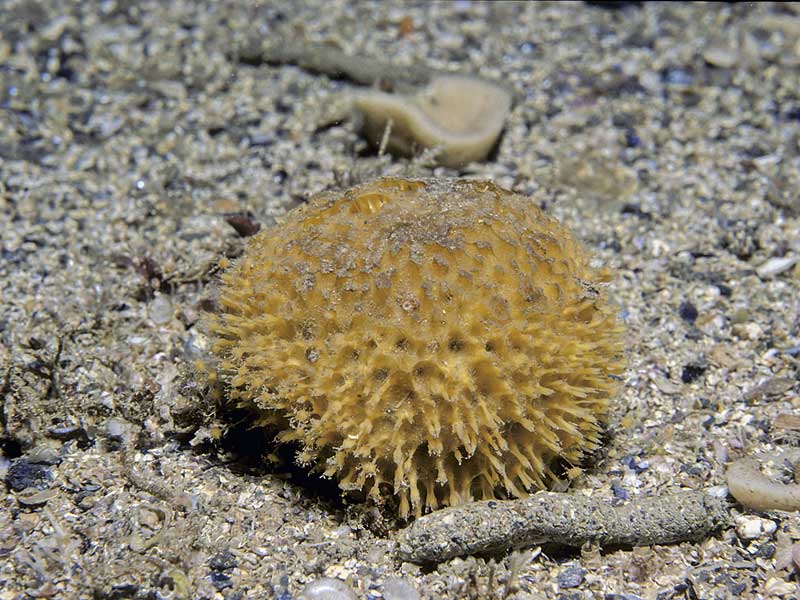
Form: Massive-globose (usually spherical to hemispherical) up to 6cm in diameter, sometimes with 'rooting' processes. Overall appearance like a small orange.
Colour: Most commonly pale to bright yellow, but can be orange.
Smell: Even when fresh, the interior smells of marine specimens which have been allowed to decay. (Is this a constant feature?).
Consistency: Moderately firm, moderately elastic. "Compact, firm when contracted."
Surface: Tuberculate ("warty") the tubercles are separated by contractile pore-bearing grooves. Sometimes 'buds' are present, found on short stalks on top of these tubercles. Often covered by a layer of silt. Appearance variable, dependent on expansion and contraction. When contracted, can appear smooth and even, faintly marked by meandering striations. These can expand into grooves or channels, leaving 'islands of tissue' between, which can be rounded in profile (i.e. tuberculate) or flat (i.e. polygonal in outline).
Apertures:
- Usually one oscule, apical, almost opposite to the point of attachment.
Contraction:
- Contracts to less than half fully expanded size when removed from water. There have been reports of the surface layer being expanded so as to appear partially separated from the underlying tissues (e.g. SMS, pers. obs.). Information on this phenomenon would be welcome.
 |
 |
 |
 |
[ More images ] |
Synonyms: Donatia lyncurium (Linnaeus, 1767:1295), Tethya aurantium (Pallas) Gray, 1867:541 of various authors. Tethya aurantium is confined to the Mediterranean, African Atlantic coasts and the Azores.
Internal characters
 |
Skeleton: Choristid, with a well developed cortex. The thick radially arranged tracts of megascleres, which can be seen with the unaided eye in torn specimens, run at right angles to the surface, and terminate in a surface tubercle without piercing the surface.
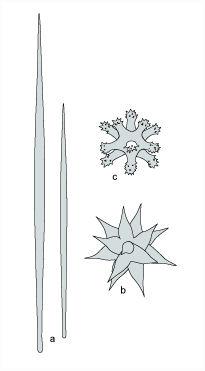
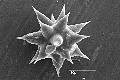
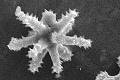
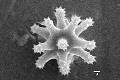
Spicules: Megascleres are strongyloxea (a) (stylote or tylote) 510-(680)-850 μm in length. Microscleres are euasters; with ca. 30 μm diameter spherasters (b) forming a distinct layer in the 'muscular' cortex, and with strongylasters with microspined tylote rays (c), ca. 12 μm in diameter, predominating in the choanosome.
 |  |  |
Habitat: On rock surfaces usually in open water, although it has been reported in harbours. A common species on horizontal or sloping rocky surfaces in clean water but tolerant of silt.
Distribution: "Arctic; N. Atlantic; Mediterranean. Littoral to 930m." Apparently absent from North Sea coasts of British Isles. Common on western and southern coasts.
Identity: Identification by sight alone stands a good chance of being correct. Suberites sometimes adopts the same form but has a smooth surface. Tetilla cranium (Mnller, 1776:255) and Tetilla zetlandica (this guide) are the same shape and have a rough surface, but are usually bright white in colour. Tetilla species have triaenes and oxea as their megascleres and T. cranium has distinctive distorted 'S' shaped microscleres (sigmaspires).
Distribution Map from NBN: Tethya citrina at National Biodiversity Network mapping facility, data for UK.
iNaturalist: Tethya citrina at iNaturalist World Species Observations database.
WoRMS: Tethya citrina at World Register of Marine Species. Accepted name: Tethya citrina Sarà & Melone, 1965. AphiaID: 134312.
Classification: Biota; Animalia; Porifera; Demospongiae; Heteroscleromorpha; Tethyida; Tethyidae; Tethya
Voucher: BELUM : Mc181. Strangford Lough, Down.
Editors: D. Guiterman, D. Moss, B.E. Picton.
| Previous species | Next species |
| Picton, B.E. & Morrow, C.C. (2023). Tethya citrina. Sarà & Melone, 1965. [In] Sponges of Britain and Ireland. https://www2.habitas.org.uk/marbiop-ni/sponges.php?item=C2130. Accessed on 2026-10-15 |