
| PORIFERA : Suberitida : Suberitidae | SPONGES |
Suberites ficus (Johnston, 1842)
 |
| Suberites ficus |
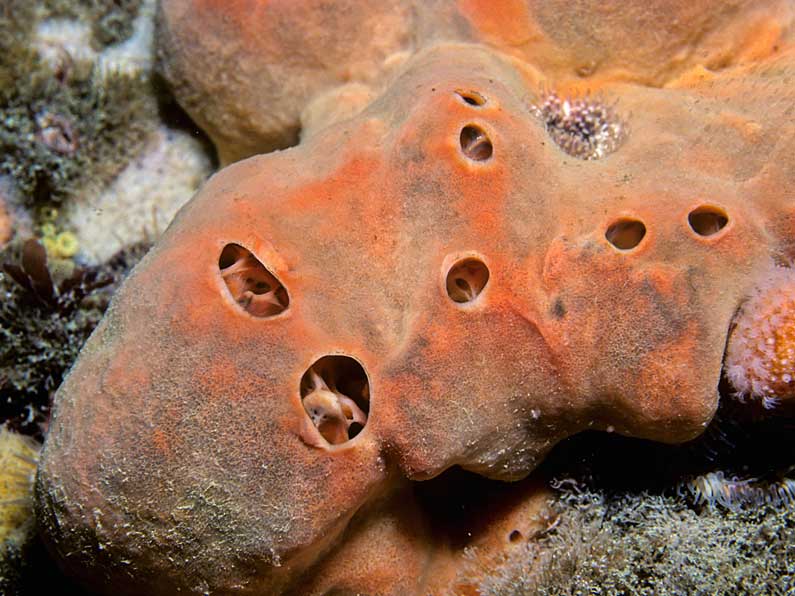
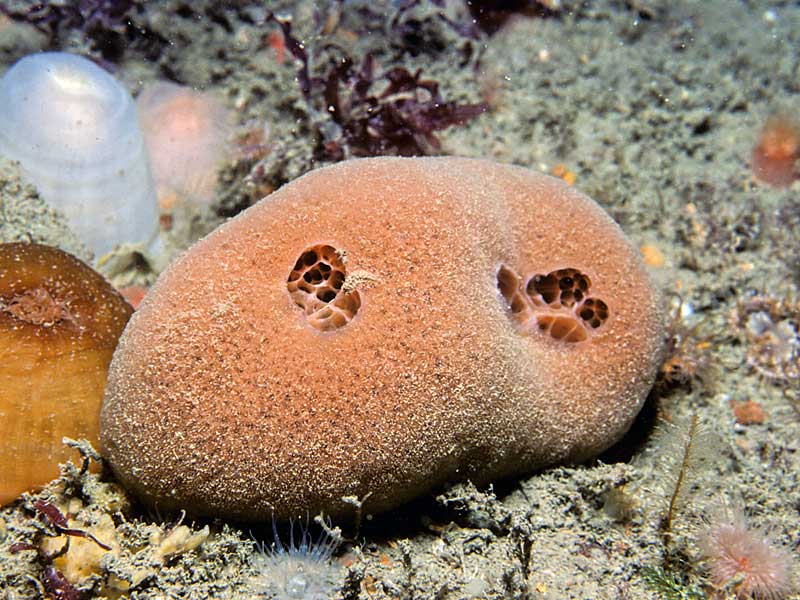
Form: Massive-lobose, massive-globose, or cylindrical with a ridged appearance in large specimens.
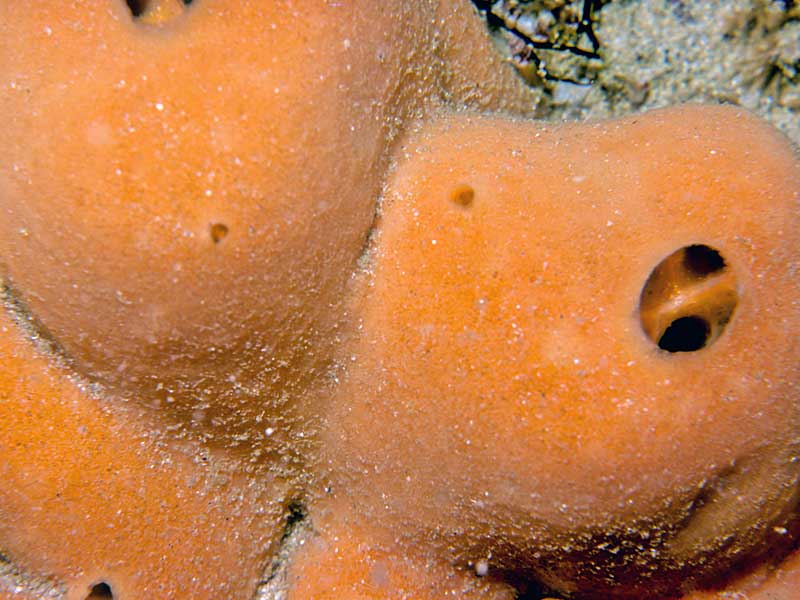
Colour: Usually orange, sometimes intermediate shades of yellow, orange or brown. It has been reported as white, white-grey, grey or green (the latter in patches, caused by the presence of symbiotic algae). The interior is yellow.
Smell: Faint, of freshly cut cucumber.
Consistency: Firm, moderately elastic, softer when undisturbed in water. Elongate forms break when bent through 20 degrees.
Surface: Smooth, not velvety (cf. Suberites carnosus), but presents high friction when the tongue is run over it. "Hirsute, even".
Apertures:
- One to many (5, or even more) oscules, mostly at the tops of the lobes (see e.g. photo 31) but other positions are possible. The oscules are large and the excurrent canals can be easily seen joining below the oscules.
Contraction:
- Noticeable: when removed from the water the sponge contracts to about 3/4 of its size when undisturbed underwater.
 |
 |
 |
 |
[ More images ] |
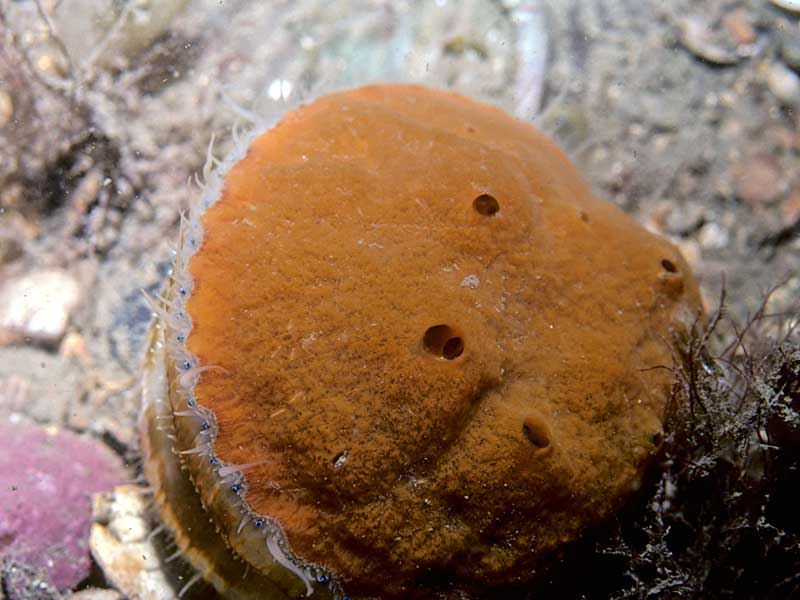
Synonyms: Suberites domuncula (Olivi, 1792:241) (The name used for this species in previous editions of this guide) is now considered to be a distinct species, with no microscleres and possibly confined to the Mediterranean. Recent work in the Isle of Man has shown three distinct species to be present there on the basis of electrophoretic evidence. These have been named provisionally; Suberites pagurorum on hermit crabs, Suberites rubra a red crust on Aequipecten opercularis and Suberites lutea a yellow crust also on Aequipecten. The massive form described here was not investigated.
Internal characters
 |
Skeleton: Subradiate, the radial arrangement of the spicules being most apparent near the surface. Internally the skeleton is confused, almost halichondroid. There is one category of spicule (tylostyle), divided into two size groups. The larger constitute the main structural megascleres, whereas the smaller are perpendicularly arranged as a dense palisade at the surface.
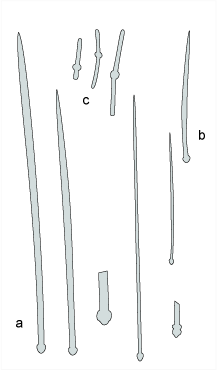
Spicules: Megascleres are tylostyles of 2 sizes, (a) 320-(380)-420 x 6 μm and (b) 100-(158)-225 x 2.5 μm. Microscleres are microrhabds, ie. centrotylote microstrongyles (c) (25-(48)-70 μm), which need careful searching of the ectosome to be seen, amongst the tips of the palisade spicules (i.e. right at the surface).
Habitat: "LWS to 1330m."? The large form is usually found where there are tidal currents, and/or oceanic water conditions although it can be found in still water in sites where there is no freshwater influence, such as Lough Hyne. On rock, wreckage. The form now known as Suberites pagurorum grows around empty gastropod shells inhabited by hermit crabs, and the other two recently named forms grow on Aequipecten valves (see Synonymy above). In still water it sometimes occurs free-living, as a large slipper-shaped mass, presumably having initially settled on a piece of hard debris which is subsequently enveloped.
Distribution: Widespread throughout Arctic and Atlantic in the northern hemisphere. The form illustrated here is not uncommon on western coasts of the British Isles.
Identity: This seems to be a species where field characters and electrophoretic evidence are more useful than spicule morphology. Traditionally the presence of centrotylote microscleres was considered diagnostic. The table given under Suberites carnosus sets out the differences between Suberites carnosus and Suberites ficus.Before coming to a conclusion, make sure that all the characters fit. The presence of centrotylote microscleres is only a confirmation of the Suberites ficus species group. Please report if any characters are unreliable. Brief notes on some other species which might be confused with Suberites carnosus or Suberites ficus are given below.
Distribution Map from NBN: Suberites ficus at National Biodiversity Network mapping facility, data for UK.
iNaturalist: Suberites ficus at iNaturalist World Species Observations database.
WoRMS: Suberites ficus at World Register of Marine Species. Accepted name: Suberites ficus (Johnston, 1842). AphiaID: 134285.
Classification: Biota; Animalia; Porifera; Demospongiae; Heteroscleromorpha; Suberitida; Suberitidae; Suberites
Voucher: BELUM : Mc151. Strangford Lough, Down.
Editors: D. Guiterman, D. Moss, B.E. Picton.
| Previous species | Next species |
| Picton, B.E. & Morrow, C.C. (2023). Suberites ficus. (Johnston, 1842). [In] Sponges of Britain and Ireland. https://www2.habitas.org.uk/marbiop-ni/sponges.php?item=C2210. Accessed on 2026-10-16 |