
| PORIFERA : Suberitida : Suberitidae | SPONGES |
Suberites carnosus (Johnston, 1842)
 |
| Suberites carnosus |
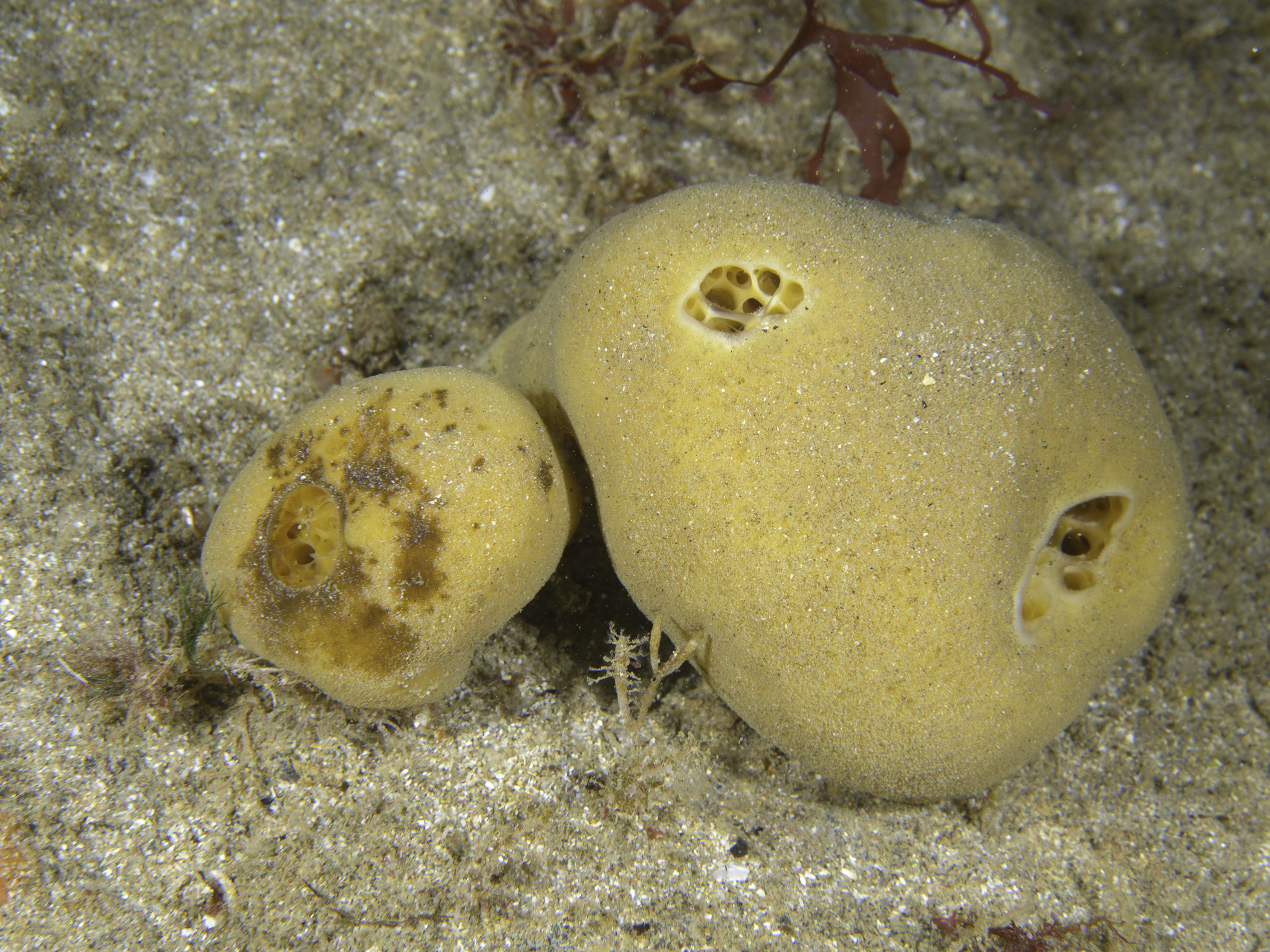
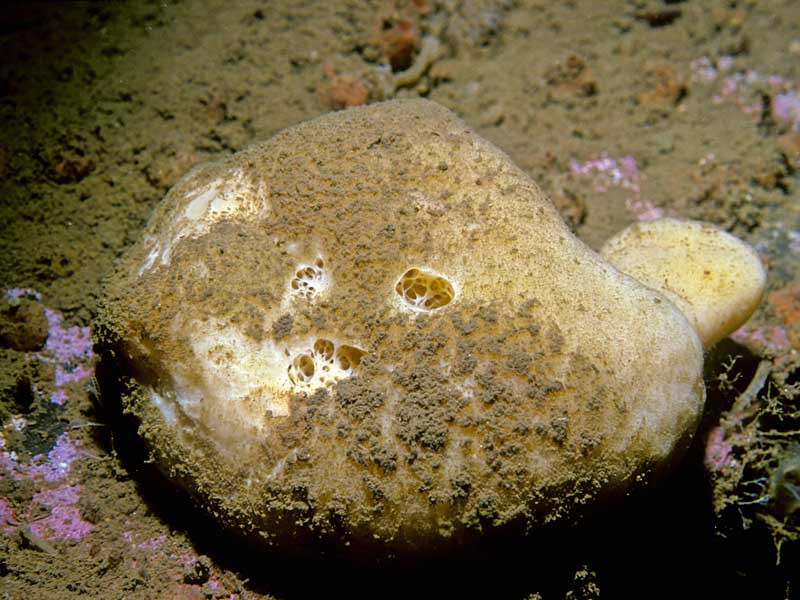
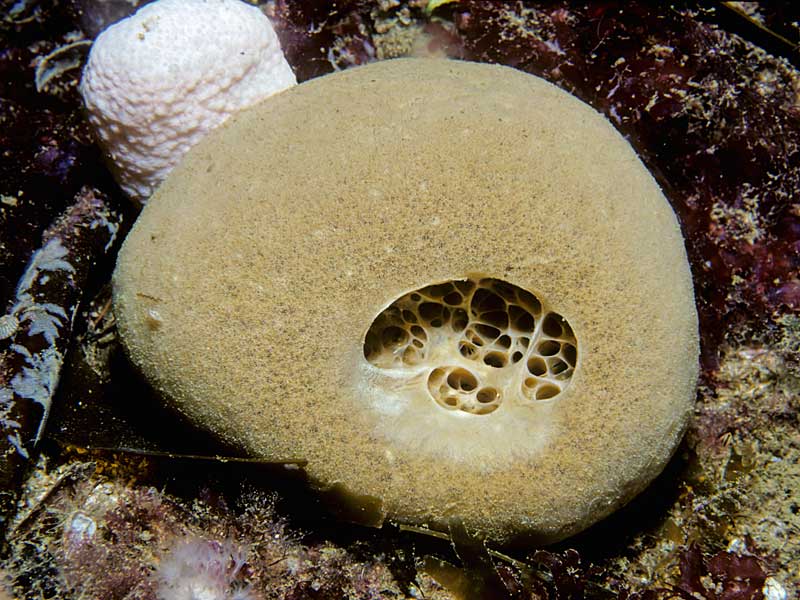
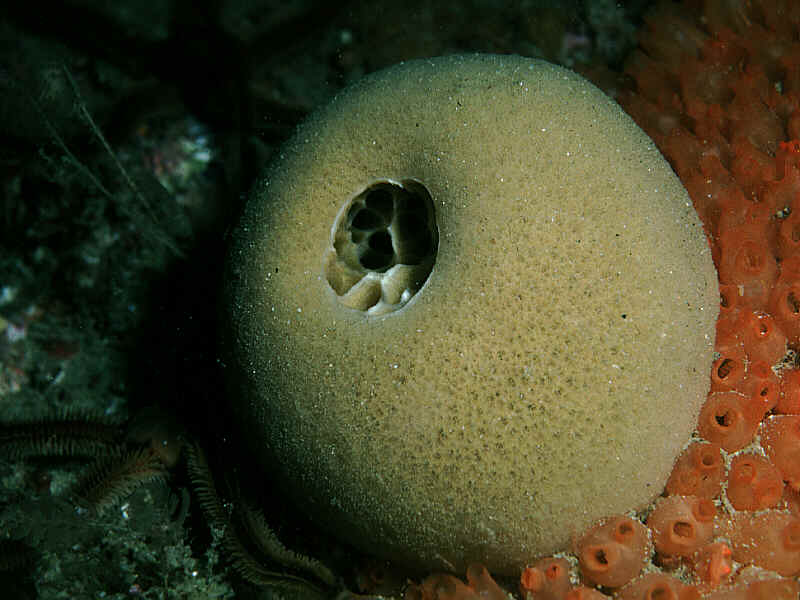
Form: In the British Isles this species typically assumes a hollow, contractile, massive-fig shape, attached by a stalk to the substrate. On the Continent a variety of forms have been recognized, graduating from thin sheets and cushions to massive-lobose and even branching forms (see Topsent, 1900, p.233). These forms have yet to be found in British waters and may not be conspecific.
Colour: Various shades of pale yellow, buff, pale orange and brown.
Smell: Smells faintly of freshly cut Laminaria stipe.
Consistency: Firm and moderately elastic when out of water. Extremely soft when fully expanded under water. Stalk breaks when bent through 20 deg. (when in contracted condition.)
Surface: Smooth, even with a minutely velvety feel. This is most easily detected with the tongue. The upper surface is often lightly coated with silt.
Apertures:
- Usually one oscule, at the top, but there may be more. If so, they are usually all on the uppermost surface.
Contraction:
- Very dramatic, contracts to about 1/4 of its fully expanded size when disturbed. Full contraction takes about 15 seconds. Further contraction occurs when the sponge is removed from the water.
 |
 |
 |
| [ More images ] |
Synonyms: (Note Suberites (Hymeniacidon) crustula (Bowerbank, 1866:185) is really Polymastia mamillaris)
Internal characters
Skeleton: Subradiate, the radial arrangement of the spicules being most apparent near the surface. Internally the skeleton is confused, almost halichondroid. There is one type of spicule (tylostyle), of two distinct sizes. The larger (a) constitute the main structural megascleres, whereas the smaller (b) are perpendicularly arranged as plumose brushes (resembling shaving brushes) at the surface. In the stalk region the spicules are condensed to form an axial skeleton.
Spicules: Tylostyles, (a,b) long and thin 330-(410)-500 μm, with typical neat suberitid swellings at the head, like pins. In any given specimen spicules are of a narrower size range than Suberites ficus (q.v). No microscleres.
Habitat: Usually growing vertically attached to horizontal rock surfaces. Sometimes found in muddy places attached to shells or stones buried in the mud, e.g. in harbours and Scottish and Irish sea lochs.
Distribution: "Arctic; Atlantic coasts of Europe; Mediterranean; etc." See the following Table for possible features distinguishing between this species and Suberites ficus. Some species which can be confused with Suberites carnosus and Suberites ficus are also given there. The brief notes are not designed to provide identification information, but are included to prevent the species mentioned from being confused with the two Suberites species under discussion.
Distribution Map from NBN: Suberites carnosus at National Biodiversity Network mapping facility, data for UK.
iNaturalist: Suberites carnosus at iNaturalist World Species Observations database.
WoRMS: Suberites carnosus at World Register of Marine Species. Accepted name: Suberites carnosus (Johnston, 1842). AphiaID: 134275.
Classification: Biota; Animalia; Porifera; Demospongiae; Heteroscleromorpha; Suberitida; Suberitidae; Suberites
Voucher: BELUM : Mc27. Strangford Lough, Down.
Editors: D. Moss, B.E. Picton.
| Previous species | Next species |
| Picton, B.E. & Morrow, C.C. (2023). Suberites carnosus. (Johnston, 1842). [In] Sponges of Britain and Ireland. https://www2.habitas.org.uk/marbiop-ni/sponges.php?item=C2200. Accessed on 2026-10-16 |