
| PORIFERA : Tetractinellida : Ancorinidae | SPONGES |
Stryphnus ponderosus (Bowerbank, 1866)
 |
| Stryphnus ponderosus |
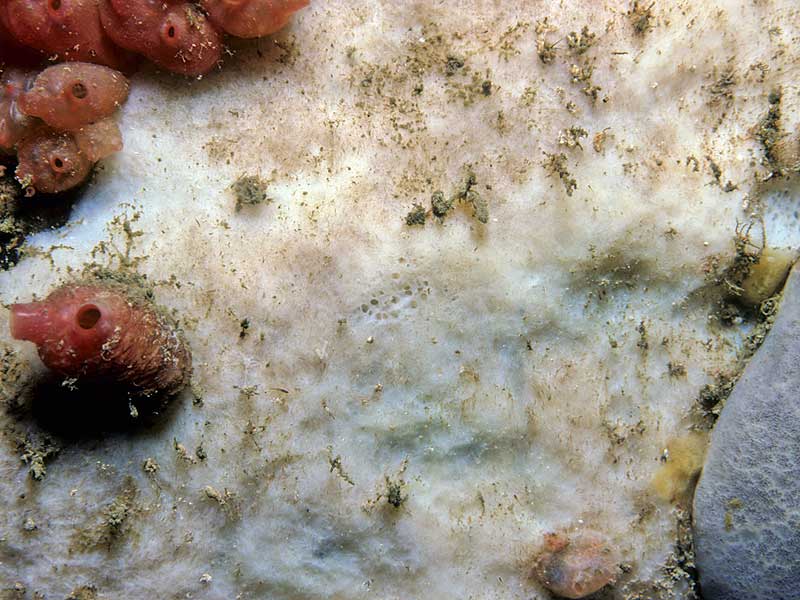
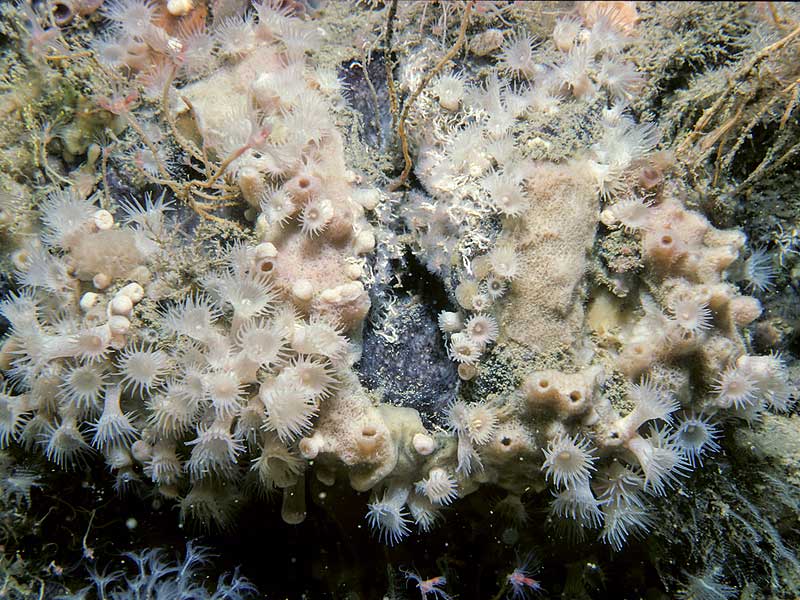
Form: Massive-lobose, with rounded lobes, or irregular in outline; occasionally goblet or cup-shaped. Often there is a central hole the size and shape of an orange in large specimens. Up to 40cms in diameter. Almost invariably coated with other sponges (e.g. Antho inconstans, Plocamilla coriacea, Desmacella annexa) or bryozoans, and consequently not obvious to the eye when seen in situ.
Colour: Pale greyish brown on the surface and ochre in the interior; "dark brown". Areas of free surface may have a purple-brown coloration.
Smell: Characteristically slightly sharp smell. Slime : None.
Consistency: Very firm and incompressible.
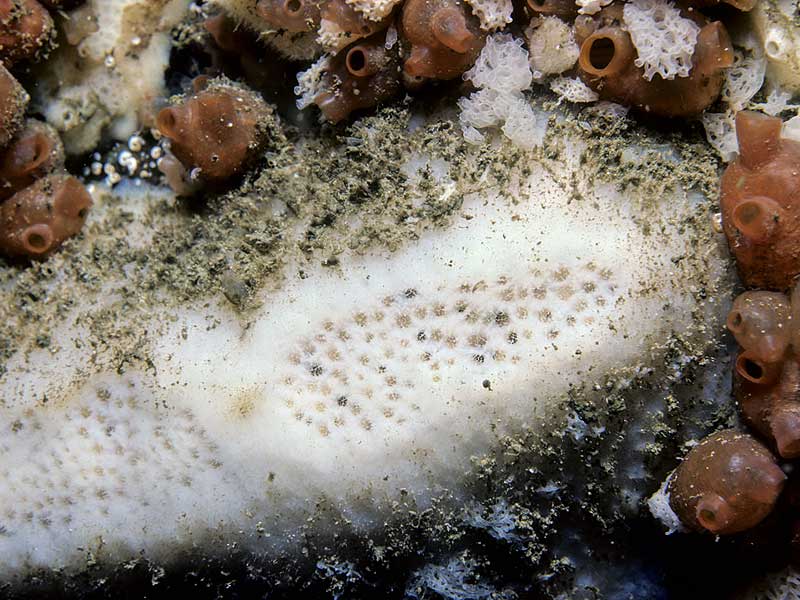
Surface: Areas of free surface are small, tending to be adjacent to the substrate, where coating species have not extended. Even; smooth or more commonly hispid, with occasional conulate patches, high friction, rough to the touch, like sandpaper (because of the heads of the megascleres penetrating the surface).
Apertures:
- Groups of 3 to 8 oscules are occasionally present on free surfaces. The oscules are small, up to 1mm in diameter, and flush with the surface.
Contraction:
- Not noticeable.
 |
 |
[ More images ] |
Synonyms: Ecionemia ponderosa Bowerbank, 1866: 56; Ancorina ponderosus.
Internal characters
 |
Skeleton: The cortex is thin, less than 0.5mm. It consists of radially arranged, densely packed bundles of dichotriaenes and oxea. Here amphiasters are numerous, oxyasters occasional. The choanosome consists of irregularly arranged oxea, with occasional dichotriaenes. In places the oxea are ordered into radial bundles directed towards the cortex. Oxyasters are numerous, and amphiasters occasional.
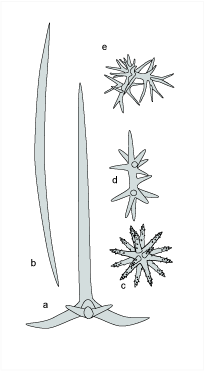
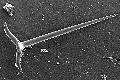
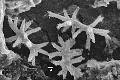
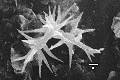
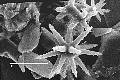
Spicules: Megascleres are oxea and short shafted dichotriaenes (sometimes modified to orthotriaenes). The oxea (b) are curved to a greater or lesser extent, 1000-(1150)-1250 μm; "1200-2500 μm" long by 20-50 μm wide. The dichotriaenes (a) have shaft lengths of 340-850 μm by 25-40 μm wide. The ratio of shaft length divided by clade diameter is between 1.6 to 2.3 - hence "short shafted". Microscleres are amphiasters (d,e) 10-13 μm long, and oxyasters (c) 18-26 μm in diameter.
 |  |  |  |
Habitat: On vertical or overhung rock faces, sand and shells, away from direct light, from 1-740m.
Distribution: Arctic; Atlantic coasts of Europe, Mediterranean. Fairly common on vertical cliff faces and limestone caves on north coast of Rathlin Is., Co. Antrim.
Identity: This species is very similar to Stelletta grubii (q.v.) in appearance and habit. The skeletal characteristics are different, most obviously the presence of short shafted dichotriaenes in Stryphnus ponderosus. Also, the distinctive hard, pale grey, 'rind' of Stelletta grubii is several millimetres thick, and obvious; that of Stryphnus is only 0.5mm thick, and inconspicuous. This can be used as a distinguishing character in the field, if a small portion of the sponge is broken off. However, beware of mistaking an epifaunal sponge for 'rind'.
Distribution Map from NBN: Stryphnus ponderosus at National Biodiversity Network mapping facility, data for UK.
iNaturalist: Stryphnus ponderosus at iNaturalist World Species Observations database.
WoRMS: Stryphnus ponderosus at World Register of Marine Species. Accepted name: Stryphnus ponderosus (Bowerbank, 1866). AphiaID: 133991.
Classification: Biota; Animalia; Porifera; Demospongiae; Heteroscleromorpha; Tetractinellida; Astrophorina; Ancorinidae; Stryphnus
Voucher: BELUM : Mc1038. Rathlin Island, Antrim.
Editors: D. Moss.
| Previous species | Next species |
| Picton, B.E. & Morrow, C.C. (2023). Stryphnus ponderosus. (Bowerbank, 1866). [In] Sponges of Britain and Ireland. https://www2.habitas.org.uk/marbiop-ni/sponges.php?item=C1560. Accessed on 2026-06-11 |