
| PHORONIDA : : Phoronidae | HORSESHOE WORMS |
Phoronis hippocrepia Wright, 1856
White horseshoe worm
 |
| Phoronis hippocrepia |
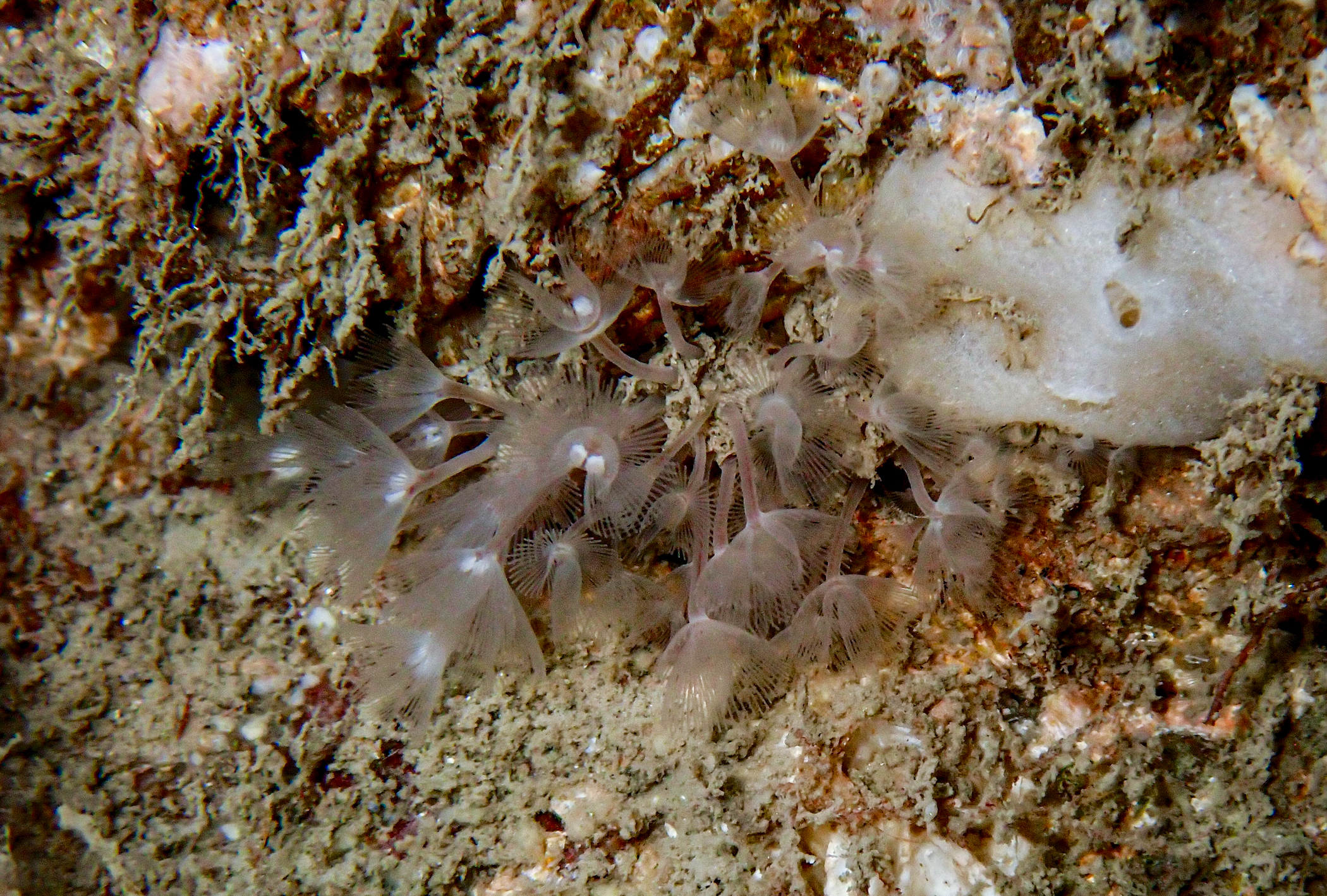
Description: These phoronids bore into soft rock (e.g. limestone or chalk) and live in a membranaceous tube. They have a distinctive horseshoe arrangement of 50-150 fine, white tentacles. The animal is a translucent white, grey or greenish and can be up to 10 cm, although are usually around 4 cm. They are often found in groups of many individuals close together.
Habitat: Soft rock such as chalk or limestone, from extreme low water to almost 50 m.
Distribution: Found on all coasts around Britain and Ireland, but rarely recorded in some areas.
Similar Species: There are other species of phoronids in Britain and Ireland but this is the only one that bores into soft rock. Others prefer shell or muddy sand.
Key Identification Features:
- Distinctive horseshoe arrangement of fine white tentacles.
- Bore into soft rock.
- May be found in large groups.
Distribution Map from NBN: Phoronis hippocrepia at National Biodiversity Network mapping facility, data for UK.
iNaturalist: Phoronis hippocrepia at iNaturalist World Species Observations database.
GBIF data for Phoronis hippocrepia
WoRMS: Phoronis hippocrepia at World Register of Marine Species. Accepted name: Phoronis hippocrepia Wright, 1856. AphiaID: 128548.
Classification: Biota; Animalia; Phoronida; Phoronidae; Phoronis
| Previous species | Next species |
| Picton, B.E., Keatley, L. & Morrow, C.C. (2025). Phoronis hippocrepia. Wright, 1856. [In] Encyclopedia of Marine Life of Britain and Ireland. https://www2.habitas.org.uk/marbiop-ni/speciesaccounts.php?item=ZA40. Accessed on 2026-07-20 |