
Northern Ireland Priority species (NIPS)
| ANGIOSPERMAE : Alismatales : Zosteraceae | FLOWERING PLANTS |
Zostera marina Linnaeus, 1753
Seagrass, eelgrass
 |
| Zostera marina |
Predominantly subtidal species of seagrass that can form dense beds in the correct conditions.
In brief
- Grass-like marine flowering plant that can form dense beds.
- One of two species of seagrass found in Northern Ireland (the other being Nanozostera noltii).
- Prefers relatively shallow areas sheltered from wave action.
- Has experienced long term and large scale decline.
- Subject to a range of threats including disease, disturbance and eutrophication.
- There is an NI Habitat Action Plan for Seagrass beds.
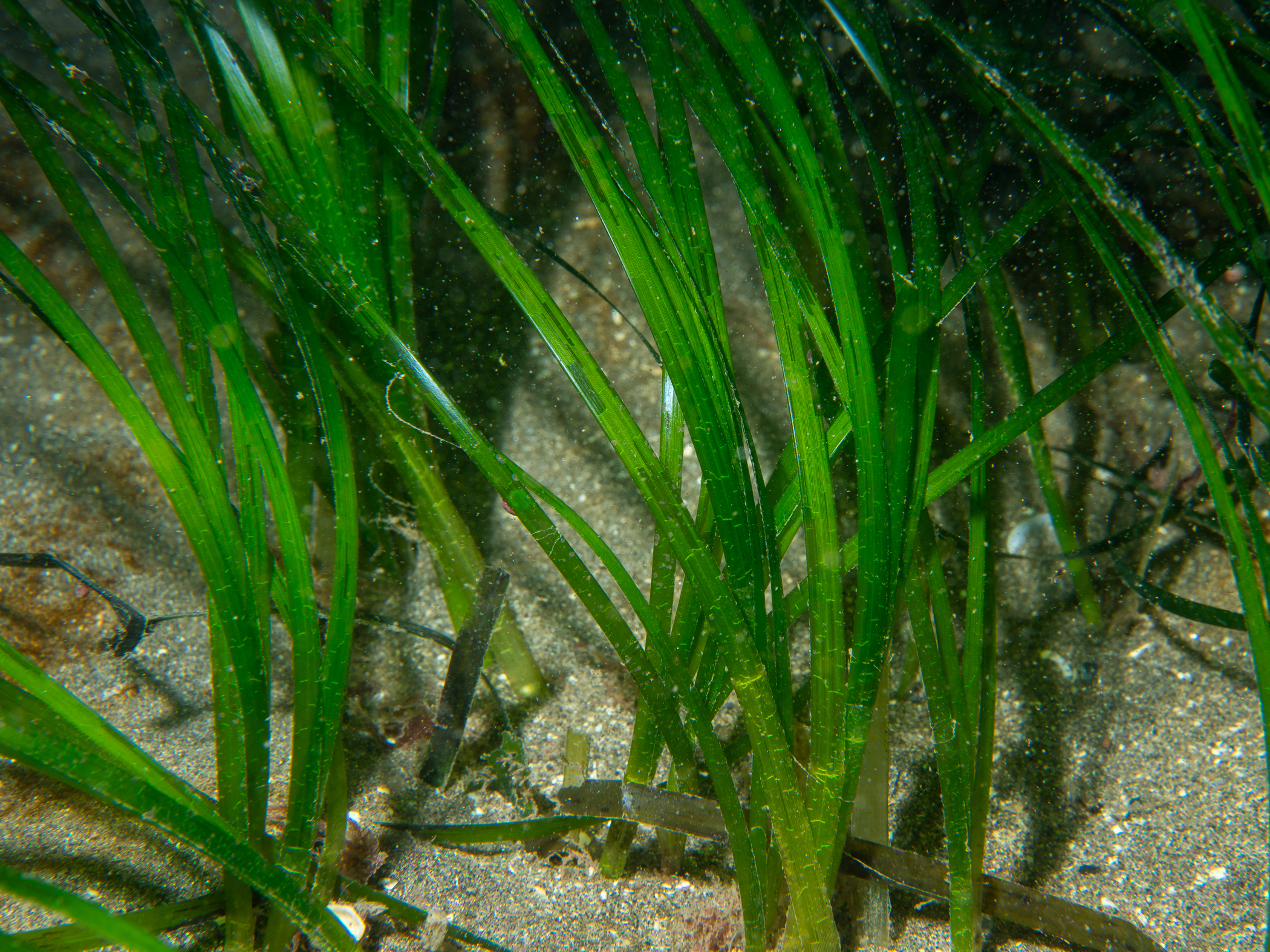
Species description: This is a green, grass-like, marine flowering plant that can form dense meadows in the correct conditions. The tips of the blades are smooth and rounded, and there are three conspicuous veins running along the blade. Zostera marina occurs subtidally, although may occasionally be exposed on a low spring tide, or, rarely, in pools.
Life cycle: Eelgrass can reproduce asexually, spreading via rhizomes but can also flower and produce seeds.
Similar species: Could potentially be confused with Nanozostera noltii but it is much more fine and usually intertidal. Nanozostera noltii also has a characteristic notch at the tip of its blade, whereas Zostera marina has a rounded tip.
How to see this species: Can be found in shallow, sheltered areas not subject to a lot of wave action e.g. sheltered inlets and bays, down to around 10 m. Depth is dependent on light penetration/water turbidity. Usually prefers sand or muddy sand but has been recorded growing on mixed sediment amongst pebbles and cobbles (e.g. at Kearney). Seagrass beds are known from Rathlin Island, The Skerries, Glenarm, Carlingford Lough and Strangford Lough.
Current status: This species and the habitat it forms has exhibited long term and large scale decline across most of its range.
Why is this species a priority in Northern Ireland?
- Criterion 1: Internationally listed species*.
- Criterion 2: Decline based on available data and expert judgement.
* listed as part of a habitat.
Threats:
- Disease: A wasting disease was responsible for die-back of large areas of seagrass in the UK in the 1930s. The fungus and slime mould which colonised the weakened seagrass have recently reappeared in seagrass beds around the Isles of Scilly.
- Natural cycles: The extent of seagrass beds may change as a result of natural factors such as severe storms, exposure to air, and freshwater pulses. Grazing by wildfowl can have a dramatic seasonal effect with more than 60% reduction in leaf cover reported from some sites. Warm sea temperatures coupled with low level of sunlight may cause significant stress and die back of seagrass.
- Physical disturbance, for example by trampling, anchoring, moorings, dredging, and use of mobile bottom fishing gear, land claim and adjacent coastal development through the construction of sea defences and potential for changes in the hydrological regime.
- Introduction of, and competition from, alien species such as Sargassum muticum.
- Increased turbidity reducing photosynthesis.
- Nutrient enrichment, at low levels, may increase production in Zostera while high nitrate concentrations have been implicated in the decline of mature Z. marina. Phytoplankton blooms, resulting from nutrient enrichment, have been shown to reduce biomass and depth penetration of eelgrass. Eutrophication can also result in a shift to phytoplankton epiphyte or macroalgal dominance.
- Marine pollution, eelgrass is known to accumulate Tributyltin and possibly other metals and organic pollutants. Several heavy metals and organic substances have been shown to reduce nitrogen fixation which may affect the viability of the plant, particularly in nutrient poor conditions. Accumulated pollutants may become concentrated through food chains.
Action: Records of new sites for this species, with details of habitat and population are always valuable. Observations with a photograph can be recorded using iNaturalist, find the MBDP-NI iNaturalist project here.
Alternatively, records can be sent to CEDaR, National Museums Northern Ireland, 153 Bangor Road, Cultra, Holywood, County Down, BT18 0EU. Tel 028 9039 5257, e-mail cedar.records@nationalmuseumsni.org, or via the online portal.
Objectives:
- Maintain extent, quality and distribution of seagrass beds in Northern Ireland.
- Assess feasibility of restoration of damaged or degraded seagrass beds.
- Until surveys assess the extent of the seagrass resource, it will not be possible to assess whether restoration is necessary, or to specify a final target.
Conservation:
- There is a Northern Ireland Priority Habitat Action Plan for Seagrass Beds.
- Rathlin Island is a Marine Protected Area with multiple designations.
- Strangford Lough is a Marine Protected Area with multiple designations.
- Seagrass beds are listed by OSPAR as under threat and/or in decline.
- Waterfoot is a Marine Protected Area designated as a Marine Conservation Zone for the feature subtidal seagrass (Zostera marina) beds on subtidal (sublittoral) sand, covering an area of over 80 hectares.
Distribution Map from NBN: Zostera marina at National Biodiversity Network mapping facility, data for UK.
iNaturalist: Zostera marina at iNaturalist World Species Observations database.
WoRMS: Zostera marina at World Register of Marine Species. Accepted name: Zostera marina Linnaeus, 1753. AphiaID: 495077.
Classification: Biota; Plantae; Viridiplantae; Streptophyta; Tracheophyta; Spermatophytina; Magnoliopsida; Lilianae; Alismatales; Zosteraceae; Zostera
| Previous species | Next species |
| Picton, B.E., Keatley, L. & Morrow, C.C. (2026). Zostera marina. Linnaeus, 1753. [In] Priority species, Marine Biodiversity Portal NI. https://www2.habitas.org.uk/marbiop-ni/priorityaccounts.php?item=ZX40. Accessed on 2026-09-13 |